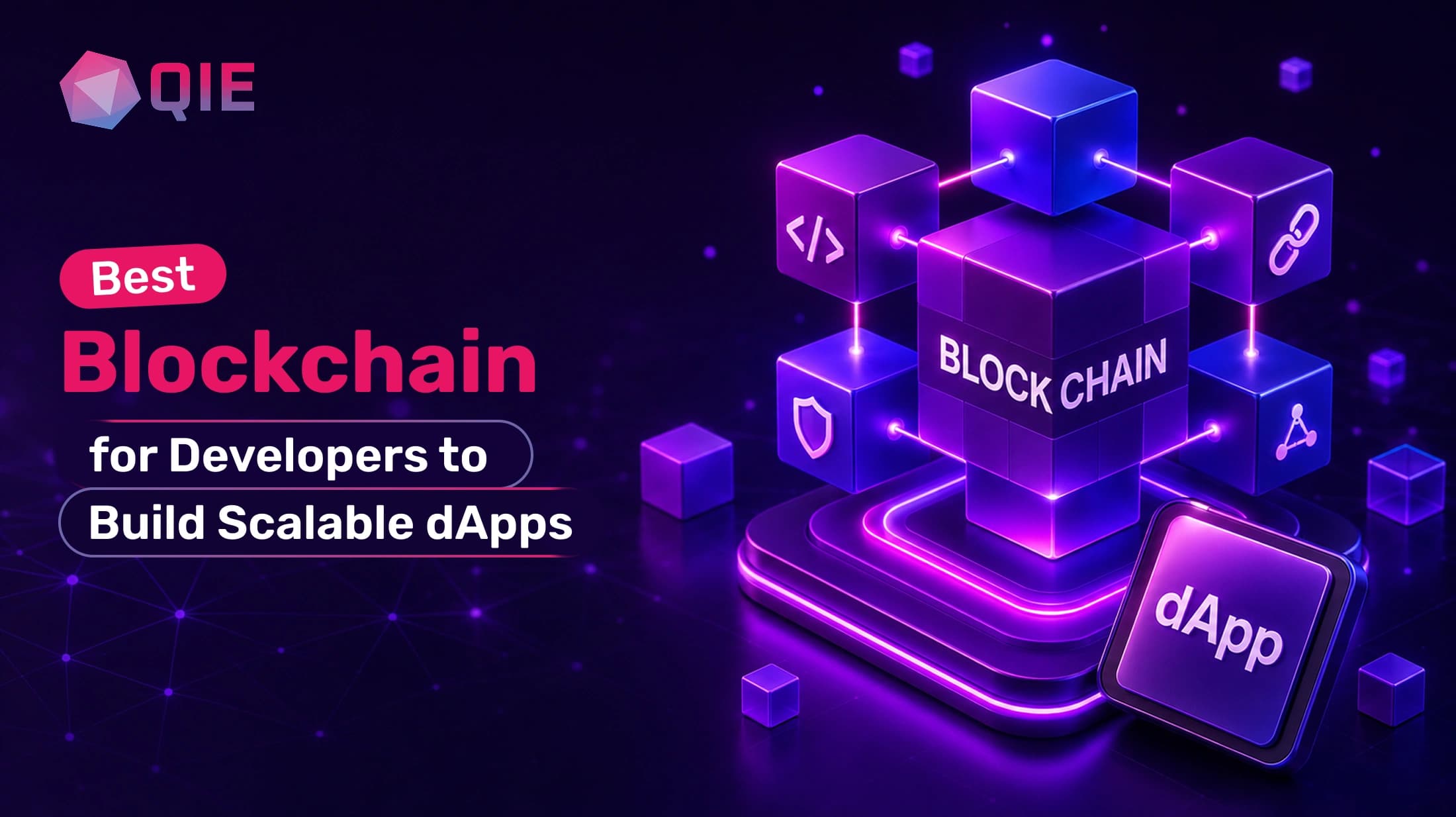
Choosing a blockchain is not just a technical decision. It shapes how fast you ship, how much you spend on gas, how well your app scales, and whether your users actually stay.
In 2026, the options have multiplied, and so have the trade-offs. Ethereum now processes over 200 million transactions per quarter and offers a developer community of active builders. Solana processed 25.3 billion transactions in Q1 2026 alone and runs at 3,000 to 5,000 real-world TPS. Meanwhile, newer chains like QIE Blockchain are offering EVM compatibility, IBC interoperability, and near-zero fees inside a single Layer 1.
For developers, choosing the right blockchain can directly affect project costs, scalability, user experience, and long-term maintenance. A blockchain that works perfectly for a DeFi protocol may not be ideal for gaming applications, AI-powered dApps, or enterprise systems.
This guide is written specifically for developers and technical decision-makers. It skips the price speculation and focuses on what actually matters when building: throughput, fees, tooling, language support, ecosystem depth, and long-term viability.
Key Takeaways
- QIE Blockchain combines EVM compatibility, Cosmos interoperability, and low-cost infrastructure for cross-chain Web3 applications.
- Ethereum remains the leading blockchain for developers because of its mature ecosystem, strong security, and extensive smart contract tooling.
- The best blockchain for developers depends on scalability needs, ecosystem maturity, developer tooling, gas fees, and interoperability requirements.
- Solidity remains the most widely used blockchain programming language in 2026, while Rust and Move continue gaining adoption across newer ecosystems.
- Developers should evaluate real-world throughput, ecosystem support, and long-term maintainability instead of relying only on theoretical TPS numbers.
- Choosing the right blockchain early can reduce development costs, improve user experience, and simplify long-term scaling.
What Makes a Blockchain Good for Developers
Not every blockchain platform is built with developers in mind. Some ecosystems have strong marketing but poor tooling. Others may offer fast speeds but lack community support or documentation.
A good blockchain for developers should reduce complexity instead of adding more friction. Here are the main factors developers should evaluate before choosing a blockchain platform.
Developer Tooling
The richness of SDKs, local development environments, testing frameworks, documentation, and debugging tools directly affects how fast a team can move from idea to deployed product. A chain with no Hardhat plugin or fragmented documentation costs weeks of onboarding time.
Throughput and Finality
Transactions per second tells you how many operations the network can process. Finality tells you how quickly those transactions become irreversible. A high-frequency trading application needs both; a simple NFT marketplace can tolerate slower finality.
Gas Fees
High transaction costs can hurt both developers and users. A blockchain with low gas fees makes experimentation, testing, and large-scale adoption easier. This is one reason many developers are exploring alternatives to Ethereum mainnet.
Unpredictable fees break user experience and eat into margins for microtransaction-heavy applications. Developers building payment tools or gaming apps need fee structures they can reason about in advance.
Programming Language Support
Teams with existing Solidity knowledge will save months by choosing an EVM-compatible chain. Teams prioritizing security may favor Move. Performance-focused infrastructure builders often lean toward Rust. Language choice matters as much as chain choice.
Interoperability
Cross-chain communication is becoming increasingly important. Modern applications often interact with multiple blockchain networks. Platforms like Polkadot focus heavily on interoperability and shared infrastructure.
Most serious applications talk to more than one chain. Native bridges, IBC support, and cross-chain messaging protocols are now baseline requirements for anything built with long-term scale in mind.
Best Blockchain Platforms for Developers in 2026
The following blockchain platforms were selected based on scalability, developer tooling, smart contract capabilities, ecosystem strength, and long-term development potential.
1. Ethereum
Ethereum remains the benchmark for developer-focused blockchains, backed by the largest developer community and one of the most mature tooling ecosystems, including Hardhat, Foundry, Remix, OpenZeppelin, and Ethers.js.
While the Ethereum mainnet handles limited TPS on its base layer, its Layer 2 ecosystem now powers most network activity with faster transactions and extremely low fees. Mainnet fees have also dropped significantly after recent upgrades, while L2 fees often stay below a cent.
Ethereum continues to lead in developer adoption, smart contract deployments, and ecosystem activity. Upcoming upgrades focused on scalability and ZK-proof integration are expected to further strengthen its position for developers building scalable dApps.
Best for: DeFi protocols, NFT platforms, DAO infrastructure, applications requiring maximum ecosystem integration, and any project where access to the widest possible developer talent pool matters.
Language: Solidity (primary), Vyper
Limitations:
- Base layer TPS is low without L2 integration.
- Mainnet gas fees can still become expensive during congestion
- Scalability depends heavily on Layer 2 solutions
2. Solana
Solana is the performance leader among general-purpose public blockchains in 2026, processing billions of transactions quarterly with sustained real-world throughput of 3,000–5,000 TPS and extremely low fees averaging around $0.00025. Its speed and cost efficiency make it ideal for high-volume and microtransaction-based applications.
The ecosystem has seen rapid developer growth, becoming second only to Ethereum in active developers. Major upgrades like Firedancer and Alpenglow are expected to significantly boost scalability and reduce finality times to near real-time speeds.
Solana also dominates in DeFi activity and DEX trading volume, while growing adoption in stablecoins and tokenized real-world assets signals increasing institutional confidence. Network reliability has also improved substantially, maintaining over 99.9% uptime across recent years.
Best for: Consumer applications, high-frequency DeFi, gaming, payment applications, NFT infrastructure, and any project requiring sustained throughput at low cost.
Language: Rust (primary)
Limitations:
- Network stability concerns have affected reliability in previous years
- Rust has a steeper learning curve than Solidity for some developers
- Ecosystem maturity is still behind Ethereum
3. QIE Blockchain
QIE is a high-performance Layer 1 blockchain built on the Cosmos SDK, combining Ethereum-style development with Cosmos interoperability. It delivers 25,000+ TPS, ~2-second block times, sub-second finality, and low predictable fees suited for gaming, DeFi, and microtransaction-heavy dApps.
QIE is fully EVM-compatible, allowing developers to deploy Solidity smart contracts using familiar tools like Remix, Hardhat, Truffle, MetaMask, and Ethers.js without modification. It also supports native IBC connectivity, enabling interoperability with 70+ Cosmos ecosystem chains.
The ecosystem includes native oracles, QIDEX, a multi-chain wallet, token creation tools, and QIE ID, a reusable decentralized identity layer for KYC-enabled dApps.
Best for: Cross-chain DeFi applications, gaming, NFTs, decentralized identity, AI-integrated Web3 applications, and developers who want Ethereum tooling without Ethereum fees.
Language: Solidity, Vyper (EVM-compatible);
Limitations:
- Smaller ecosystem compared to Ethereum and Solana
- Ecosystem tooling is still growing
4. Hyperledger Fabric
Hyperledger Fabric is a permissioned blockchain framework designed for enterprises that require strict privacy, access control, and regulatory compliance. Hosted by the Linux Foundation, it allows only authorized participants to access the network and supports private channels for confidential transactions.
Unlike most public blockchains, Fabric lets developers build smart contracts, known as chaincode, using familiar languages like Go, Node.js, and Java. Its modular architecture also enables organizations to customize consensus, identity management, and network components based on business needs.
The platform is widely used in sectors like healthcare, finance, and supply chain, where data confidentiality is critical. In 2026, the Fabric-X initiative expanded the ecosystem with features focused on tokenization, enterprise-grade auditability, EVM compatibility, and scalable infrastructure for digital assets and CBDCs.
Best for: Enterprise supply chain, healthcare data management, financial settlements, trade finance, government systems, and any application where participant identity and data privacy are non-negotiable.
Language: Go (primary), Node.js, Java
Limitations:
- Less suitable for public decentralized applications
- Smaller public developer ecosystem
- More complex enterprise setup requirements
5. Aptos
Aptos is a Layer 1 blockchain created by former Meta engineers behind the Diem project, focused on scalability, security, and developer experience. Its biggest differentiators are the Move programming language and the Block-STM parallel execution engine.
Move is designed to prevent common smart contract vulnerabilities at the language level, while recent upgrades have expanded its functionality and improved tooling with dedicated IDE support. Block-STM enables parallel transaction processing, allowing Aptos to achieve extremely high throughput with sub-second finality.
Backed by major investors like a16z, Multicoin Capital, and Coinbase Ventures, Aptos has seen rapid ecosystem and developer growth. Its ecosystem includes tools and platforms like Petra Wallet, Pontem Wallet, and LiquidSwap, while broader Move language adoption continues to rise across the Aptos and Sui ecosystems.
Best for: Asset management applications, financial infrastructure, gaming where asset ownership matters, and any use case where smart contract security is the primary development constraint.
Language: Move
Limitations:
- Smaller ecosystem compared to Ethereum
- Move adoption is still growing and it has a smaller developer pool than Solidity or Rust
- Fewer mature developer tools compared to older chains
6. Polkadot
Polkadot was built to solve blockchain interoperability through a relay chain and parachain architecture, allowing independent blockchains to share security while maintaining their own functionality. Created by Ethereum co-founder Gavin Wood, Polkadot remains one of the most active blockchain ecosystems for developers.
Its Substrate framework, built with Rust, enables teams to launch highly customizable parachains using built-in modules for governance, staking, identity, and consensus. Cross-chain communication is powered by XCM, allowing parachains to exchange data and assets without relying heavily on external bridges.
Recent upgrades improved execution performance, Ethereum tooling compatibility, and tokenomics efficiency. The ecosystem also introduced the Polkadot Docs MCP AI assistant in 2026 to improve developer onboarding and productivity.
Best for: Teams building sovereign application-specific blockchains, cross-chain infrastructure, and applications that need custom consensus or governance logic baked into the chain layer.
Language: Rust (Substrate framework)
Limitations:
- Development complexity can be high
- Smaller mainstream adoption.
- Parachain setup can require significant resources
Side-by-Side Comparison of Top Blockchains
| Blockchain | Real-World TPS | Avg. Fee | Finality | Primary Language | Best For | Type |
|---|---|---|---|---|---|---|
| Ethereum | 15-20 (L1), 320+ (L2 combined) | $0.01-$0.22 | ~12 sec | Solidity | DeFi, NFTs, enterprise dApps | Public, permissionless |
| Solana | 3,000-5,000 | ~$0.00025 | ~400ms | Rust | Consumer apps, gaming, payments | Public, permissionless |
| QIE Blockchain | 25,000+ | Near-zero ($0.0001) | ~2 sec | Solidity, Go | Cross-chain DeFi, gaming, identity | Public, permissionless |
| Hyperledger Fabric | Custom (private) | None (permissioned) | Configurable | Go, Node.js, Java | Enterprise, supply chain | Permissioned |
| Aptos | 20,000 (real-world) | ~$0.001 | Sub-second | Move | Asset management, secure DeFi | Public, permissionless |
| Polkadot | Variable (parachain) | Variable | ~60 sec (GRANDPA) | Rust (Substrate) | Sovereign chains, interoperability | Public, shared security |
Best Blockchain by Use Case
Different blockchains excel in different areas depending on scalability, security, interoperability, and cost efficiency. Choosing the right blockchain depends largely on the type of application you plan to build and the technical requirements behind it.
- DeFi Protocols: Ethereum remains the first choice for DeFi protocols requiring deep liquidity and composability with existing protocols. Solana is the better choice for high-frequency, low-latency trading applications. QIE Blockchain offers a cost-efficient alternative with IBC-based interoperability for teams building cross-chain DeFi.
- NFTs and Gaming: Solana leads with high throughput and ultra-low fees, making it ideal for gaming and NFT marketplaces. QIE also stands out with near-zero fees and full EVM compatibility for easy migration of Ethereum-based projects.
- Enterprise Applications: Hyperledger Fabric is the preferred option for enterprises needing permissioned access, private transactions, and compliance-focused infrastructure.
- Security-Focused Financial Apps: Aptos is designed for asset-critical applications, with the Move language reducing common smart contract vulnerabilities at the protocol level.
- Payments and Microtransactions: Solana and QIE are both well-suited for payment systems due to their sub-cent transaction fees and scalable throughput.
- Decentralized Identity: QIE provides a native decentralized identity layer through QIE ID, enabling reusable KYC verification across dApps.
Blockchain Programming Languages in 2026
Blockchain development in 2026 is driven by specialized programming languages optimized for different ecosystems and use cases. Solidity continues to dominate EVM development, while Rust, Move, Go, and Cairo power high-performance infrastructure, secure smart contracts, enterprise systems, and ZK-based applications.
Solidity remains the leading language for Ethereum and EVM-compatible chains due to its mature tooling and large developer ecosystem. Rust powers infrastructure-heavy ecosystems like Solana and Polkadot, while Move is gaining adoption for security-focused applications on Aptos and Sui. Go dominates enterprise blockchain development through Hyperledger Fabric and Cosmos SDK, and Cairo is emerging as a specialized language for ZK-rollup infrastructure.
For most teams in 2026, Solidity is the practical starting point. Teams building on Solana or Polkadot infrastructure should invest in Rust. Teams deploying on Aptos should learn Move. Teams building enterprise permissioned systems or Cosmos SDK chains should develop Go competency.
How to Choose the Right Blockchain for Your Project
Choosing the right blockchain is not about picking the most popular network, but selecting the one that aligns with your application's performance needs, cost structure, security requirements, interoperability goals, and development resources. The best choice depends entirely on the type of product you are building.
For high-speed and low-cost applications, networks like Solana, QIE, and Aptos provide scalable infrastructure with fast finality and affordable transaction fees. Teams already experienced with Solidity and EVM tooling will move faster on Ethereum-compatible ecosystems, while enterprises requiring private access, compliance, and auditability are better suited for Hyperledger Fabric.
It is equally important to evaluate interoperability, governance, developer tooling, and ecosystem maturity from the beginning. Blockchains with native cross-chain capabilities and strong developer ecosystems reduce long-term integration challenges, while platforms like Ethereum and Solana continue to offer the largest liquidity pools, developer communities, and composable application ecosystems in the industry.
Common Mistakes Developers Make When Choosing a Blockchain
1. Prioritizing TPS Numbers Over Real-World Performance
Theoretical TPS figures, like Solana's 65,000 TPS or Aptos's 160,000 TPS, are measured under ideal, controlled conditions. Real-world sustained throughput is what matters for your application. Solana's real-world TPS is 3,000 to 5,000. Aptos's real-world geo-distributed performance is approximately 20,000 TPS. These are still excellent numbers, but they are the numbers to design against.
2. Ignoring the Learning Curve of a New Language
Choosing Aptos for its performance advantages without budgeting time for your team to learn Move is a common planning failure. A 3 to 6 month Rust onboarding period is realistic. Factor that into your project timeline before committing.
3. Choosing a Chain Based on Its Tokenomics
A chain's token price is not a signal of its technical quality. Developer infrastructure, documentation depth, tooling maturity, and community support are.
4. Underestimating the Cost of L2 Complexity
Ethereum with a Layer 2 strategy is powerful, but it adds architectural layers. Developers must manage bridge security, cross-layer state, and sometimes different execution environments. This complexity is worth it for applications that need Ethereum's ecosystem, but it should not be taken on casually.
5. Skipping the Testnet Phase
Every major chain has a testnet. Deploying to mainnet without running your full application lifecycle on a testnet first is an avoidable mistake, regardless of how straightforward the deployment looks.
Benefits of Choosing the Right Blockchain for Your Needs
When a team makes the right chain selection from the beginning, the compounding benefits appear quickly.
Development Speed Improves
The right tooling ecosystem means your team spends time building features, not debugging environment issues or writing low-level infrastructure from scratch. Ethereum's tooling depth, for example, means most common smart contract patterns have reference implementations and audit reports available.
User Experience Improves
When fee costs are predictable and transaction confirmation times match user expectations, retention improves. Users who submit a transaction and wait 30 seconds with no feedback, or who receive unexpected fee estimates, do not return.
Security Surface Shrinks
A chain and language combination chosen for the right reasons makes it easier to apply security best practices. Move's resource model, for example, eliminates entire vulnerability classes that require explicit defensive programming in Solidity. The right choice reduces audit scope.
Operational Costs Become Predictable
Fee structures that are stable and transparent let you build cost models for your application that hold over time. Volatile fee environments, like Ethereum mainnet during peak congestion periods, made financial modeling for application costs effectively impossible.
Conclusion
There is no single best blockchain in 2026. The right choice depends on your application's goals, scalability needs, security requirements, and ecosystem priorities.
Ethereum leads in ecosystem depth and DeFi, while Solana excels in high-speed consumer applications. Hyperledger Fabric remains the top choice for enterprise infrastructure, while Aptos focuses on secure smart contracts. Polkadot is a strong choice for interoperability and sovereign chains.
For teams looking to combine Ethereum compatibility, Cosmos interoperability, and scalable low-cost infrastructure, QIE offers a practical option for building modern cross-chain applications.
Start building on QIE Blockchain.
Frequently Asked Questions
Speed depends on the dimension you measure. Solana leads in real-world sustained throughput (3,000 to 5,000 TPS, with the Firedancer upgrade pushing toward 10,000+). Aptos leads in finality speed (sub-second). QIE Blockchain offers 25,000+ TPS with 2-second block times inside a single Layer 1.
Yes. Solidity is the top preferred language among blockchain developers at 32% according to the 2025 Solidity Developer Survey. Solidity powers Ethereum and every EVM-compatible chain. It remains the most practical starting point for most smart contract developers.
QIE Blockchain ($0.0001 average fee), Solana ($0.00025 average fee), and Ethereum Layer 2 networks (often below $0.01) are the most cost-efficient options for deployment and user transactions in 2026.
QIE Blockchain is a high-performance Layer 1 blockchain built on the Cosmos SDK, with full EVM compatibility and native IBC interoperability. It offers 25,000+ TPS, near-zero fees, and a developer ecosystem that includes free oracle infrastructure, SDKs, an on-chain token creator, a decentralized exchange, and the QIE ID decentralized identity layer. Full documentation is available at docs.qie.digital.
If you are starting from scratch, Solidity is the highest-leverage first language. It runs on Ethereum and every EVM-compatible chain such as QIE, the tooling is mature, and the community is large. If you plan to build on Solana or Polkadot infrastructure, add Rust to your roadmap. If you are targeting Aptos, learn Move. For enterprise blockchain or Cosmos SDK development, Go is the right choice.