There is a moment most Web3 developers have experienced. You build something that works. Users show up. Then they see the gas fee, and they leave.
It does not matter how good the product is. A $4 fee on a $2 in-app action, or a $0.80 fee on a micro-DeFi transaction, tells the user the math does not work for them. They close the tab.
This is not a story from 2021 when Ethereum was running at $50 gas spikes. This still happens in 2026, on Layer 2 networks, with teams who built perfectly functional dApps but did not think carefully enough about where they deployed, how they wrote their contracts, or what the fee experience looks like from the user's side of the screen.
This guide covers all three layers developers must solve to build dApps with low gas fees in 2026: the network layer, the contract layer, and the user experience layer.
Key Takeaways
- Gas fees still drive users away in 2026, even on cheap networks, if you are not deliberate about all three layers.
- Your network choice matters more than anything else you will decide before launch.
- Most contract gas waste comes from one place: unnecessary storage writes.
- Small habits add up: calldata over memory, custom errors over string reverts, cached loop variables.
- QIE gives you near-zero fees, 25,000 TPS, and full EVM compatibility without the bridge headache.
- Always profile gas usage before and after optimization, not just before deployment.
Why Gas Fees Still Matter in 2026
The 2026 dApp landscape looks very different from what it was three years ago. Consumer Layer 2s like Base have normalized sub-cent transactions. ZK-rollups have made Ethereum scaling practical. New low gas fee blockchain networks have entered the picture with stronger throughput and more predictable transaction costs.
And yet, gas fees remain one of the top reasons users abandon dApps and developers switch chains mid-project.
Here is why.
How Gas Is Actually Calculated
Gas is the unit of computational cost on any EVM-compatible blockchain. Every operation your smart contract performs, from storing a value to running a loop, has a gas cost assigned to it by the EVM. The total transaction fee is:
Gas Units x Gas Price (in Gwei) = Total Fee
Since EIP-1559, the gas price is split into two parts: a base fee that gets burned, and a priority tip that goes to the validator. Both fluctuate based on network demand.
The important number to internalize is this: writing a new value to on-chain storage (an SSTORE opcode) costs 20,000 gas. Reading from memory costs 3 gas. That is a 6,666x difference between the two most common operations in a Solidity contract. Most of the gas waste in production dApps comes from treating storage like it is free.
Unoptimized smart contracts consume 20 to 50 percent more gas than they need to. That overhead is invisible to you during development and very visible to your users during every transaction.
What High Gas Does to Real Users
In markets where users are transacting with smaller amounts, a $0.50 gas fee on a $1 DeFi action is a 50 percent tax on participation. In gaming dApps, a fee per action kills the in-game economy. In DeFi, fee unpredictability makes it impossible to build products around tight margin assumptions.
The practical result is user abandonment, narrower total addressable markets, and slower adoption. Every one of these is a business problem, not just a technical one.
Right Blockchain to Build dApps With Low Gas Fees
This is the highest-leverage decision you will make. Getting the network wrong can cost you users before a single line of your frontend code is ever written.
The Multi-Chain Reality
The blockchain landscape has split into several categories: Ethereum Layer 2 rollups for developers who need Ethereum's security and ecosystem, high-throughput Layer 1 networks for builders who need raw performance and low fees without bridge complexity, and specialized chains for specific use cases like gaming or enterprise.
The old assumption, that Ethereum mainnet was the default and everything else was a compromise, no longer holds. Founders choosing their stack today are weighing throughput, fee predictability, tooling compatibility, and native interoperability as first-class requirements.
Ethereum Layer 2 Networks
Layer 2 rollups batch multiple transactions off the main chain and settle them on Ethereum, spreading the cost across many users. This reduces fees substantially while inheriting Ethereum's security.
Arbitrum One handles up to 4,000 TPS using optimistic rollups with full EVM compatibility, assuming transactions valid unless challenged. Base, built by Coinbase on the OP Stack, averages $0.01 per transaction and waives EntryPoint fees for ERC-4337 operations, making gasless dApp development near-free. Optimism shares the same architecture at around $0.15 per transaction and suits projects staying within that ecosystem.
Polygon zkEVM processes over 7,000 TPS and uses zero-knowledge proofs to mathematically validate every transaction before settling on Ethereum, offering stronger security without a challenge window. zkSync and StarkNet push fees 80 to 100 times cheaper than mainnet, making them well-suited for high-volume DeFi applications.
When a Purpose-Built Layer 1 Makes More Sense
Layer 2 solutions come with trade-offs that developers often underestimate until they are deep in production. Bridge complexity adds security assumptions. Cross-chain interactions require sequencers, latency buffers, and additional tooling. The cost floor on L2 is low, but the architectural overhead is real.
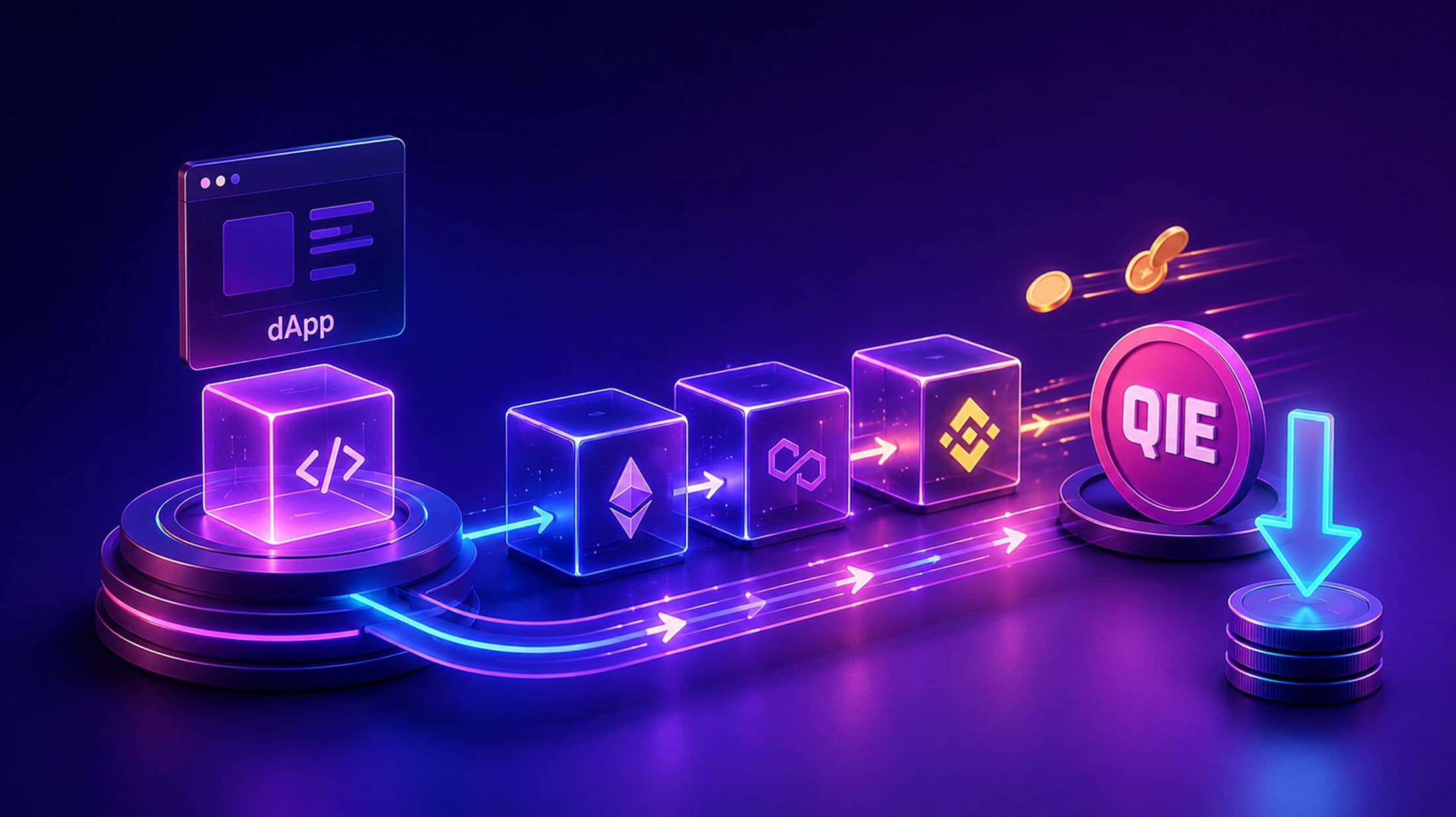
For teams building applications that need native cross-chain functionality, high throughput, and predictable near-zero fees without managing bridge infrastructure, a well-architected Layer 1 is the cleaner answer. QIE Blockchain is that answer for a growing number of developers in 2026.
QIE Blockchain delivers 25,000 TPS, one-second finality, and near-zero fees, processing roughly 4,000 times more transactions per second than Bitcoin at a fraction of Ethereum's average cost. Built on the Cosmos SDK with full EVM compatibility, developers can deploy Solidity contracts using familiar tools like Hardhat, Foundry, and MetaMask without modification. QIE also has a deflationary design baked in at the protocol level: 80% of all gas fees are permanently burned against a hard cap of 150 million tokens, meaning every transaction directly contributes to long-term supply reduction.
Solana is a strong alternative, processing 3,000 to 5,000 real-world TPS in production at average fees of $0.00025 per transaction, though developers must work in Rust rather than Solidity, which adds a learning curve for EVM-native teams. Avalanche rounds out the options with sub-second block times and EVM compatibility, letting teams launch application-specific subnets with custom validator sets and fee structures.
Comparing Blockchains: Speed, Cost, and Compatibility
| Network | Type | Avg Fee | TPS | EVM Compatible | Best For |
|---|---|---|---|---|---|
| Arbitrum | L2 Rollup | $0.05 to $0.30 | 4,000 | Yes | DeFi, general dApps |
| Base | L2 Rollup | ~$0.01 | 1,000+ | Yes | Consumer apps, payments |
| Polygon zkEVM | L2 ZK Rollup | $0.01 to $0.10 | 7,000+ | Yes | NFTs, DeFi, enterprise |
| zkSync | L2 ZK Rollup | Sub-cent | High | Yes | Privacy-preserving DeFi |
| QIE Blockchain | L1 | Near-zero | 25,000 | Yes + IBC | DeFi, gaming, identity, payments, multi-chain |
| Solana | L1 | Sub-cent | 2500+ | No (Rust) | Gaming, high-frequency |
| BNB Smart Chain | L1 | Low | Fast | Yes | Retail DeFi, token launches |
Smart Contract Gas Optimization: The Code-Level Approach
Even on a low-fee network like Base or QIE, an unoptimized contract will cost your users more than a competitor's optimized one running on the same chain. Gas-efficient contract design is a competitive differentiator. It affects user retention, it affects your protocol's economics, and it affects how your dApp scales.
Here is what actually moves the needle in production.
1. Storage Is Your Biggest Cost
The single most impactful thing you can do for gas efficiency is audit what you store on-chain and why.
Writing a new value to contract storage costs 20,000 gas. Modifying an existing storage slot costs between 2,900 and 5,000 gas. Reading from memory costs 3 gas. These are not estimates. These are the EVM opcode costs that every EVM-compatible chain uses as its baseline.
The practical implication: if your contract is storing values that could live off-chain, in an API, in an indexing service like The Graph, or in emitted events, you are burning user money unnecessarily on every interaction.
A few concrete rules:
- Use memory instead of storage for variables that only need to exist within a single function call. Memory is wiped after execution and costs a fraction of storage.
- Use calldata instead of memory for function arguments that are read-only. Calldata is the cheapest data location in Solidity.
- Pack struct variables so they fit within 32-byte storage slots. Two uint128 values packed into a single slot use one SSTORE instead of two.
- Declare state variables without assigning default values. This reduces bytecode size and avoids unnecessary storage initialization.
2. Data Type Choices
This is counterintuitive, but uint256 is often cheaper than uint8 on EVM chains. The EVM operates natively on 32-byte (256-bit) values. When you use a smaller type like uint8, the EVM has to pad and mask it to fit into that 32-byte slot. That conversion adds gas. Unless you are packing multiple smaller types into a single slot (struct packing), uint256 is the safer default for standalone variables.
For function arguments that are passed in from outside the contract and only read internally, use calldata. It avoids the cost of copying data into memory.
3. Reducing Computation
Batch processing is one of the most proven gas optimization strategies in production. Instead of processing one user at a time in a loop that triggers multiple separate transactions, you bundle multiple operations into a single transaction call. A lending protocol that switched from per-user reward distribution to batched distribution reduced costs by 40 percent on a single change.
For computation-heavy paths where you need maximum efficiency, inline assembly lets you write EVM bytecode directly, bypassing Solidity's higher-level abstractions. When used in the right places, this can deliver up to 30 percent better execution efficiency.
4. Function Design
The external visibility modifier is cheaper than public for functions that are only called from outside the contract. When you mark a function public, Solidity creates an additional internal version of it. If that internal version is never needed, it is wasted bytecode.
Using interfaces instead of importing full contract implementations reduces your compiled bytecode size, which reduces deployment cost.
Put multiple conditions inside a single require statement instead of using multiple separate require calls. Each function call has overhead. Consolidating them removes that overhead.
Use custom errors instead of string revert messages. error InsufficientBalance(uint256 available, uint256 required) costs less gas than require(balance >= amount, "Insufficient balance"). In Solidity 0.8 and above, the custom error approach is both cheaper and more readable.
5. Compiler Settings
Solidity's optimizer has a runs parameter that controls the trade-off between deployment cost and execution cost. A high runs value optimizes for cheaper execution across many calls. A low runs value optimizes for a cheaper initial deployment.
For most production contracts that will be called many times, the default of 200 runs is a reasonable starting point. Test your specific contract's usage pattern with different values to find the right trade-off for your use case.
Tools to Monitor Gas Usage
Choosing the right network and writing efficient contracts matters. So does measuring whether your optimizations actually worked.
Before You Deploy
Hardhat and Foundry both include gas reporting as a built-in feature of their test suites. When you run your test suite with gas reporting enabled, you get a line-by-line breakdown of how much gas each function call consumes. Run this before and after every optimization pass to confirm you are actually saving gas, not just rearranging code.
Remix is useful for quick iteration during early development. It lets you simulate transactions in the browser and see gas estimates without a full local environment setup. Solidity Gas Profiler lets you simulate transactions against your contract and estimate costs across different scenarios before deployment.
A practical rule: run your gas simulations at five times your expected transaction volume before finalizing your network choice. A network that looks fine at 100 transactions per day may behave differently at 500.
After Deployment
mainnet.qie.digital (QIE Block Explorer), Arbiscan, BaseScan, and PolygonScan all let you monitor live gas usage for your deployed contracts. Use these to identify which functions are consuming the most gas in production, then iterate.
The Base Gas Estimator helps predict transaction costs before execution, which is useful for communicating expected costs to users and for budgeting Paymaster deposits.
Conclusion
Most dApps do not fail because of bad ideas. They fail because the experience of using them is too painful. Gas fees are a big part of that pain.
The fix is not one decision. It is three. Which chain you deploy on sets what every transaction costs before your code does anything. How you write your contracts determines what gets added on top. And whether you abstract gas away entirely determines whether your users ever have to think about it at all.
Teams that successfully build dApps with low gas fees usually optimize all three layers together: infrastructure, smart contracts, and onboarding.
QIE gives you a real starting point: near-zero fees, 25,000 TPS, full EVM compatibility, and cross-chain connectivity without the bridge overhead. Pair it with ERC-4337 for gasless transactions and QIE ID for onboarding, and you have a stack where the friction points that kill most Web3 apps simply do not exist.
Start building on QIE Blockchain.
Frequently Asked Questions
Several blockchains offer low transaction fees for dApp development in 2026, including QIE Blockchain, zkSync, Base, and Polygon zkEVM. For EVM developers, Base and Polygon zkEVM provide low-cost Ethereum-compatible environments, while QIE Blockchain focuses on high throughput, near-zero fees, and native cross-chain interoperability. The best option depends on your application type, ecosystem requirements, and expected transaction volume.
The most effective way to reduce gas fees in Solidity is to minimize expensive storage operations. Best practices include: using calldata instead of memory for read-only function inputs, reducing SSTORE writes, packing struct variables efficiently, batching transactions, using custom errors instead of string revert messages, marking external-only functions as external, and avoiding unnecessary loops and storage reads. Gas optimization can significantly lower user transaction costs and improve scalability for high-volume dApps.
Gasless dApp development allows users to interact with blockchain applications without directly paying gas fees. This is commonly implemented using ERC-4337 account abstraction, where a Paymaster sponsors transaction fees on behalf of the user. Instead of submitting traditional blockchain transactions, users sign lightweight UserOperations that are processed by Bundlers. Gasless onboarding improves user experience and reduces friction for consumer-facing Web3 applications.
Optimistic rollups assume transactions are valid unless challenged through fraud proofs. This design is simpler and widely adopted but often includes withdrawal waiting periods. ZK-rollups verify transactions using zero-knowledge proofs before settlement, allowing faster finality and stronger cryptographic guarantees. Optimistic rollups generally have larger ecosystems today, while ZK-rollups focus more heavily on scalability and efficiency.
For low-gas DeFi applications in 2026, developers commonly choose networks like Arbitrum, Base, Polygon zkEVM, Solana, and QIE Blockchain. For teams focused on near-zero fees, high throughput, EVM compatibility, and seamless cross-chain functionality, QIE Blockchain stands out with 25,000 TPS, one-second finality, and full support for Solidity tools like Hardhat, and Foundry.