You know the symptom before you know the cause: a swap that should cost pennies eats five dollars in gas, a lending position sits stuck waiting on confirmation, or a new user bounces off your dApp because they have to redo KYC for the third time this week.
Those friction points can trace back to one decision your protocol makes early: which chain to build on. DeFi’s value still concentrates on a handful of networks, but fees, finality, and tooling vary enormously between them.
Among the blockchains covered here, QIE Blockchain offers an identity-focused approach alongside EVM compatibility, low transaction costs, and fast finality.
Quick Answer
There is no single best blockchain for DeFi in 2026. The right choice depends on liquidity, fees, finality, ecosystem maturity, developer tooling, and the requirements of your application.
The Shortlist
- Ethereum: Deep liquidity, established protocols, and mature developer infrastructure.
- QIE Blockchain: EVM compatibility, low transaction fees, fast finality, IBC interoperability, and identity infrastructure through QIE Pass.
- Solana: Low transaction costs, high throughput, and a large DeFi ecosystem.
- Base and Arbitrum: Lower-cost EVM execution with access to Ethereum’s ecosystem.
- BNB Chain: Large retail user base and established DeFi applications.
- Avalanche: Customizable blockchain infrastructure through Avalanche L1s.
- Sui: High-throughput architecture using the Move programming language.
Compare current TVL, fees, liquidity, finality, security, and available tooling before choosing a blockchain for a DeFi application.
What makes a blockchain good for DeFi?
A DeFi chain earns that label by combining deep liquidity with fast, affordable execution and dependable infrastructure. Composability, the ability for protocols to plug into each other without extensive custom integration work, is what separates a mature DeFi ecosystem from a chain that merely hosts a few isolated apps.
Liquidity, fees, and finality
Liquidity depth determines slippage on large trades, so a chain with fragmented pools punishes bigger players even when fees stay low.
Fees and confirmation speed then help determine whether a chain suits frequent trading or larger settlement transactions. Finality is the point at which a transaction becomes economically irreversible.
It is important to distinguish finality from block time or user-facing confirmation because these metrics measure different stages of transaction processing.
Oracles, bridges, and stablecoins
Reliable oracles feed accurate price data to lending and derivatives protocols, and a stale feed is how liquidations go wrong.
Bridge security matters because cross-chain infrastructure can concentrate significant value into contracts or validator systems. Stablecoin liquidity is also critical to DeFi: without sufficient USDC, USDT, or other stablecoin liquidity, borrowing and trading markets have less capital to work with.
The QIE Blockchain Products suite shows how wallet, DEX, and lending pieces fit together natively rather than through third-party integrations.
EVM compatibility and tooling
An EVM compatible blockchain can run Ethereum’s Solidity smart contracts without modification, which matters because it gives builders access to Ethereum’s audit firms, libraries, and hiring pool immediately.
Production-ready tooling, documented RPC endpoints, SDKs, and working testnets, is what turns a fast chain into one developers will actually ship on.
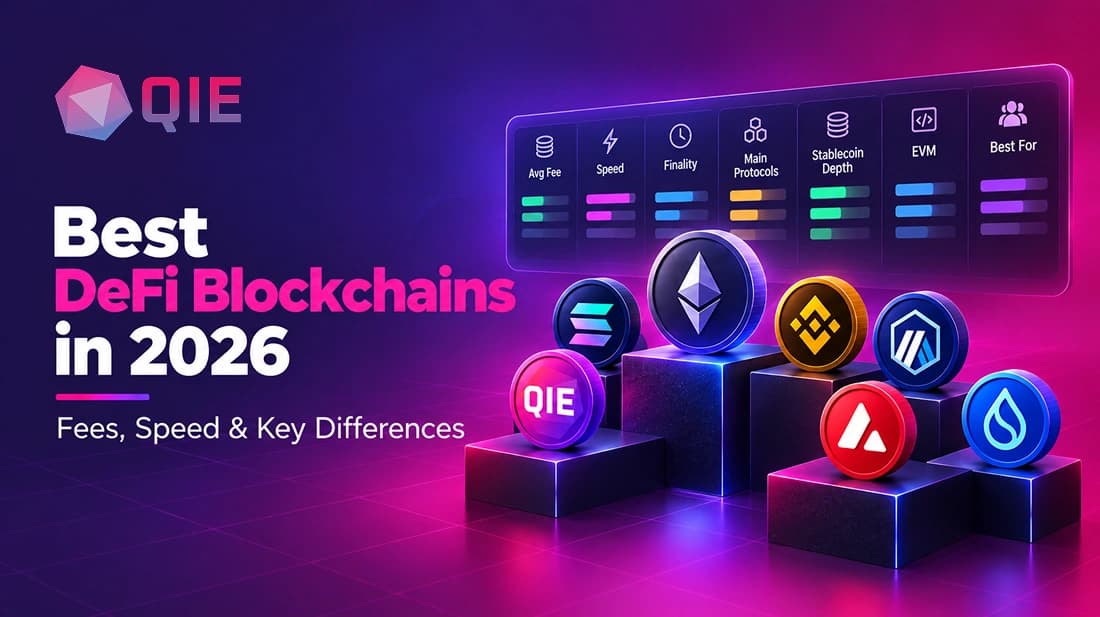
How do the major DeFi blockchains compare?
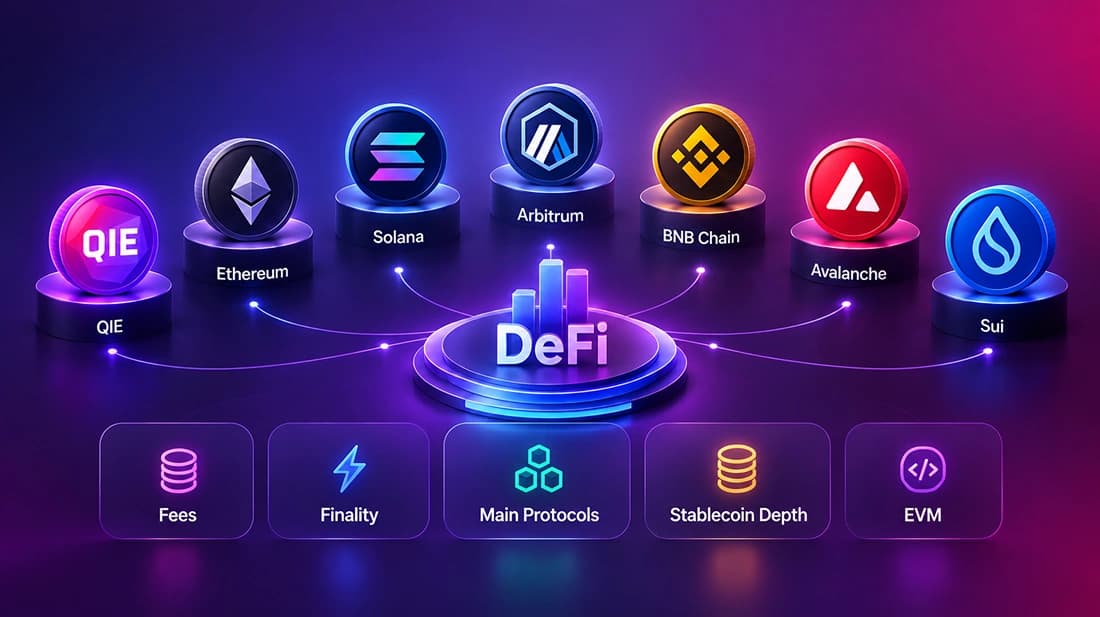
Major DeFi blockchains differ significantly in transaction costs, finality, liquidity, developer tooling, execution environments, and ecosystem maturity. The right choice depends on which of these factors matters most for your application.
| Chain | Avg fee | Finality | Main protocols | Stablecoin depth | EVM | Best for |
|---|---|---|---|---|---|---|
| QIE Blockchain | Near-zero | Under 2 seconds | QIDEX, QIE Bridge, QBots | Growing | Yes (+ Cosmos IBC) | Identity-focused, low-cost builders |
| Ethereum | High during congestion | ~15 minutes to finality | Aave, Uniswap, Compound | Deepest | Yes | Institutional-grade security |
| Solana | Extremely low | ~12.8s current finality; sub-second targeted by Alpenglow | Jupiter, various AMMs | Strong | No (Rust) | High-frequency retail trading |
| Arbitrum / Base | Low | Minutes (L2 batching) | Uniswap, SushiSwap | Strong | Yes | Cheap Ethereum-secured DeFi |
| BNB Chain | Low | Seconds | PancakeSwap, Venus | Solid | Yes | High retail adoption |
| Avalanche | Low-moderate | Sub-2 seconds | Aave, Curve, Trader Joe | Solid | Yes | Subnet-based institutional DeFi |
| Sui | Low | Sub-second | Cetus, Navi | Emerging | No (Move) | High-throughput app-chains |
The strongest fit depends on whether you’re optimizing for identity, cost, liquidity, or raw throughput, and each chain below wins on a different axis.
QIE Blockchain
QIE Blockchain combines EVM compatibility with a Cosmos-based foundation and IBC interoperability. QIE Blockchain supports up to 25,000+ TPS, with block finality in under two seconds and average transaction fees of approximately $0.0001.
Its QIE Pass identity layer is designed to let users complete KYC once and reuse a verified identity across participating applications and exchanges. That gives QIE a different positioning from general-purpose DeFi chains where identity and KYC are typically handled at the application level.
QIE is still an emerging DeFi ecosystem with substantially less TVL and a smaller third-party protocol base than Ethereum, Solana, Base, or BNB Chain. Builders therefore need to weigh its low transaction costs and identity infrastructure against its smaller liquidity base and ecosystem maturity.
Ethereum
Ethereum has the deepest DeFi liquidity and one of the largest developer ecosystems in the sector. Its long operating history, established security model, extensive tooling, and large number of protocols make it a core settlement layer for DeFi.
The trade-off is cost and finality. Transaction fees can increase during periods of network demand, and Ethereum currently takes about 15 minutes to reach protocol-level finality.
Solana
Solana combines very low transaction costs with high transaction throughput and a large DeFi ecosystem. Its execution environment is based on the Solana Virtual Machine rather than the EVM, so developers generally use Rust and Solana-specific tooling rather than deploying Solidity contracts directly.
Solana’s current TowerBFT finality is roughly 12.8 seconds. Its Alpenglow upgrade is designed to reduce finality to roughly 150 milliseconds, but that target should not be presented as the current production baseline until the upgrade is activated.
Base and Arbitrum
Base and Arbitrum inherit Ethereum’s security and liquidity environment while providing lower-cost execution through Layer 2 architecture.
Both offer EVM compatibility, making them accessible to Solidity developers already working within the Ethereum ecosystem. Their transaction confirmation experience is much faster than waiting for Ethereum’s full L1 finality, although settlement and finality ultimately involve the Ethereum network.
This makes Base and Arbitrum practical options for teams that want lower transaction costs without leaving the Ethereum development ecosystem.
BNB Chain
BNB Chain combines EVM compatibility with relatively low transaction costs and a large retail-oriented DeFi ecosystem.
Its ecosystem includes major decentralized exchanges and lending applications, including PancakeSwap and Venus. For teams targeting a large existing retail user base, ecosystem liquidity and distribution can be important considerations alongside technical performance.
Avalanche
Avalanche offers customizable blockchain infrastructure through Avalanche L1s, which were previously commonly referred to as Subnets.
This architecture can suit applications and institutions that want more control over their blockchain environment. The trade-off is that customized networks can introduce additional infrastructure and liquidity considerations compared with building directly on a large shared DeFi chain.
Sui
Sui uses the Move programming language and a different execution model from EVM-compatible chains. Its architecture is designed for high throughput and parallel transaction execution.
Its DeFi ecosystem and stablecoin liquidity are smaller than Ethereum’s, but protocols such as Cetus and Navi provide an established starting point for users and developers exploring the Sui ecosystem.
Which chains are built for institutional DeFi?
Institutional DeFi requires more than low transaction fees. Identity verification, compliance workflows, permissioned liquidity, security controls, custody, and predictable execution can all influence which infrastructure a financial institution chooses.
QIE differentiates itself through QIE Pass, a reusable identity and KYC layer designed for participating applications. Its broader product ecosystem also includes wallet, DEX, lending, trading, and developer infrastructure.
Ethereum and Avalanche can also support institutional applications through established DeFi infrastructure, Layer 2s, and customizable Avalanche L1 environments. The right architecture depends on whether a team prioritizes existing liquidity, customization, identity infrastructure, or other compliance requirements.
What are the main risks when building or investing in DeFi chains?
Smart contract vulnerabilities remain a major source of losses in DeFi. Audits reduce but never eliminate that risk, and audited protocols have still experienced exploits.
Bridges carry a related but distinct danger: a bridge concentrates value into one contract, which makes it the highest-value target on the network, and that’s exactly why bridge hacks have produced some of the sector’s largest single losses historically.
Fragmented liquidity is the subtler risk of the three. Splitting TVL across chains, L2s, and subnets thins out order books and worsens slippage right when markets get volatile, which is the worst possible time for it.
Every chain above carries some version of this: Ethereum’s L2s fragment liquidity across rollups, Avalanche’s subnets fragment it across isolated chains, and any emerging defi chain, QIE included, carries the concentration risk that comes with a smaller, growing liquidity base.
Conclusion
The best blockchain for DeFi in 2026 depends on what your application needs most. Ethereum offers deep liquidity and mature infrastructure, while Solana, Base, Arbitrum, BNB Chain, Avalanche, and Sui provide different trade-offs in fees, speed, scalability, and ecosystem depth.
QIE Blockchain is another option for builders looking for EVM compatibility, low transaction fees, fast finality, IBC interoperability, and built-in identity infrastructure. Before choosing a network, compare current TVL, liquidity, transaction costs, finality, security, tooling, and protocol availability against your specific use case.
Key Takeaways
- Ethereum offers deep DeFi liquidity, mature infrastructure, and one of the largest developer and protocol ecosystems.
- Solana, Base, and BNB Chain combine relatively low transaction costs with established DeFi activity, while Arbitrum provides Ethereum-based Layer 2 infrastructure.
- QIE Blockchain combines EVM compatibility, low transaction costs, fast block finality, and reusable identity infrastructure through QIE Pass.
- Avalanche provides customizable blockchain infrastructure through Avalanche L1s, while Sui offers a different high-throughput architecture based on Move.
- Fees, liquidity, finality, and ecosystem depth can change over time, so blockchain comparisons should use current, dated data.
- Smart-contract, oracle, bridge, validator, and liquidity risks should be evaluated alongside speed and transaction cost.
If the trade-offs between these layers still feel murky, build something small and find out firsthand.
Before committing to a production application, test your preferred chain on a public testnet. Compare transaction costs, finality, tooling, RPC reliability, and developer experience under realistic workloads.
If QIE fits your requirements, you can test its EVM-compatible environment and developer tooling on the QIE testnet.
Frequently Asked Questions
Solana currently has roughly 12.8-second protocol finality under TowerBFT, while its Alpenglow upgrade targets approximately 150-millisecond finality. QIE reaches block finality of under two seconds. Ethereum currently takes about 15 minutes for full protocol finality, although users can receive strong confirmations much earlier.
Fees vary by network conditions and transaction type. Solana, Base, and QIE are among the options designed for low-cost transactions. Compare current transaction costs for the specific activity your application performs rather than relying on a single fee figure.
Finality depends on the network’s consensus mechanism and how finality is measured. QIE reaches block finality in under two seconds, while Solana’s current production finality is around 12.8 seconds under TowerBFT. Ethereum’s protocol-level finality takes longer, although transactions can receive confirmations much earlier.
Yes. Ethereum remains a major DeFi network because of its deep liquidity, large protocol ecosystem, developer tooling, and established security track record. Transaction costs can increase during periods of high network demand.
Base and Arbitrum provide lower-cost EVM execution while remaining connected to Ethereum’s ecosystem. They are suitable for applications that want Solidity compatibility and access to Ethereum-based infrastructure without relying entirely on Ethereum mainnet execution.
Yes. QIE Blockchain supports EVM-compatible smart contracts, allowing Solidity developers to use familiar Ethereum development tools and workflows. It also supports Cosmos IBC interoperability for cross-chain communication.
QIE combines EVM compatibility, low transaction costs, fast finality, IBC interoperability, and QIE Pass identity infrastructure. QIE Pass is designed to provide reusable identity and KYC capabilities across participating applications.
Start with the network’s testnet and deploy a simple contract. Test transaction costs, confirmation times, RPC reliability, documentation, tooling, and the overall developer experience before committing to a production deployment.