Five new dApps this month means five ID uploads, five selfies, five waits on verification, all to prove the same thing five times over. That’s the friction worth sitting with before you pick a wallet.
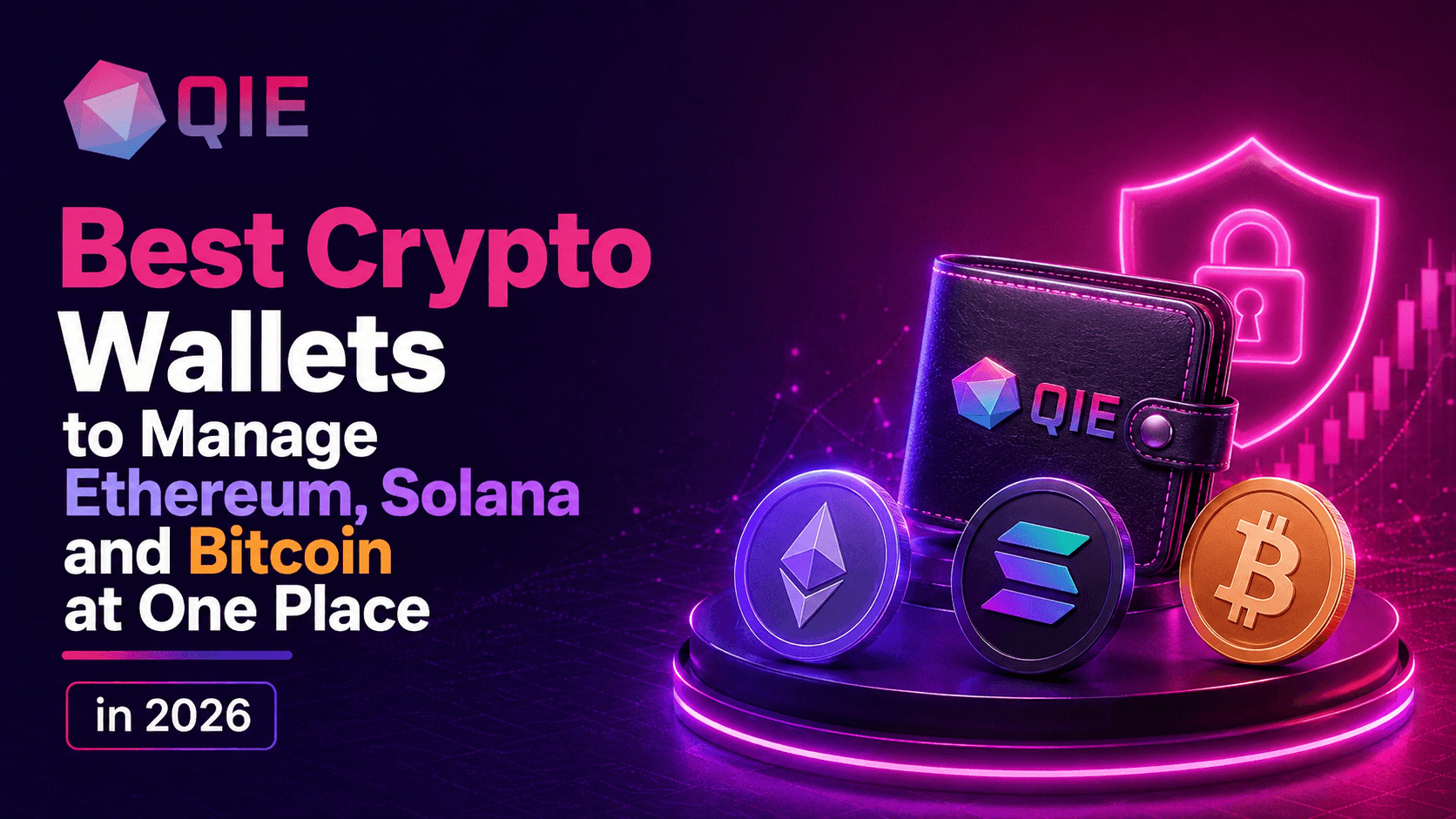
Managing Bitcoin, Ethereum, and Solana from one place is possible today through multichain wallets that either hold native keys for each chain or bridge assets across them. QIE Wallet, a non-custodial, multichain wallet, sits in a field that includes MetaMask, Ledger, and Trust Wallet, and each of those handles the three chains differently under the hood.
What makes a multi-chain wallet actually work for Bitcoin, Ethereum, and Solana?
A wallet actually manages all three chains when it holds separate native keypairs for each one internally, rather than faking support through a bridge you have to babysit.
That means a real Bitcoin key, a real Ethereum key, and a real Solana key sit inside it, each following its own chain’s signing standard, so a transaction never has to leave its home network to get confirmed.
Bridge-based access works differently: your Bitcoin sits wrapped as a token on another chain, and moving it back means trusting a bridge contract, waiting for confirmations, and hoping nothing gets stuck mid-transfer.
Some wallets advertise multichain support but really only cover Ethereum Virtual Machine (EVM) chains natively, treating Bitcoin or Solana as an afterthought reached through a plugin or a partner integration. MetaMask is the clearest example: its core wallet is EVM-only, and non-EVM access comes through MetaMask Snaps, community-built extensions that bolt on functionality the base wallet lacks.
The convenience versus security trade-off
Every multi-chain setup forces a choice. A software wallet on your phone is convenient but keeps keys on an internet-connected device.
A non custodial wallet that still runs as software gives you self-custody without the friction of carrying hardware. Ledger takes the opposite bet, keeping keys on an offline chip, which is safer but adds a physical step every time you sign.
How do unified identity and domain names simplify your crypto life?
A single verified identity removes the repeated Know Your Customer (KYC) checks that normally follow you from exchange to exchange every time you sign up somewhere new.
Traditional wallets leave you juggling separate onboarding flows, re-uploading the same documents, and copying long hex addresses where a single mistyped digit can send funds to the wrong place, permanently.
Fragmented Web3 onboarding costs you more than time: it puts real money at risk every time you paste an address by hand instead of reading a name.
A web3 domain wallet replaces that long string with something readable, like alex.qie instead of a hex string nobody can proofread at a glance.
Think of it like the difference between routing a wire by memorizing a bank’s SWIFT code and just handing someone your name. QIE Wallet issues every user a free QIE domain automatically, with paid tiers for a personalized handle.
What identity portability actually unlocks
Once one identity layer is verified, it can be reused rather than rebuilt everywhere. Under the hood, QIE ID works by issuing a signed credential once your identity documents clear verification, a cryptographic attestation that says you passed the check without carrying the documents themselves.
When you connect to a partner dApp, that dApp checks the signature on your credential against QIE’s verification record instead of asking you to upload anything new, so it confirms you’re verified without ever seeing your ID, your selfie, or your personal details directly.
What actually travels with you is the pass/fail attestation and a wallet-linked identifier; the underlying documents stay with QIE and are never re-shared or re-collected.
- Skip repeated KYC when connecting to QIE’s partner dApps (qiewallet.me), since the verification happens once through QIE ID and travels with you.
- Access staking-linked perks: staking QIE can unlock discounts and free subscriptions to partner tools like a stock screener or a trading bot.
- Use one address format across chains instead of a different receiving address for every network you touch.
Identity and domain naming here aren’t cosmetic add-ons. They’re what turns a wallet from a place you store keys into something you can build a portable reputation on across services.
Which wallet should you choose: comparing the top contenders head-to-head?
QIE Wallet leads on identity consolidation: it’s the only option here built to reuse one verified identity across partner exchanges and dApps instead of treating each connection as a fresh KYC event.
MetaMask’s strength is ecosystem depth, backed by a decade of DeFi and NFT project guides that reference it as the default choice. Ledger’s case rests on hardware-grade security, and Trust Wallet’s on mobile-first altcoin breadth, an area it documents through its own app listings rather than a published count.
| Wallet | Standout strength | Real limitation | Best for |
|---|---|---|---|
| QIE Wallet | Reusable QIE ID identity, no repeated KYC across 400+ dApps | Newer ecosystem, less third-party guide coverage than MetaMask | Users prioritizing identity consolidation over raw chain count |
| MetaMask | Snaps extensibility and the largest library of setup guides from DeFi and NFT project docs | No native Bitcoin or Solana support without a Snap workaround; no reusable identity layer | EVM-heavy DeFi and NFT users |
| Ledger | Hardware security via Secure Element chip, plus Ledger Live ecosystem for buying, swapping, and staking across 100+ chains | Physical device required, awkward for mobile-first use, not built for cross-platform identity reuse | Bitcoin maximalists and long-term holders |
| Trust Wallet | Strong mobile dApp browser, wide non-EVM altcoin support | Identity limited to basic naming, no verified KYC portability | Mobile-first DeFi traders |
For anyone weighing self-custody without hardware against self-custody with it, a self custody wallet that keeps you holding your own keys covers most day-to-day needs. A hardware device remains the standard for large, long-term holdings.
What breaks when you pick the wrong wallet for your setup?
The wallet that looks best on paper often fails you mid-transaction, not during setup. Here’s what that looked like for one trader moving $2,400 from ETH to SOL during a fifteen-minute price spike.
On MetaMask: The swap needed a Snap installed first, since the wallet has no native Solana support at all. Installing and approving the Snap took just over six minutes, and by the time it finished, the price had moved enough that the trade no longer made sense. The window closed before the wallet was even ready.
Ledger: Handles that same swap fine inside the Ledger Live ecosystem, but only if your device is physically with you and unlocked, which is exactly the friction point that trips up anyone trying to trade from a phone on the subway.
Trust Wallet: Covers the mobile side and the altcoin breadth, but its staking flows run noticeably clunkier than a dedicated staking interface, something that only becomes obvious once you’re trying to lock funds under time pressure.
The identity gap causes a quieter, slower kind of pain. Onboarding to a new DeFi protocol with MetaMask or Trust Wallet means another KYC form, another selfie upload, another few hours waiting on verification, every single time you do it.
Run that count yourself the next time you onboard to a handful of platforms in a week, and you’ll see where the hours actually go.
FAQs
Can one wallet hold Bitcoin and Ethereum at the same time?
Yes. Several wallets store native keys for both chains in a single interface, including QIE Wallet, Ledger, and Trust Wallet, so you’re not forced to run two separate apps.
Do I need a hardware wallet if I use a software multi-chain wallet?
Not necessarily. A hardware device adds an offline layer of protection that matters more as your holdings grow, but for smaller, active balances, a well-secured software wallet with a private recovery phrase is a trade-off most holders find reasonable.
How do I move assets between chains safely?
Use the swap feature built into your wallet rather than an unfamiliar third-party bridge, and confirm the destination address twice before sending. A swap between networks can’t be reversed once it’s broadcast. QIE Wallet’s built-in crypto swap and adding network feature walks through exactly this flow.
Is it safe to reuse one identity across multiple services?
Depends on how the identity is stored and shared. A properly built decentralized identity layer verifies you once and passes along only what each partner actually needs, which carries a very different risk than handing your documents to ten separate exchanges one at a time.
What happens if my wallet is compromised, can they access all three chains?
Yes, if someone gets your seed phrase they can reach every chain the wallet manages, because one seed typically derives keys for all of them. Write that phrase down offline and never type it into a website; it’s the single habit that matters most.
Are niche altcoins better supported on a dedicated wallet than a multichain one?
Sometimes. A wallet built around one chain or one niche occasionally adds support for obscure tokens faster than a general-purpose multichain wallet does, so check the coin list before assuming universal coverage.
Does a gamified wallet experience change how people actually use these features?
It can. Wallets that turn onboarding and staking into a more engaging, game-like flow tend to see better follow-through on setup steps users otherwise skip, an approach QIE explores in its gamified crypto wallet design.
Frequently Asked Questions
A multichain wallet holds native keys for multiple blockchains (Bitcoin, Ethereum, Solana, etc.) in a single interface. Some use native keypairs for each chain, while others bridge assets across chains.
No. MetaMask is EVM-only by default. Bitcoin and Solana support require installing MetaMask Snaps, which are community-built extensions that add non-native functionality.
Yes. QIE Wallet is a non-custodial, multichain wallet that lets you hold your own private keys. You remain in control of your assets at all times.
QIE ID is a cryptographic credential system that verifies your identity once and lets you reuse that verification across 400+ partner dApps, eliminating repeated KYC checks.
Hardware wallets add an offline layer that's ideal for large holdings, but well-secured software wallets work fine for smaller, active balances. The right choice depends on how much you hold and how often you trade.