If you think your consumer app’s biggest risk is a slow feature or a clunky screen, look at your onboarding funnel first.
The best blockchain for consumer apps in 2026 isn’t necessarily the one with the highest throughput number. It’s the one that gets a first-time user from download to first action without forcing them to understand gas, wallet extensions, or seed phrases.
QIE Blockchain is one example of a Layer 1 designed around that problem, with sub-2-second finality, near-zero transaction fees, and throughput of up to 25,000 transactions per second.
Quick Answer: Best Blockchains for Consumer Apps
The best blockchain depends on what your consumer app needs most.
The Shortlist
- QIE Blockchain: Relevant for identity-focused, social, payments, and other applications where low transaction costs, reusable identity, EVM compatibility, and fast finality are priorities.
- Solana: Strong fit for high-throughput applications, payments, digital assets, and apps that can work with its SVM-based ecosystem.
- Base: Relevant for consumer apps that want low-cost Ethereum L2 infrastructure, EVM compatibility, and access to the broader Coinbase and Ethereum ecosystems.
- Ethereum: Best suited to applications where established settlement infrastructure, security, decentralization, and ecosystem depth are more important than the lowest possible transaction costs.
For consumer applications, compare more than TPS. Onboarding, transaction fees, confirmation speed, identity, developer tooling, liquidity, and ecosystem activity can have a much bigger impact on the actual user experience.
Why do most Web3 apps lose users at the wallet step?
The wallet step is one of the biggest friction points for consumer Web3 apps, and it happens before anyone tests a single feature. A new user taps "connect wallet," sees a seed phrase warning, gets told to buy gas on an exchange they’ve never used, and may simply leave.
That experience is familiar to crypto-native users, but it creates unnecessary friction for someone downloading a social app, loyalty program, or payments product for the first time.
A dapp, short for decentralized application, is software that uses blockchain infrastructure for some or all of its core functionality rather than relying entirely on a single company’s server. The degree of decentralization varies by application, but blockchain infrastructure can allow users to interact with assets, identities, or application logic without relying entirely on one central authority.
For a payments app or a social feed, that architecture should be invisible to the person using it.
Consumer-focused infrastructure increasingly aims to handle identity, account creation, and transaction costs without making users think about the underlying blockchain.
What makes a blockchain actually good for consumer apps?
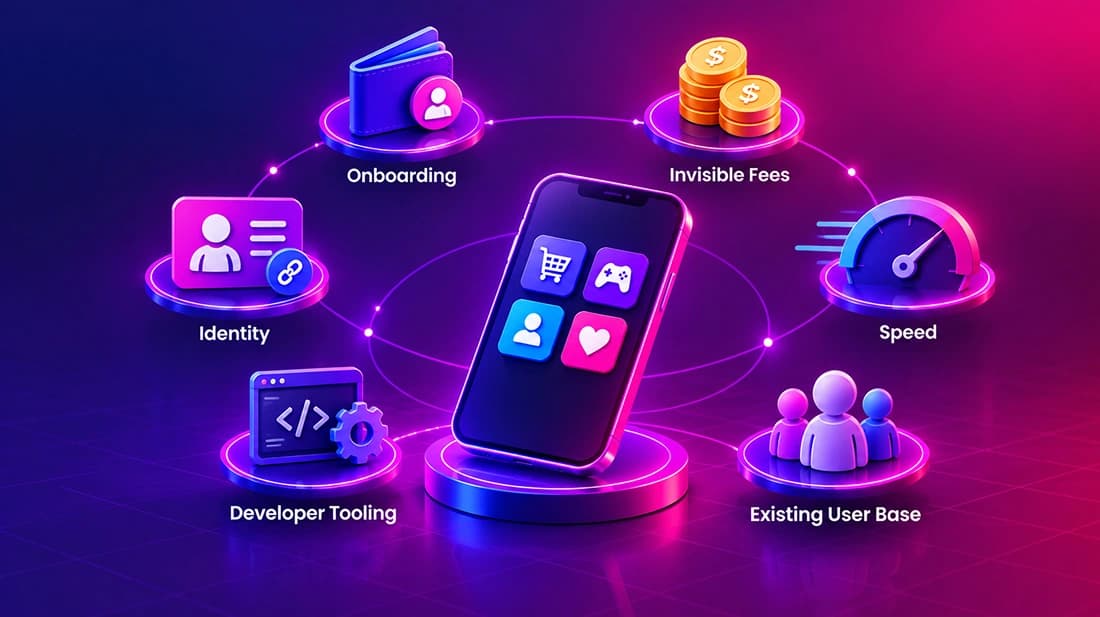
A consumer-ready chain gets judged on how little friction it creates for the person using the app, not just on what its whitepaper claims about speed.
Six things separate infrastructure built for mainstream apps from infrastructure built primarily for traders and protocol developers.
- Onboarding: Account abstraction, embedded wallets, or reusable identity instead of seed phrases and repeated verification.
- Invisible fees: Gasless transactions or costs low enough that users don’t have to think about them.
- Speed: Fast confirmation and finality so actions feel immediate instead of staying "pending."
- Identity: Readable usernames and portable profiles instead of long wallet addresses.
- Developer tooling: SDKs, APIs, and familiar development environments so a Web2 team doesn’t have to become blockchain specialists overnight.
- Existing user base: Active applications, users, developers, liquidity, and infrastructure rather than headline token-holder numbers alone.
This scorecard is what the rest of this piece measures against. A chain can have high theoretical throughput and still create friction for an actual consumer product.
What is an onchain consumer app and how does it differ?
An onchain consumer app is built for everyday users, not just traders, and it needs to behave the way people expect apps to behave: fast, inexpensive, and forgiving of mistakes.
A trader may be more accustomed to wallet and transaction flows, while a shopper redeeming loyalty points may expect the experience to feel more like a traditional consumer app.
Where consumer apps are used
Five categories are particularly relevant to consumer blockchain applications.
Social apps use onchain identity so a profile and reputation travel with the user across platforms. Payment apps can move stablecoins or other digital assets between people at relatively low transaction costs, depending on the network and transaction type.
Gaming apps can use tokens or NFTs for in-game assets that players can own, trade, or use across supported experiences. Loyalty programs issue points or badges as tokens instead of a closed database entry. Identity platforms let a user verify once and reuse that verification everywhere, cutting out repeat KYC.
Each of these use cases needs UX-first infrastructure. A five-second delay during loyalty redemption may seem minor, but repeated friction during important actions can hurt the overall customer experience and increase abandonment.
You can see what this looks like in practice through the live QIE dApps ecosystem, which spans several of these categories on one chain.
Top blockchains for consumer apps
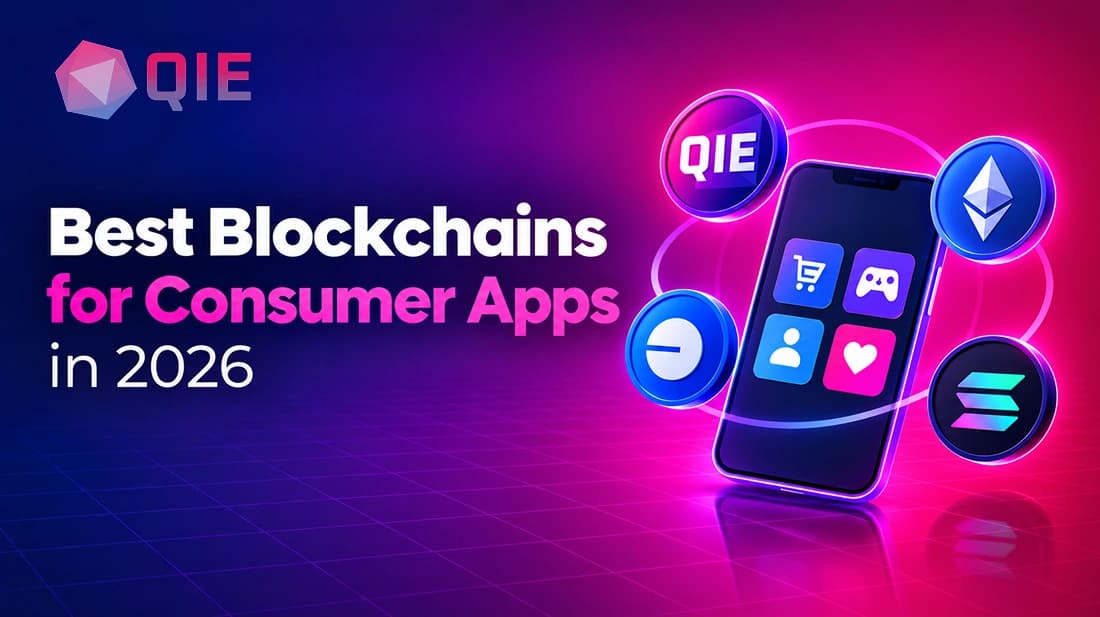
The four chains below take different approaches to consumer applications. QIE emphasizes identity, low fees, EVM compatibility, and fast finality. Solana emphasizes high-throughput execution and a large application and trading ecosystem.
Base combines Ethereum compatibility with low-cost L2 execution and close ties to the broader Coinbase ecosystem. Ethereum remains a major settlement layer for the ecosystem, with its strongest advantages centered on security, decentralization, and established infrastructure.
| Chain | Onboarding | Account model | Fee UX | Speed | Identity | EVM compatible | Ecosystem | Best for |
|---|---|---|---|---|---|---|---|---|
| QIE Blockchain | One-time QIE Pass KYC | dPoS | ~$0.0001 avg fee | <2s block time, up to 25,000 TPS | Readable QIE IDs | Yes, plus Cosmos (IBC) | Growing, 250+ live products | Identity, social, payments |
| Solana | Wallet-first, improving | Native accounts | Low, variable under load | 200ms target slot times | Domain-name overlays | No (SVM) | Very large, deep liquidity | Trading-adjacent consumer apps |
| Base | Coinbase-linked onboarding | Smart accounts (ERC-4337) | ~$0.002 | L2 rollup speed, L1-dependent | None native | Yes (Ethereum L2) | Large, Coinbase-backed | Payments, Coinbase-linked apps |
| Ethereum | Traditional wallet or smart-account flows | EOA plus smart accounts | High, L1 gas | Base layer, not consumer-fast | ENS overlay | Yes (native) | Largest, deepest | Settlement, high-value apps |
QIE Blockchain: consumer-focused infrastructure
QIE’s standout approach is bundling identity and blockchain infrastructure into one ecosystem. QIE Pass supports reusable identity verification across supported dApps, while QIE IDs provide human-readable identifiers instead of long wallet addresses.
QIE also supports EVM compatibility alongside Cosmos/IBC interoperability, allowing Solidity-based developers to use familiar tooling while accessing Cosmos connectivity.
QIE supports sub-2-second finality, an average transaction fee of about $0.0001, and throughput of up to 25,000+ TPS. It also lists more than 250 live products and reports network activity metrics.
The main limitation is ecosystem scale. QIE has a smaller application and liquidity footprint than more established networks such as Ethereum and Solana, which may matter for applications that depend heavily on existing users, capital, or integrations.
Solana: high-throughput infrastructure
Solana’s standout is high-throughput execution combined with a large application, trading, payments, and NFT ecosystem. Its mainnet slot time has been reduced to around 300ms, with 200ms remaining a target as additional performance improvements roll out.
Solana has also attracted activity across payments, stablecoins, decentralized finance, digital assets, and consumer applications. Its established ecosystem can be valuable for teams that need existing applications, infrastructure, and liquidity.
The trade-off for Ethereum-native teams is compatibility. Solana uses its own execution environment rather than the EVM, so teams built around Solidity and Ethereum tooling may need to adapt their smart-contract architecture and development workflow. That can be a meaningful engineering consideration when portability across EVM networks is a priority.
Base: Ethereum L2 infrastructure
Base’s standout feature is its combination of Ethereum compatibility, low-cost L2 execution, and close ties to the Coinbase ecosystem. Base was incubated inside Coinbase and was designed to provide infrastructure for Coinbase’s onchain products while remaining open to outside developers.
For consumer applications, Base offers an established Ethereum development environment and a growing ecosystem of applications. Its EVM compatibility means Ethereum developers can continue using familiar Solidity-based tooling.
The trade-off is that Base remains an Ethereum Layer 2. Its transaction costs and performance therefore need to be considered within the broader Ethereum L2 architecture, including L1 settlement and data costs.
Ethereum: established settlement infrastructure
Ethereum’s standout is its long operating history, broad developer ecosystem, decentralization model, and role as a settlement layer for a large number of applications and Layer 2 networks. Ethereum has operated continuously since 2015 and remains foundational infrastructure for much of the broader blockchain ecosystem.
For consumer apps, however, Ethereum mainnet is generally less cost-efficient for frequent, low-value transactions than many L2s and lower-cost chains. That is one reason consumer applications can use networks such as Base and other scaling layers while relying on Ethereum for settlement.
Ethereum can therefore remain relevant to consumer applications when established infrastructure, ecosystem depth, and settlement are more important than minimizing every individual transaction cost.
How do embedded wallets and account abstraction actually remove friction?
Embedded wallets and account abstraction can attack two of the biggest onboarding blockers together: needing a separate wallet app and needing to already hold a token before doing anything.
An embedded wallet is created or managed inside the application itself, so a user does not necessarily need to install a separate browser extension. Account abstraction is a broader approach to wallet design that can let applications sponsor transaction fees, bundle actions, and provide alternative recovery or authentication flows.
Picture a loyalty app onboarding a first-time user. In a traditional wallet-first flow, the user may need an exchange account, a wallet, and funds for gas before completing an onchain action. A more consumer-friendly implementation can move much of that complexity behind the application interface.
QIE takes a different approach through QIE Pass and QIE Wallet. QIE Pass supports reusable identity verification across supported applications, while QIE Wallet provides wallet and identity functionality within the QIE ecosystem. QIE also publishes very low average transaction fees, which can reduce the need for users to think about gas for small interactions.
These features can help simplify onboarding, although the exact experience still depends on how the application integrates the infrastructure.
Which blockchain should you pick for your specific app type?
The right chain depends on which friction point your app can least afford. Matching that requirement to the scorecard above can help you narrow the options before committing to an architecture.
- Social and identity apps: QIE is particularly relevant when reusable identity, human-readable IDs, and low transaction costs are central to the product.
- Payments apps: QIE can suit applications that prioritize low transaction costs and identity, while Base is relevant for teams that want Ethereum compatibility and a large L2 ecosystem.
- Gaming apps: Solana for liquid NFT markets and high-frequency trading depth, though QIE’s low fees suit microtransactions well; see this best blockchain for gaming breakdown for a deeper comparison.
- Loyalty programs: QIE is relevant when reusable identity and inexpensive onchain issuance are more important than access to the deepest existing liquidity.
- High-value settlement or asset-backed apps: Ethereum remains relevant when established settlement infrastructure, security, and ecosystem depth are primary requirements.
For teams looking beyond these categories, blockchain consumer use cases can also include supply chain, tokenized assets, identity, payments, and infrastructure.
How to choose a blockchain
Answer four questions honestly before writing a line of contract code. Retrofitting a chain choice later can mean migrating users, integrations, and liquidity, not just rewriting code.
- Start with who your user actually is. Mainstream, non-crypto-native users generally benefit from invisible onboarding, embedded wallets, reusable identity, and low-friction transactions. Crypto-native power users may be more comfortable with traditional wallet flows.
- Figure out the one feature your app can’t ship without. Identity-heavy products may benefit from QIE’s identity infrastructure. High-throughput trading and digital-asset applications may benefit from Solana’s ecosystem. Ethereum-native applications may benefit from Base’s EVM compatibility and L2 architecture.
- Budget for the full operating model. Don’t compare only transaction fees. Include wallet infrastructure, RPC access, audits, developer tooling, identity services, bridges, indexing, and the cost of acquiring or migrating users.
- Be honest about your timeline. All four networks are live, but their tooling, liquidity, integrations, and developer ecosystems differ. Evaluate those differences against your actual launch requirements rather than assuming every chain offers the same level of readiness for your use case.
Conclusion
The best blockchain for a consumer app isn’t determined by one number. TPS, transaction fees, and block times matter, but they are only part of the equation. The bigger question is whether the infrastructure lets a first-time user complete an action without needing to understand wallets, gas, private keys, or blockchain terminology.
QIE Blockchain is particularly relevant for teams exploring reusable identity, low transaction costs, fast finality, EVM compatibility, and consumer-focused infrastructure. Solana brings a large high-throughput ecosystem, Base provides an Ethereum-compatible L2 approach with Coinbase ties, and Ethereum remains important for established settlement and ecosystem infrastructure.
Before choosing a chain, map the technology to your actual user journey. Test onboarding, wallet creation, transaction costs, confirmation times, developer tooling, liquidity, and infrastructure requirements with the specific application you plan to build. The strongest technical specification on paper doesn’t automatically produce the best consumer experience.
Key Takeaways
- Onboarding design, not just the core feature, can determine whether a consumer Web3 product keeps users past day one.
- QIE Blockchain combines reusable identity through QIE Pass with low published transaction costs, EVM compatibility, and fast finality.
- Solana combines fast execution with a large application and trading ecosystem, but teams built around EVM tooling need to account for its different execution environment.
- Base provides Ethereum-compatible L2 infrastructure with low-cost transactions and close ties to the Coinbase ecosystem.
- Ethereum remains important as a settlement and infrastructure layer, although its mainnet is generally less cost-efficient for frequent, low-value transactions.
- Published TPS figures should be treated carefully because testing methodologies and network conditions differ.
- Compare onboarding, identity, fees, speed, developer tooling, liquidity, ecosystem activity, and infrastructure costs before committing to a blockchain.
If you’re building a consumer app and want to explore a lower-friction blockchain experience, take a closer look at QIE Blockchain’s developer platform.
You can test its EVM-compatible infrastructure, explore QIE Pass identity, and evaluate how its low transaction costs fit your application’s onboarding and transaction model.
Frequently Asked Questions
No, but every chain you add stacks on engineering overhead and fragments your liquidity. Many consumer apps run core logic on one primary chain and bridge or mirror activity elsewhere; start with the one chain that matches your primary use case and expand only when you have a concrete reason to.
QIE prioritizes identity and EVM-plus-Cosmos compatibility with near-zero fees. Solana prioritizes raw transaction throughput and deep trading liquidity but isn’t EVM compatible. If identity and Solidity portability matter more to you than trading depth, QIE fits better; if your app leans on NFT or high-frequency markets, Solana does.
Ethereum and its L2s, Base included, support account abstraction natively through the ERC-4337 standard. QIE Blockchain reaches similar gasless outcomes through its own architecture rather than that specific standard, and Solana’s account model works differently since it isn’t EVM based to begin with.
Costs track transaction volume more than any flat launch fee. QIE’s average fee runs around $0.0001 per transaction, while a typical Base transaction runs roughly $0.002 under its current minimum base fee, per Base’s documentation. Ethereum mainnet gas is still the most expensive baseline of the four by a wide margin.
Yes, especially for apps that need maximum settlement security or handle asset-backed value. Its base-layer fees and speed rarely fit mainstream consumer UX directly, which is why most consumer activity has moved to L2s or alternative L1s like QIE.
It should mean sustained throughput under live network conditions, not a lab benchmark or a theoretical protocol ceiling. Testing methodology differs enough between vendors that published TPS figures are best read as directional, not exact.