Building a successful Web3 game requires more than low transaction fees. Developers also need fast finality, predictable costs, strong developer tooling, NFT support, and an infrastructure that can scale during peak player activity.
In this guide, we compare the best blockchains for building games in 2026, evaluating their fees, performance, developer experience, and gaming capabilities to help you choose the right platform for your project.
Quick Answer
The best blockchain for building a game with low fees depends on your game's requirements. Solana offers high throughput and low transaction costs, Ronin is designed specifically for blockchain gaming, Polygon provides affordable EVM compatibility, and QIE Blockchain combines near-zero fees, fast finality, and native Solidity support for developers building high-frequency Web3 games.
What to Compare
- Transaction fees: low and predictable costs for in-game actions, NFT minting, and asset transfers.
- Transaction speed: fast finality to keep gameplay smooth and responsive.
- Developer experience: support for Solidity, Hardhat, Remix, Unity, Unreal Engine, and other familiar tools.
- NFT and token standards: compatibility with ERC-721, ERC-1155, or equivalent gaming asset standards.
- Scalability: the ability to handle thousands of concurrent players without network congestion.
- Player onboarding: wallet experience, account management, and identity solutions that reduce friction for new users.
The right blockchain ultimately depends on your game type, expected player volume, existing development stack, and long-term ecosystem goals.
Why Blockchain Choice Makes or Breaks Web3 Game Retention
For most players, wallets, gas fees, and tokenomics are barriers rather than bonuses. The blockchain layer should enable true asset ownership and power open economies behind the scenes, letting the player focus solely on the game itself. When infrastructure friction bleeds into the gameplay experience, the design has already failed.
A DeFi trader executes a handful of swaps per session and can absorb a $2 fee. A game player might trigger dozens of on-chain actions in a single hour: crafting, trading items, minting rewards, competitive matchmaking.
DeFi applications can still function with gas fees of ten dollars or more, but gaming dApps can't survive that. Nobody pays a gas fee triple the value of the item they're trying to acquire.
The Retention Math Is Unforgiving
Player retention rates in blockchain gaming have improved dramatically, from sub-5% monthly retention to 35–45% for quality titles, meaning blockchain games finally approach mainstream benchmarks. The studios hitting those numbers share one trait: they treat fee predictability as a core product requirement.
What Actually Breaks Sessions
Fee volatility is more damaging than fee level. A player who pays a consistent fraction of a cent per action budgets for it. A player who pays $0.001 on Tuesday and $1.20 on Friday during a popular NFT mint simply stops playing.
For applications requiring frequent user interactions, such as payments, gaming, or on-chain trading, fee predictability remains a significant factor alongside transaction speed.
Slow finality compounds the problem. A two-second asset settlement feels like lag. A thirty-second wait breaks the gameplay loop entirely.
Which Blockchains Deliver Low Fees and Fast Finality for Games?
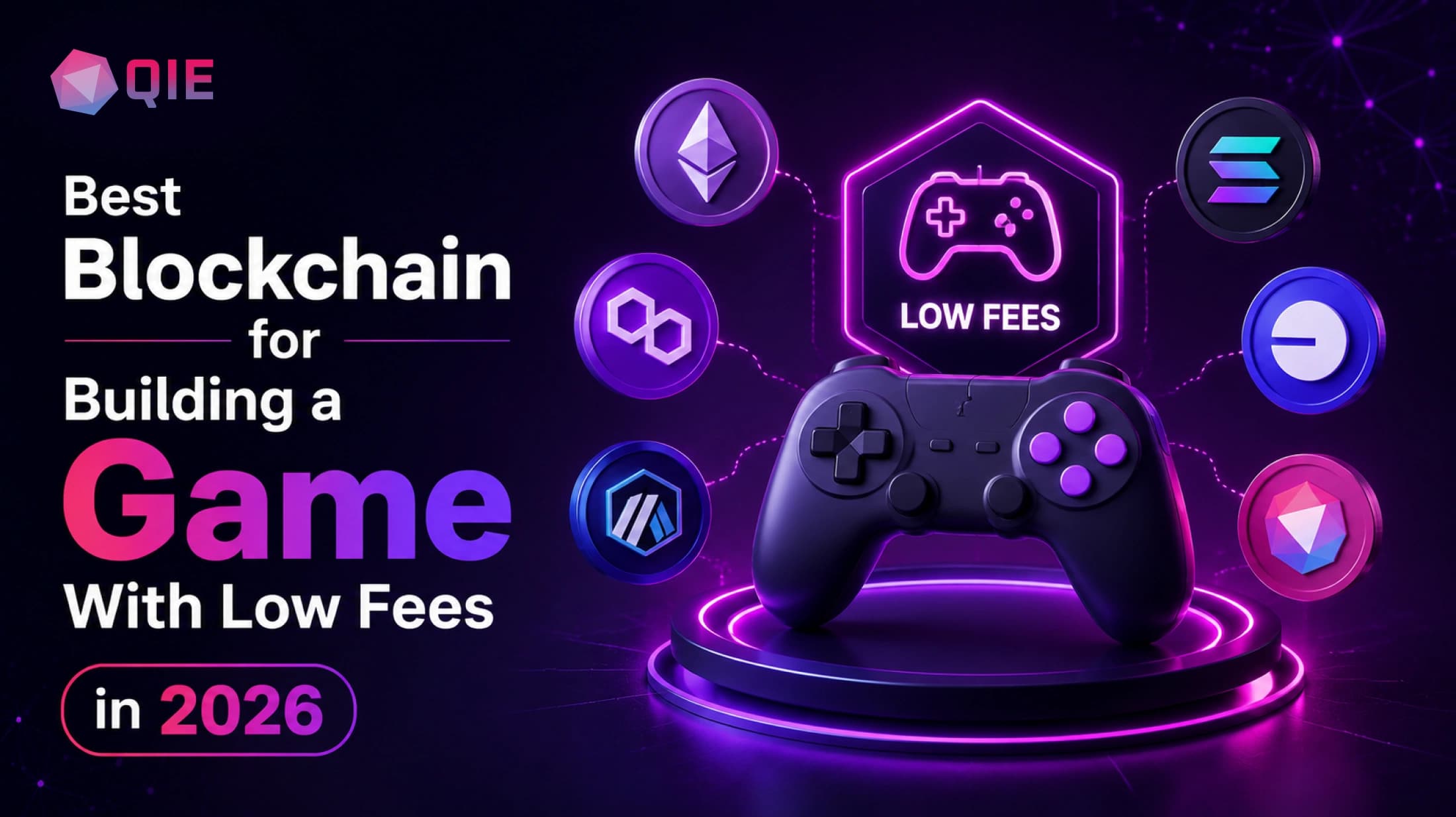
For the best blockchain for building a game with low fees in 2026, QIE Blockchain, Solana, and Ronin lead the field, each for distinct reasons. QIE combines EVM compatibility with near-instant finality and a deflationary tokenomics burn that structurally suppresses fee spikes.
Solana delivers extremely low transaction costs with high retail adoption and a liquid NFT ecosystem. Ronin offers a gaming-native EVM chain with sponsored gas for players. Polygon, Immutable X, and Oasys round out the landscape with their own tradeoffs.
The Broader Landscape
The top gaming blockchains in 2026 have each carved out a defensible position, and the market is no longer converging on a single winner. The better frame is specialization:
- QIE Blockchain: near-zero fees, full EVM compatibility, deterministic finality, and native identity for high-frequency Web3 games
- Immutable: built for NFT economies
- Ronin: built for player retention, now backed by Ethereum L2 security
- Polygon: EVM pragmatism at low cost
- Avalanche: subnet architecture for AAA infrastructure
- Solana: high-frequency performance at the cost of EVM compatibility
Each comes with a real cost:
- Solana’s non-EVM architecture requires Rust, so your Solidity contracts don't port
- Avalanche’s subnet architecture can also fragment liquidity, as each subnet operates as its own ecosystem
What cuts across all options is the imperative to minimize bridge exposure. The industry's worst incidents have all involved cross-chain asset movement, and Ronin's $625M bridge exploit in 2022 remains the clearest proof of that risk.
How QIE's Fee Mechanics and Throughput Serve Real-Time Gameplay
QIE Blockchain is a production-ready Layer 1 that provides a high-performance Web3 identity layer with near-instant finality and up to 25,000 transactions per second.
The QIE wallet, DEX, ID system, QIE Pass, and QIE lottery are all live today, which means the infrastructure has been stress-tested against real transaction loads, not just benchmarked in a controlled environment.
The Burn Mechanism That Kills Fee Spikes
Most chains with low average fees still spike under load because validators can extract more during congestion. QIE's deflationary tokenomics model burns 80% of the base fee on every transaction.
Think of it like a pressure valve: the more activity on the network, the more tokens leave circulation permanently, which means validators can't raise the base fee to capture congestion premiums the way they can on demand-driven chains. Costs stay predictable at scale, not just when the network is quiet.
Ethereum fees spiked to $8.50 during RWA tokenization events in 2025 (arXiv), driving users to alternative chains. That's the scenario a game studio can't survive. A viral moment that should be your best day becomes the day your players churn.
EVM Tooling: Port Your Contracts, Not Your Team
QIE is a fully EVM-compatible blockchain, which means Solidity contracts, Hardhat, Remix, and Truffle all work without modification. ERC-721 and ERC-1155 are natively supported, so in-game NFT systems, liquid NFT marketplaces, and composable asset standards transfer directly from any existing Ethereum-based project.
A studio that has already built on Ethereum or Polygon can deploy to QIE in days. You're not retraining your team on Move or Rust. The delegated proof-of-stake consensus keeps validator overhead lean while maintaining the security guarantees your players expect.
Identity as a Game Mechanic
QIE Pass gives players one verified identity across every dApp on the network, eliminating the repetitive wallet-address friction that breaks onboarding. A new player signing into your game doesn't need to configure a fresh wallet, pass KYC again, or manage separate credentials.
Seed phrases, manual wallet setups, and gas fee anxiety have historically kept mainstream gamers away from Web3; QIE removes that friction at the infrastructure level.
For integration, QIE developer documentation, testnet access, and grant programs for developers are available.
What Criteria Should You Weigh When Choosing a Game Blockchain?
The right framework for a dApp development platform in gaming covers six dimensions. Here's how the leading chains stack up against each one.
| Criterion | QIE Blockchain | Solana | Ronin | Polygon |
|---|---|---|---|---|
| TPS (concurrent players) | ~25,000 | ~65,000 theoretical | Gaming-optimized, OP Stack L2 throughput | 7,000–10,000 |
| Fee predictability | 80% burn, no spike model | Low avg, priority fee spikes possible | Sponsored gas (Waypoint) | Sub-$0.01, demand-sensitive |
| EVM / Solidity support | Full EVM + Cosmos | Non-EVM (Rust) | Full EVM | Full EVM |
| NFT standards | ERC-721 / ERC-1155 | Metaplex (non-standard) | ERC-721 / ERC-1155 | ERC-721 / ERC-1155 |
| Identity / onboarding | QIE Pass (native) | Wallet-dependent | Ronin Waypoint | Wallet-dependent |
| Developer tooling | Hardhat/Remix native | Rust SDK | Unity + Unreal SDK | Hardhat/Remix native |
| Grant program | Developer-focused grants | Solana Foundation grants | Immutable perpetual rewards | Polygon Village grants |
Fee Predictability vs Fee Average
Most developers make the mistake of optimizing for average fee rather than fee variance. Solana's averages sit around $0.017 per transaction as of early 2026, but that figure masks what happens during a popular tournament weekend, when a competitive match triggering 50 on-chain actions can become unplayable if priority fees surge.
The spike is the number that matters for a game, and averages hide it.
Bridge Security: The Underappreciated Kill Switch
Bridge risk exposure is the most important and most underappreciated factor in this decision. Billions of dollars have been stolen from cross-chain bridge contracts, and game economies that require frequent bridging inherit that risk directly.
QIE's native EVM and Cosmos compatibility removes reliance on cross-chain bridges entirely, keeping your game economy on a single chain without sacrificing interoperability.
Developer Support Programs
Solana's developer grants run through the Solana Foundation. Immutable offers a developer incentive program with perpetual rewards for studios, along with Unity and Unreal Engine integration for cross-platform play.
QIE’s testnet and grant program are specifically designed for indie studios that want to validate economics before committing to mainnet. For a broader comparison of what each chain offers developers, see this guide to the best blockchain for developers.
One thing worth keeping in mind: the chains with the most aggressive grant programs often have the least stable developer ecosystems. Grants attract builders, but tooling that works on day one, documentation that doesn’t require a Discord deep-dive, and a fee model you can explain to your players without a whitepaper are what actually retain them.
Conclusion
For a game studio, the chain that "looks cheapest" on a benchmark chart and the chain that actually protects your economy during a viral event are often different chains. Solana’s raw throughput and NFT liquidity are real, but the Rust rewrite and priority-fee spikes during peak demand are real costs too.
Ronin's move onto Ethereum as an L2 strengthens its security story but ties its cost structure more closely to Ethereum's data-posting market going forward. Polygon and Avalanche each solve part of the problem while introducing their own fragmentation or centralization tradeoffs.
QIE's case rests on one structural difference: the 80% fee burn is designed specifically to prevent the spike-under-load pattern that breaks gaming sessions, while full EVM compatibility means a Solidity-based studio can port a game in days rather than months.
Before you commit to any chain, run the session math on your own game: on-chain actions per session × peak concurrent players × fee at peak load (not average load).
If you're already building in Solidity and want to test that math against near-zero, predictable fees under real conditions, deploy to QIE’s testnet before committing to mainnet.
Frequently Asked Questions
Minting an NFT on Ethereum can cost $20–$100 in gas, while on Solana you can mint for fractions of a penny. QIE's 80% base-fee burn keeps minting costs near-zero and structurally resistant to the spikes that hit Solana during high-demand events like popular NFT launches.
Estimate your expected on-chain actions per player, multiply them by your peak concurrent users, and calculate costs using the blockchain's peak transaction fee, not its average fee. For example, if your game processes 20 on-chain actions per session with 5,000 concurrent players, you'll generate around 100,000 transactions during that period. A network with stable, predictable fees makes those costs easier to forecast, while chains with frequent fee spikes can significantly increase operating costs during peak demand.
QIE Blockchain provides approximately 3-second deterministic finality, allowing in-game asset transfers, marketplace trades, and gameplay actions to settle quickly without noticeable delays. Fast finality is especially important for competitive multiplayer games, real-time economies, and frequent player interactions where waiting for confirmations can disrupt the gameplay experience.
Directly, without rewriting. QIE is a fully EVM-compatible blockchain, so any contract written in Solidity and tested with Hardhat or Truffle deploys as-is. Solana requires Rust, and Sui uses Move, which offers strong asset-level security but carries a steep learning curve for teams already invested in Ethereum tooling.
Integration documentation is available at https://docs.qie.digital. Developers can access the testnet at qie.digital/faucet and apply for grants at qie.digital/developer. The grant program is designed for game developers that want to validate their in-game economy before committing to mainnet deployment.
Optimizing for average fee rather than fee variance. A chain that averages $0.001 per transaction but spikes to $1.50 during a popular event will destroy player retention exactly when you need it most. The fee burn mechanism, not the headline average, determines whether your game economy stays playable at scale.