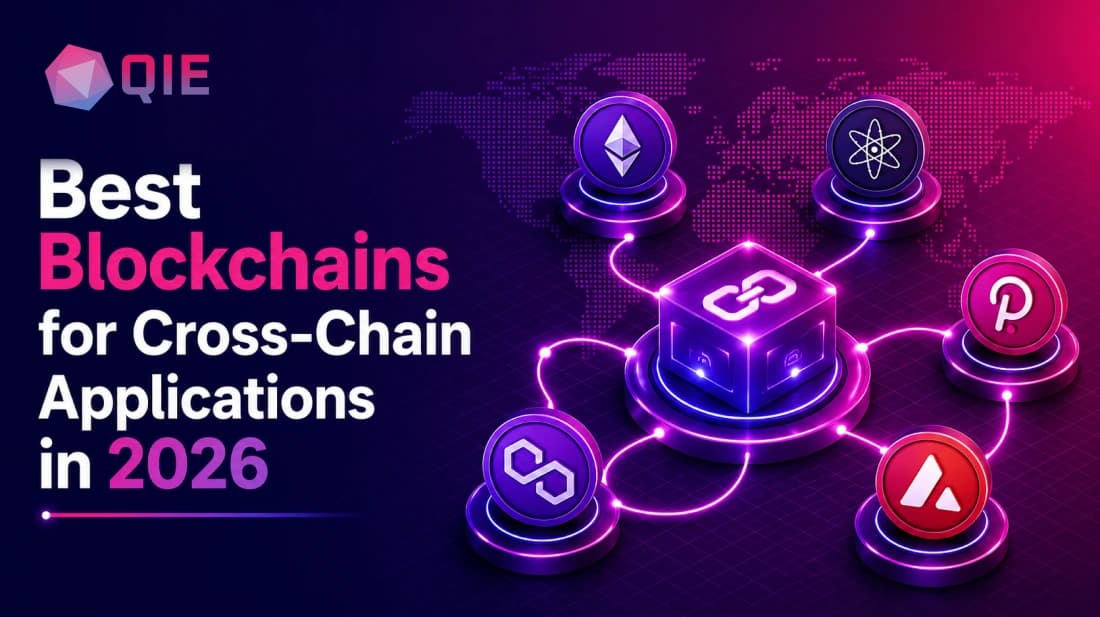
A DeFi protocol on Ethereum may want to access liquidity on Cosmos, while a gaming application may need to move assets or messages between Ethereum and Avalanche. Because blockchains do not share a common execution environment, developers need interoperability infrastructure to connect them.
Choosing the right blockchain for cross-chain applications in 2026 depends on its interoperability model, security assumptions, finality, transaction costs, liquidity, scalability, and developer tooling.
The best option is not necessarily the fastest chain. It is the one that provides the right balance of connectivity, security, and usability for the application.
Quick Answer
The Shortlist
- QIE: Best for EVM + native IBC connectivity
- Cosmos: Best for IBC-native applications and appchains
- Ethereum: Best for liquidity and developer ecosystem
- Polkadot: Best for native interoperability through XCM
- Avalanche: Best for customizable, high-performance L1s
Choose based on the chains you need to connect, security model, finality, fees, liquidity, and developer tooling, not TPS alone.
Why Cross-Chain Interoperability Matters in 2026
Blockchain interoperability allows separate networks to exchange data, assets, messages, or instructions without requiring them to share the same underlying blockchain.
The security model varies by implementation and can involve light clients, validator sets, oracle networks, multisig schemes, or other verification mechanisms.
Without interoperability, applications are often limited to the users, assets, and liquidity available on a single network. Cross-chain infrastructure allows developers to expand across ecosystems while choosing how much security, latency, cost, and complexity they are willing to accept.
Key Cross-Chain Interoperability Mechanisms
Most cross-chain applications rely on one of three broad approaches:
- Bridges: transfer assets between networks using mechanisms such as lock-and-mint, burn-and-mint, lock-and-unlock, or liquidity-based settlement. Their security depends on how the bridge verifies the source chain and protects the assets or messages being transferred.
- Native interoperability: protocols such as IBC and Polkadot’s XCM provide native communication within compatible blockchain ecosystems. These approaches can reduce reliance on externally managed bridge contracts, although their security and capabilities depend on the underlying implementation.
- Cross-chain messaging protocols: systems such as Chainlink CCIP allow applications to send messages and transfer tokens between supported networks using additional verification infrastructure. They can provide broader connectivity but introduce their own costs and trust assumptions.
The right approach depends on the chains you need to connect, the security assumptions you can accept, and whether cost, latency, liquidity, or network coverage is the primary constraint.
What Makes a Blockchain Good for Cross-Chain Applications?
A strong cross-chain blockchain should be evaluated across several factors:
| Criterion | What to measure | Why it matters |
|---|---|---|
| Interoperability | Native protocols and supported networks | Determines how easily applications can communicate across chains |
| Security | Verification model, validator distribution, audits | Determines the trust assumptions behind cross-chain transactions |
| Chain support | Connected ecosystems and assets | Determines potential reach and liquidity |
| Finality | Time to reliable transaction finality | Affects confirmation speed and cross-chain UX |
| Transaction cost | Network and cross-chain fees | Important for frequent or low-value transactions |
| Liquidity | TVL and available trading liquidity | Affects swaps, slippage, and capital efficiency |
| Developer tooling | SDKs, APIs, documentation, libraries | Reduces development and integration effort |
| Adoption | Active applications and users | Provides network effects and ecosystem support |
| Scalability | Throughput and performance under load | Determines whether the network can support growth |
Finality and bridge security are related but distinct. Faster, reliable finality can reduce confirmation delays, but cross-chain security also depends on how the destination chain verifies the source chain and how validators, light clients, or oracle networks are secured.
Developers should evaluate both rather than treating transaction speed as a proxy for interoperability security.
Best Blockchains and Protocols for Cross-Chain Applications
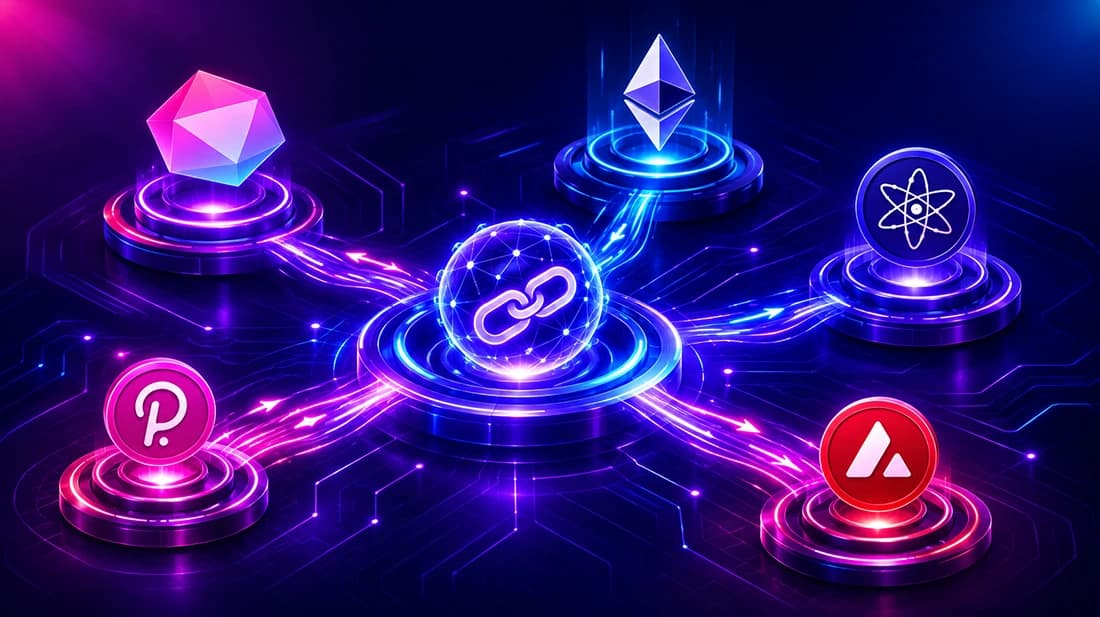
One framing note before the comparison: these selections operate at different layers of the blockchain stack. QIE, Ethereum, Cosmos-based chains, and Avalanche L1s are Layer 1 networks, while Polkadot provides a broader Layer 0 architecture with interoperable connected chains.
The comparison therefore focuses on how each ecosystem supports cross-chain applications rather than treating them as identical technologies.
QIE Blockchain
Best for: developers who want EVM compatibility, native IBC connectivity, and blockchain-based identity infrastructure in one ecosystem.
QIE is a Layer 1 blockchain designed to combine Ethereum-compatible development with Cosmos-based infrastructure and IBC connectivity. Developers can deploy Solidity-based applications while using IBC for communication with compatible chains, reducing the need to rely exclusively on external bridges for supported routes.
QIE’s developer environment supports familiar EVM tooling, including Hardhat, alongside its Cosmos SDK-based infrastructure. Its ecosystem also includes applications and services designed around the QIE network.
Limitation: QIE has a newer and smaller ecosystem than Ethereum, Cosmos, Polkadot, and Avalanche, so developers should evaluate available integrations, liquidity, audits, and third-party infrastructure for their specific use case.
Cosmos
Best for: sovereign application chains that need native interoperability through IBC.
The Cosmos ecosystem is built around independent application-specific blockchains that can communicate through the Inter-Blockchain Communication protocol (IBC). IBC uses light-client verification and relayers to authenticate packets between compatible chains.
IBC has historically been concentrated among Cosmos-based networks, but newer developments such as IBC Eureka are extending the protocol to additional blockchain environments, including Ethereum. This gives developers a broader path toward interoperable applications while retaining IBC’s verification model.
Limitation: liquidity and users remain distributed across individual chains, and developers must evaluate connectivity, application support, and liquidity separately for each ecosystem they target.
Ethereum
Best for: applications that prioritize liquidity, ecosystem depth, and access to the largest EVM developer community.
Ethereum remains one of the most important networks for cross-chain applications because of its deep DeFi liquidity, large developer ecosystem, and broad adoption. Many cross-chain protocols and applications support Ethereum as a major source or destination network.
Ethereum does not provide a native general-purpose interoperability protocol comparable to IBC or Polkadot XCM, so applications connecting Ethereum to other ecosystems often rely on bridges or cross-chain messaging infrastructure.
Limitation: base-layer transaction costs and confirmation requirements can make frequent cross-chain activity more expensive or slower than on high-throughput networks.
Polkadot
Best for: applications that need native interoperability between chains within the Polkadot ecosystem.
Polkadot uses Cross-Consensus Messaging (XCM) to allow compatible chains to exchange messages and interact with assets and applications without relying on an external bridge for communication within the ecosystem. Its shared-security architecture provides a common security foundation for connected chains.
For applications that need to interact with networks outside the Polkadot ecosystem, additional interoperability infrastructure may still be required.
Limitation: Polkadot’s architecture can be more complex for developers who are accustomed to standard EVM-only environments, and external ecosystem connectivity may require additional infrastructure.
Avalanche
Best for: developers building customizable, high-performance application-specific L1s.
Avalanche allows developers to create application-specific L1 networks with customizable validator and execution requirements. Its EVM compatibility makes the ecosystem accessible to Ethereum developers, while Avalanche’s native interoperability infrastructure supports communication between compatible Avalanche networks.
Limitation: developers targeting ecosystems outside Avalanche may still need additional bridge or messaging infrastructure, and the interoperability model is less universal than protocols designed specifically for broad cross-chain communication.
Best Blockchains for Cross-Chain Applications Compared
| Chain | Best for | Interoperability | EVM compatible | Finality / settlement | Key limitation |
|---|---|---|---|---|---|
| QIE | EVM + IBC + identity infrastructure | Native IBC | Yes | ~1-2 second finality | Smaller ecosystem and fewer third-party integrations |
| Cosmos ecosystem | IBC-native application chains | IBC | Depends on chain | Chain-dependent | Liquidity and users are distributed across individual chains |
| Ethereum | Liquidity and developer ecosystem | No native general-purpose cross-chain protocol | Yes | ~12-second block time; ~15-minute finality | Cross-chain applications often require external interoperability infrastructure |
| Polkadot | Interoperability between connected Polkadot chains | XCM | Depends on connected chain | Chain-dependent | More complex architecture; external ecosystems require additional infrastructure |
| Avalanche | Custom application-specific L1s | Avalanche native interoperability | Yes | Fast, chain-dependent | Broader external connectivity may require additional infrastructure |
Which Cross-Chain Interoperability Approach Should You Use?
The right architecture depends on three questions:
- 1Which chains must your application connect?
- 2What security assumptions are acceptable?
- 3Is cost, latency, liquidity, or network coverage the primary constraint?
Bridges: Broad Chain Coverage
Bridges can connect networks that do not share a native interoperability protocol. Their designs vary, including lock-and-mint, burn-and-mint, lock-and-unlock, and liquidity-based models. Security depends on how the bridge verifies transactions and protects assets or messages.
For high-value applications, evaluate the bridge’s verification model, validator or oracle design, audit history, upgrade controls, and history of incidents before integrating it.
Native IBC: Interoperability for Compatible Chains
IBC is well suited to applications operating across compatible IBC-enabled networks. IBC uses light-client verification to allow compatible destination chains to verify cross-chain packets based on the source chain’s state.
If your application needs to reach networks outside the IBC ecosystem, you may need an additional interoperability layer.
Cross-Chain Messaging: Broader Application Connectivity
Messaging protocols such as Chainlink CCIP provide infrastructure for sending messages and transferring tokens between supported networks. They can be useful when applications need to connect heterogeneous ecosystems without implementing separate integrations for every chain.
The trade-off is additional infrastructure, fees, and trust assumptions that developers need to evaluate alongside the protocol’s security model.
How to Choose a Cross-Chain Interoperability Solution
- Need the broadest possible chain coverage: consider a bridge or cross-chain messaging protocol with strong security controls.
- Connecting compatible IBC networks: native IBC is often the simplest option.
- Building within the Polkadot ecosystem: XCM provides native cross-chain communication.
- Need EVM compatibility plus IBC: consider an EVM-compatible IBC-enabled chain such as QIE.
- Need deep DeFi liquidity: Ethereum remains a major starting point for liquidity-intensive applications.
- Building a customizable application-specific network: Avalanche can be a strong fit.
Conclusion
The best blockchain for cross-chain applications depends on the networks you need to connect and the security model your application requires. QIE is a strong option for developers who want EVM compatibility with native IBC connectivity, while Cosmos, Ethereum, Polkadot, and Avalanche each offer distinct interoperability strengths.
Evaluate interoperability, security, finality, liquidity, fees, and developer tooling before choosing the network that fits your use case.
Key Takeaways
- QIE: a strong fit for developers who want EVM compatibility and native IBC connectivity in one Layer 1.
- Cosmos: best suited to application-specific chains and applications built around IBC interoperability.
- Ethereum: a leading choice when liquidity, adoption, and EVM ecosystem depth are the priority.
- Polkadot: strong for native interoperability between connected Polkadot chains through XCM.
- Avalanche: well suited to customizable, high-performance application-specific L1s.
- Native interoperability can reduce reliance on externally managed bridges, but every architecture has different security, cost, and connectivity trade-offs.
- The best cross-chain blockchain is determined by the networks you need to connect, the security model you can accept, and the application’s requirements for liquidity, latency, cost, and scalability.
Ready to test IBC-native development? Explore the QIE developer documentation and start building on QIE Testnet.
Frequently Asked Questions
A blockchain executes transactions and maintains application state. An interoperability protocol allows separate blockchains to exchange messages, assets, or data. Ethereum, QIE, Avalanche, and Cosmos-based chains are examples of blockchain networks, while IBC and XCM are interoperability protocols.
Yes. If the target networks support a compatible native interoperability protocol such as IBC or XCM, an application may communicate across those networks without relying on a traditional pooled-asset bridge. The exact capabilities depend on the chains and interoperability implementation.
Major risks include smart-contract vulnerabilities, validator or oracle compromise, weak verification assumptions, upgrade-key risks, source-chain reorganization, and liquidity or accounting failures involving wrapped assets. Developers should evaluate the complete cross-chain security model rather than relying on audits alone.
If the target chains support compatible IBC infrastructure, IBC can reduce reliance on externally managed bridge contracts. If one or more target networks are outside the IBC ecosystem, a bridge or messaging protocol may be necessary. Compare the verification model, validator or oracle design, audits, upgrade controls, fees, and supported chains before choosing.
Ethereum remains one of the deepest sources of DeFi liquidity, while ecosystems such as Cosmos, Avalanche, and others provide liquidity through their own applications and connected networks. Actual liquidity varies by asset, protocol, and market conditions, so developers should evaluate current TVL and pool depth rather than relying on a single ecosystem-wide figure.
No. Native interoperability can reduce additional bridge fees and infrastructure costs, but total costs depend on the source and destination chains, transaction fees, relayer costs, messaging infrastructure, and the specific implementation. Compare the complete cost of each route rather than assuming one model is always cheaper.