Sending money abroad is still slow and expensive for most people. Banks add fees at every step, and a transfer can take days. Blockchains can move value in seconds for a fraction of a cent.
This guide compares seven chains for cross-border payments and remittances on fees, finality, stablecoin support and cash-out reach, and shows where the real costs hide.
Quick Answer
Blockchain in cross border payments works like this: a cross border payments blockchain sends stablecoins from one wallet to another in seconds, with no chain of banks in between. A good blockchain for payments keeps the network fee tiny, so your real cost and wait sit at the two ends: buying the stablecoin and cashing it out. Here is what matters:
The Shortlist
- Speed: USDC on Base or Solana settles in roughly 2 to 10 seconds for under $0.01, against 1 to 5 business days and $15 to $50 for a SWIFT wire.
- Cost: the World Bank puts the average remittance cost at 6.36%, or about $12.72 on $200. A SWIFT wire takes 7.5% to 25% of the same $200.
- Best for cash-out: Stellar, with USDC cash-out at MoneyGram in 170+ countries.
- Best for very fast, cheap confirmation: Solana (median fee about $0.001) and Base (under one cent).
- Best for USDT: Tron, though fees vary a lot between casual and regular users.
- QIE Blockchain: about $0.0001 per transfer and 1 to 2 seconds finality. It supports QUSDC, a 1:1 representation of USDC on QIE, and readable .qie names instead of long addresses.
Before you send: check that the receiver’s exchange supports the same stablecoin on the same network, and send a small test first.
Why sending money abroad is slow and costly
Traditional cross-border payments pass through several banks. Each one adds a fee and a delay. That is why remittance fees stay high.
Remittance fees are everything you pay to send money abroad. That includes the transfer fee, plus the gap between the real exchange rate and the rate you are given.
Here are the numbers:
- The World Bank reports that sending remittances costs an average of 6.36% of the amount sent (data as of August 2025). On $200, that is about $12.72.
- One analysis from Eco puts a SWIFT wire at 1 to 5 business days and $15 to $50 per transfer. On a $200 transfer, that is 7.5% to 25%.
| Method | Typical cost | Speed | Who it suits |
|---|---|---|---|
| Bank wire (SWIFT) | $15 to $50 per wire | 1 to 5 business days | Large, one-off transfers |
| Money transfer or payment app | About 6.36% on average (World Bank, all channels) | Minutes to days | People without a crypto wallet |
| Stablecoin on a fast chain | Under $0.01 network fee, plus exchange and cash-out fees | Roughly 2 to 10 seconds on-chain | People and businesses who can use wallets |
A cross border payments solution built on a blockchain skips most of those hops. The network fee is tiny. The real costs move to the two ends: buying the stablecoin and cashing it out.
How blockchain in cross border payments works
If you are asking how does remittance work with crypto, the idea is simple. A cross border payments blockchain replaces the chain of banks with one shared network.
A stablecoin is a digital token pegged to a currency, usually the US dollar. It holds its value, so it acts like digital cash.
In four steps:
- 1The sender buys or deposits a stablecoin, such as USDC or USDT.
- 2The sender sends it to the receiver’s wallet.
- 3The chain confirms the transfer. This is finality, the point where the payment cannot be reversed.
- 4The receiver cashes out to local money through an exchange, an agent or an app.
Steps 1 and 4 are where most of the cost and delay live. This is why digital remittance services focus on easy on-ramps and off-ramps. An on-ramp turns local money into crypto. An off-ramp turns crypto back into local money.
For a family sending rent money, a stablecoin is the safer choice, since it does not swing in price the way Bitcoin does. This is how stablecoin remittances work in practice.
On-ramps and off-ramps: where transfer costs add up
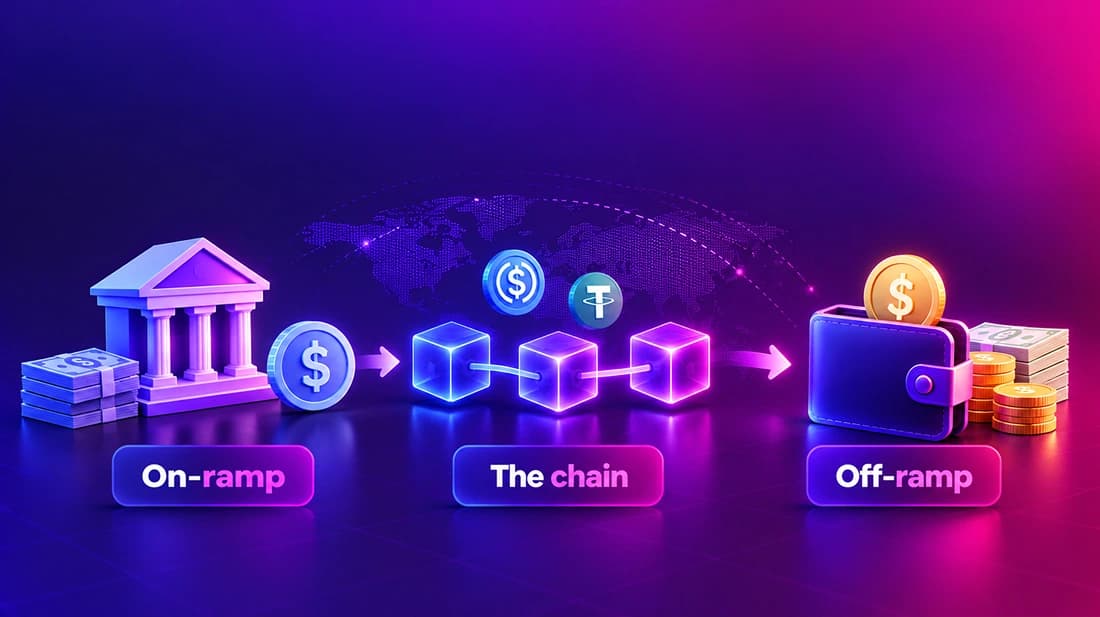
A blockchain payments system has three parts: the on-ramp, the chain and the off-ramp. Most of the cost and delay sit at the two ends.
- On-ramp: the service that turns local money into a stablecoin. It might be an exchange, a card purchase or a bank transfer. You pay a spread and sometimes a fee.
- The chain: the network that moves the stablecoin. This is the fast, cheap part, often under one cent.
- Off-ramp: the service that turns the stablecoin back into local money. This might be an exchange, a local agent or a card. Fees, limits and speed vary a lot by country.
This is why a chain with a huge cash-out network can beat a chain that is a few milliseconds faster. For an international remittance, a receiver who cannot cash out cheaply gets little value from a one-second transfer.
When you plan a corridor, check the off-ramp first. Ask three things: which local exchanges or agents accept the stablecoin on that chain, what they charge, and how long withdrawals take.
What makes a blockchain good for cross-border payments?
When you choose a blockchain for payments, judge any chain on six points:
- Fee: what the network charges per transfer.
- Finality: how fast the payment becomes final.
- Stablecoins: whether USDC or USDT run on the chain.
- Cash-out reach: how many countries have easy off-ramps.
- Wallet experience: how easy it is to send and receive.
- Rules: local regulation and exchange support.
7 best blockchains for cross-border payments compared
This table covers seven chains, with QIE Blockchain first. Where a figure is not published by the source, it says so.
| Chain | Typical fee | Time to finality | Stablecoins | Cash-out reach | Best for | Main limit |
|---|---|---|---|---|---|---|
| QIE Blockchain | About $0.0001 | 1 to 2 seconds | QUSDC: a 1:1 representation of USDC on QIE, bridged from Ethereum | On-ramp: buy crypto with a card or bank transfer in QIE Wallet. Exit: bridge to Ethereum or BNB Smart Chain in about 2 minutes. | Sending to a readable .qie name with built-in identity | Newer ecosystem |
| Stellar | Under one cent | About 5 seconds | USDC and EURC issued by Circle | USDC cash-out at MoneyGram in 170+ countries | Cash-in and cash-out in local currency | Fewer DeFi apps |
| XRP Ledger | 0.00001 XRP default | 3 to 5 seconds | Issued tokens, including stablecoins | Through partners and exchanges | Fast, low-cost settlement for institutions | Issuers can set transfer fees on tokens |
| Tron | Varies with energy (staking vs burning TRX) | Blocks every 3 seconds, about 57 seconds to full finality | USDT-heavy | Wide USDT support on exchanges | USDT transfers in emerging markets | Fees vary a lot between users |
| Solana | Median about $0.001 | About 0.5s confirmed, about 12.8s finalized | USDC and other major stablecoins | Broad exchange support | Very fast, very cheap transfers | Full finality takes longer than confirmation |
| Base (Ethereum L2) | Under one cent | About 2s blocks, 200ms preconfirmation | USDC | Through Coinbase and Ethereum tools | Apps in the Ethereum ecosystem | L1 data fee component can vary |
| Polygon | Fractions of a cent | 2 to 5 seconds | Major stablecoins | Wide wallet and exchange support | Low fees with wide support | Fees are paid in POL |
For a deeper look at speed, see our fastest blockchains by TPS and finality comparison.
Pros and cons of each blockchain
1. QIE Blockchain: Low fees, EVM compatibility, and readable wallet names
QIE combines very low transaction fees, EVM compatibility, 1 to 2 second finality, readable wallet names through QIE ID, and identity features through QIE Pass.
In January 2026, QUSDC was announced as a 1:1 representation of USDC on QIE, created by bridging USDC from Ethereum. Circle remains the issuer of USDC. You can trade QUSDC on QIEDEX or hold it in QIE Wallet.
The wallet also supports crypto purchases by bank card or bank transfer through Alchemy Pay. To move assets between networks, the QIE bridge connects QIE with Ethereum and BNB Smart Chain, with transfers taking around two minutes.
Watch out for: Check the available withdrawal options in your country before using QIE for remittances.
2. Stellar
Stellar is designed for payments, with transaction finality in about five seconds and fees below one cent, according to its cross-border payments page. Its integration with MoneyGram supports converting USDC into local currency in more than 170 countries, giving users an established cash-out route in supported markets.
Watch out for: Stellar has a smaller range of apps than major Ethereum-compatible ecosystems. Check whether the wallet, stablecoin, and cash-out service you need are available in your destination country.
3. XRP Ledger
The XRP Ledger typically finalizes transactions in around 3 to 5 seconds once a ledger version is validated. Its default transaction fee is 0.00001 XRP, making the base network cost low.
Watch out for: Some token issuers can charge additional transfer fees. Review the terms of the specific token you plan to send, including the XRP Ledger’s transfer fee mechanism.
4. Tron
Tron is a popular network for USDT transfers. Eco estimates that approximately $92.3 billion in USDT is on the network. Its widespread use makes it a familiar option for users and exchanges that support TRC-20 USDT.
Watch out for: Transaction costs depend on how you obtain the network resources needed to send funds. Users who stake TRX may have access to resources that reduce direct fees, while others may need to burn TRX. Your actual cost can vary based on your account and transaction.
5. Solana
Solana supports fast stablecoin transfers. Its payments documentation describes funds being secured in about 400 milliseconds, with a median transaction fee near $0.001. This refers to fast confirmation, not full finalization, which takes around 12.8 seconds under the conditions described here.
Watch out for: Confirm that the recipient’s wallet or exchange supports the specific stablecoin on Solana. Support for the same token on another network does not mean it can be deposited using Solana.
6. Base
Base is an Ethereum Layer 2 network that supports applications built with Ethereum development tools. Its preconfirmations can arrive in about 200 milliseconds, providing quick initial feedback that a transaction is being processed.
Watch out for: Transaction costs include an Ethereum Layer 1 data fee as well as other applicable fees. The total can vary with network conditions, so check the estimated cost before sending funds.
7. Polygon
Polygon offers low-cost transactions and support across a wide range of wallets and applications, making it an option for users who need to move supported assets between services.
Watch out for: Transactions require POL to pay network fees. If your wallet does not have enough POL, the transfer may fail even if you have enough of the token you want to send.
For developers looking to reduce transaction costs when building on-chain applications, see how to build low-gas-fee dApps.
USDC vs. USDT: which stablecoin should you use?
USDC is more common in the US, EU and much of APAC, while USDT is more common in LATAM and Africa. The right choice is the one your receiver’s exchange or agent supports. Ask before you send.
Stablecoin remittances work best when both sides use the same coin on the same network. For a full guide to fees, finality and compliance on stablecoin rails, see our best blockchain for stablecoin payments guide.
Send crypto using a name instead of a wallet address
A wallet address is a long string of letters and numbers. One wrong character can send money to the wrong place.
A QIE ID is a readable name such as alice.qie, tied to your wallet. It replaces a long wallet address with a name that is easy to share and check. QIE Domains work as a universal payment address with memorable wallet addresses.
QIE Pass adds identity. It offers one-time KYC verification that partner platforms can reuse, with single sign-on for Web3 apps.
This helps when sending money to family, because you can confirm the name before you send. It works inside the QIE ecosystem, so the receiver needs a QIE wallet.
Blockchain for business payments: use cases and considerations
A business that moves money abroad often looks for a cross border payments platform or cross border payments solution. There are two routes:
- Use a provider. A payments company handles licenses, wallets and cash-out for you. This is faster to launch.
- Build on a chain. You run your own flows with stablecoins and smart contracts. This gives more control and more work.
Before you choose, check five things: which countries you can pay into, which stablecoins your partners accept, who handles KYC and AML checks, how you reconcile payments, and what the off-ramp costs. Stablecoin payments can also settle at any hour, so treasury teams can move money outside bank hours.
Instant cross border payments are possible on-chain. Cash-out still depends on local banks and agents, so test one corridor before you scale.
Businesses also ask about speed and cost for payroll, supplier payments and marketplace payouts. These flows benefit most from blockchain payments because they are frequent and low value, so a bank fee of $15 to $50 hurts. They also need predictable fees, clear records and a plan for stablecoin price risk. Start with one corridor, one stablecoin and a small monthly volume. Measure the total landed cost against your current bank route, then widen.
5 mistakes to avoid when sending crypto abroad
Most losses come from small mistakes, not from technology.
- 1Wrong network. USDT on Tron and USDT on Ethereum are different. If the receiver’s exchange only accepts one, the other can be lost.
- 2Wrong address. One wrong character sends money to the wrong place. Copy and paste, and send a small test first.
- 3Unsupported token. Some exchanges accept a stablecoin on one chain but not another. Check before you send.
- 4Ignoring the spread. The exchange rate you are shown may differ from the market rate. Compare the total received, not just the fee.
- 5Skipping the rules. Some exchanges ask for ID or limit transfers. Check the rules on both sides.
A small test transfer takes a minute and prevents most of these.
Crypto remittance risks and regulations
Local rules differ. Exchanges ask for ID checks, and some countries limit crypto transfers.
- Stablecoin risk. A stablecoin can lose its peg. Hold only what you need, and use well-known issuers.
- Scams. Check names and addresses twice, and never share your recovery phrase.
- Tax. Some countries tax crypto transfers or gains. Check local rules.
This is not financial or legal advice. Check the law where you live and where you send.
Conclusion
On the chain leg, crypto remittances are fast and cheap, and digital remittance services built on stablecoins are getting easier to use. In the end, cost and speed depend on exchanges and cash-out partners.
QIE Blockchain offers very low fees with readable names and reusable identity, Stellar offers the strongest cash-out network today, Solana and Base offer very fast confirmations, and Tron carries most USDT.
Pick a chain by cash-out reach, fees and your country’s rules. For related reading, see the best blockchains for fintech, the best blockchains for micropayments and the best blockchain for stablecoin payments.
Key Takeaways
- A SWIFT wire runs 1 to 5 business days and $15 to $50. USDC on Base or Solana settles in roughly 2 to 10 seconds for under $0.01.
- Your real cost is the exchange spread and the cash-out fee, not the network fee.
- Choose the chain by cash-out reach and local rules, then by fees and speed.
- Stellar offers MoneyGram cash-out in 170+ countries. Solana confirms in about half a second.
- QIE IDs such as alice.qie make sending safer by replacing long addresses.
Ready to try it? Create a QIE Wallet and send a small test transfer using a .qie name instead of a long wallet address.
Frequently Asked Questions
It depends on your needs. Stellar offers USDC cash-out through MoneyGram in 170+ countries. Solana confirms in about half a second with a median fee near $0.001. QIE offers readable .qie names and QIE Pass identity. Pick the chain your receiver can cash out from.
You buy a stablecoin, send it to the receiver’s wallet, and the receiver cashes out to local money. The on-chain transfer takes seconds. Buying and cashing out add the real cost and wait.
For the network fee, a stablecoin on a fast chain is usually cheapest. Eco’s comparison puts a SWIFT wire at $15 to $50 against under $0.01 on-chain. Exchange spreads and cash-out fees still apply, so compare the total.
Often, yes, for the network fee. The World Bank puts the average remittance cost at 6.36%. The total with crypto depends on your exchange and cash-out costs. A small transfer can still be cheaper on-chain.
The one your receiver can cash out. USDC is more common in the US, EU and much of APAC, and USDT is more common in LATAM and Africa, per Arbitrum.
An international remittance is money a person sends to someone in another country, often to family. A crypto remittance does the same job by sending a stablecoin instead of moving money through banks. The receiver then cashes out to local money.
In many countries, yes, but rules differ. Some require exchanges to verify sender and receiver, and a few restrict crypto. Check local law before you send.
Roughly 2 to 10 seconds for USDC on Base or Solana, per Eco, and about a minute for full finality on Tron. Cash-in and cash-out at each end add the real wait.