A merchant running a $1,000 USDC transfer feels the difference immediately: sent natively on a fast chain, it lands in under two seconds for a fraction of a cent; bridged from Ethereum through a Layer 2, it can take ten minutes and lose value to slippage along the way.
That gap, repeated across thousands of transactions a day, is the whole stablecoin payments story in 2026. The best blockchain for the job depends on three things: how fast a transaction becomes irreversible, what it actually costs after fees and bridging, and whether the chain meets Travel Rule and KYC requirements.
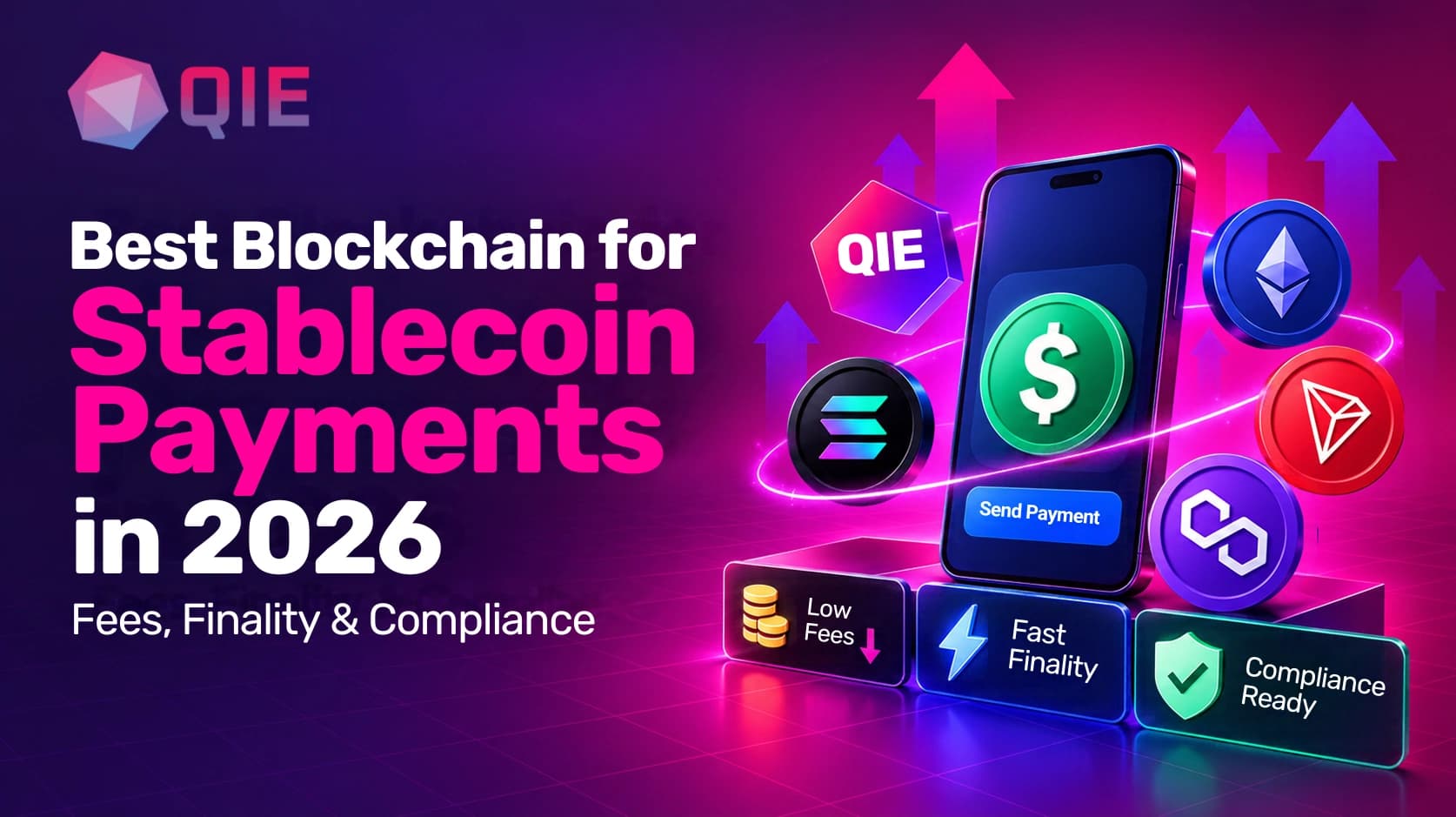
QIE Blockchain, Solana, Ethereum, and Tron each solve pieces of this differently, and the right pick comes down to your use case. This guide compares the best blockchains for stablecoin payments in 2026 on fees, finality, and compliance.
Quick answer
Choosing the best blockchain for stablecoin payments comes down to three things: how fast a transaction becomes truly irreversible, what it costs once fees and bridging are factored in, and whether the chain meets Travel Rule and KYC requirements.
Raw throughput numbers matter far less than these three in practice.
The Shortlist
- QIE Blockchain: best for compliance-ready speed: sub-second finality, native EVM and Cosmos support, and a built-in identity layer that removes repeated KYC checks.
- Solana: best for high-volume retail payments: sub-cent fees and deep liquidity for everyday consumer transfers.
- Tron: best for USDT volume: still moves more USDT globally than any other chain, though centralization concerns linger.
- Ethereum: best for institutional compliance: the industry’s security and audit benchmark, at the cost of higher fees.
Match the chain to the job rather than chasing a single “best” answer. The comparison below breaks down finality, fees, and native stablecoin support across all five chains in this guide.
What makes a blockchain good for stablecoin payments?
A blockchain works for stablecoin payments when it settles fast, costs little, and won’t get flagged by a compliance officer six months later.
Five criteria matter to developers and fintech teams building real flows: settlement finality, real-world throughput, per-transaction cost in USD, native stablecoin support, and regulatory readiness.
Finality is the point at which a transaction can’t be reversed or reorganized, no matter what a wallet interface shows you in the meantime. That’s a different thing from a transaction simply appearing in a block explorer, which can still get orphaned before it’s truly locked in.
Real TPS versus marketing TPS
Marketing decks quote theoretical peak throughput. Real-world transactions per second is what a network sustains under actual load, with real validators, real network latency, and real congestion from other apps competing for block space.
A chain claiming a high TPS figure in a lab benchmark might run at a fraction of that once wallets, DEXs, and NFT mints share the same blocks.
A checkout system built around peak numbers will choke during a sale spike. Teams evaluating infrastructure should read a broader breakdown of Best Blockchain for Developers before committing, since fee structure and tooling maturity affect this as much as raw speed.
Regulatory readiness closes the loop. A chain with no compliance hooks, no identity layer, and no way to screen addresses becomes a liability once a fintech team is handling more than a few thousand dollars.
Why does finality matter more than TPS?
A payment isn’t finished until it’s irreversible, and a fast chain with slow finality just pushes the risk further down the line. Ethereum’s practical finality, once you account for the recommended confirmation depth, runs to roughly a quarter of an hour under typical network conditions.
Solana’s block confirmation is sub-second, but full economic finality (the point where reversal becomes computationally implausible) takes longer under Solana’s confirmation model. QIE Blockchain targets sub-second finality through its delegated proof of stake design.
Picture a large remittance, the kind a business sends to settle a supplier invoice. If it shows up in the recipient’s wallet in half a second but the underlying chain can still reorganize that block, the merchant who released goods on that signal is exposed.
A slower chain with absolute finality can end up costing less in expected losses than a fast one with only probabilistic finality, even if the fast one looks better in a demo. A technically quick blockchain transaction and a settlement guarantee a treasury team can actually lean on are two different things.
How do the top blockchains for stablecoin payments compare?
Here’s how the major stablecoin settlement chains stack up on the metrics that actually decide a payment flow.
| Chain | Finality | Real-world TPS | Base fee (stablecoin transfer) | Native stablecoins | Consensus |
|---|---|---|---|---|---|
| QIE Blockchain | Sub-second, with 25,000+ TPS network capacity and dPoS-with-slashing consensus | 25,000+ | ~$0.0001 | USDC, USDT (EVM + Cosmos) | dPoS with slashing |
| Solana | Sub-second confirmation | Several thousand sustained under real load | Sub-cent | USDC native | Proof of History + PoS |
| Ethereum | Roughly a quarter of an hour practical, per CoinMarketCap | Low on L1, materially higher with L2 rollups | Cents to tens of cents depending on congestion | USDC, USDT, DAI | Proof of Stake |
| Tron | Roughly one to a few minutes | High sustained volume | ~$0 with staked TRX energy, ~$4 for a typical unstaked transfer | USDT dominant | dPoS |
| Polygon | Minutes (checkpointed to Ethereum) | Moderate | Low | Bridged and native mixes | PoS |
QIE’s dPoS model runs on staked validators who confirm blocks in roughly two seconds and get slashed for misbehavior. It’s what enables sub-second finality without giving up decentralization.
Ethereum’s validators lean the other way, prioritizing security over speed, a legitimate tradeoff for high-value settlement but a poor fit for point-of-sale checkout.
What does a payment actually cost?
A stablecoin payment’s true cost includes the base network fee, any DEX slippage, bridge fees, and compliance overhead, not just the number shown at checkout. Sending stablecoins natively on a chain like QIE or Solana costs a fraction of a cent and settles in under a couple of seconds.
Route that same payment from Ethereum to Polygon through a bridge, and you’re adding a bridge fee, DEX slippage on the wrapped asset, and 5 to 10 minutes of extra latency while the bridge’s own confirmation window clears.
That gap is why teams building for volume increasingly favor chains where stablecoins are minted natively rather than wrapped. Take a look at the range of QIE dApps already handling native transfers with no bridge step in the middle.
Which blockchains rank best for stablecoin payments in 2026?
- QIE Blockchain: sub-second finality, native EVM and Cosmos support, and a built-in identity layer that removes repeated KYC friction. Its gas-fee burn model ties usage to token scarcity, making it the pick for teams that want compliance and speed without bridging.
- Solana: sub-cent transaction fees and unmatched retail adoption, though it’s non-EVM, requires Rust, and has a history of network stability issues.
- Tron: still dominant for USDT volume worldwide, with lingering centralization concerns around validator concentration.
- Ethereum: the deepest developer network and the industry’s security benchmark, at the cost of gas fees that spike hard during congestion.
- Stellar: purpose-built for cross-border payments blockchain use cases where throughput needs stay modest.
- Polygon: cheap Ethereum scaling, but it still checkpoints to L1 for full finality.
- BNB Chain: high volume and moderate fees, running on a centralized validator set.
- Stablecoin-native L1s (Plasma, Tempo, Arc, Stable): chains built purely for stablecoin settlement, worth watching but still thin on developer ecosystem compared to the incumbents above.
Why does native vs. bridged stablecoins matter for payment flows?
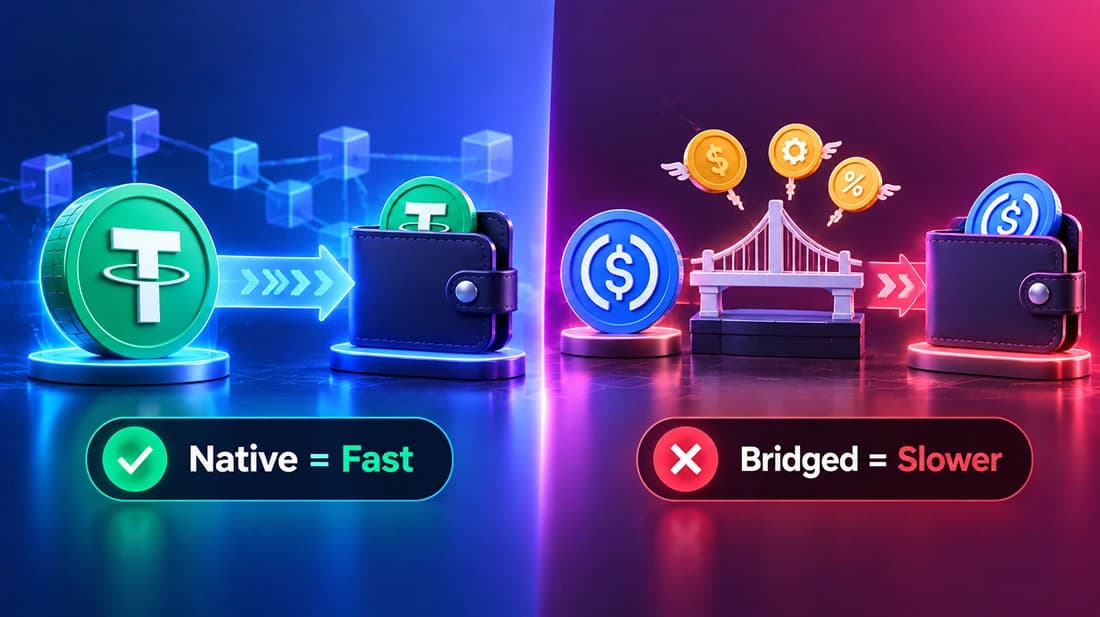
Native stablecoins strip out an entire layer of risk and cost that bridged assets carry by design. A native stablecoin like USDT on Tron is minted directly by the issuer on that chain.
A bridged stablecoin, say wrapped USDC moved to a secondary chain, depends on a custodian or smart contract holding the original asset in escrow while a synthetic version circulates elsewhere.
If you’ve ever wondered why the same “USDC” behaves differently depending on which chain it landed on, this is why: one version is the real thing, the other is a receipt for it.
Native USDT on Tron settles with fast finality, and the fee runs near-zero if the sender has staked TRX energy, or roughly $4 for a typical one-off transfer. The bridged equivalent tacks on a bridge fee plus DEX slippage on top of that, and can take 5 to 10 minutes to fully settle.
QIE Blockchain’s native EVM and Cosmos ecosystem support exists specifically so developers don’t get forced into that bridge dependency.
How do you handle compliance and identity for stablecoin payments?
You handle it by layering on-chain identity checks with off-chain screening tools, and building the workflow around existing frameworks instead of inventing your own.
Four frameworks matter right now. KYC, or Know Your Customer, is the practice of verifying a user’s identity before onboarding them. The FATF Travel Rule requires originator and beneficiary information on transfers generally above $3,000.
The US GENIUS Act, signed into law in 2025, requires stablecoin issuers to hold reserves one-to-one in cash or short-dated Treasuries, publish monthly reserve composition disclosures, and submit to regular audits before they can legally issue a payment stablecoin in the US market.
It also restricts who can issue: only permitted payment stablecoin issuers, meaning banks, credit unions, and approved nonbank entities under federal or state oversight, qualify.
The EU’s MiCA (Markets in Crypto Assets regulation) works differently. It requires any issuer of an e-money token, the category most stablecoins fall into, to be authorized as an e-money institution or credit institution in an EU member state, to hold reserves that are fully backed and largely held in EU-supervised custody, and to give holders a redemption right at par value at any time.
Large e-money tokens also face additional transaction volume caps and reporting obligations once they cross usage thresholds set by regulators.
How do you accept a stablecoin payment on-chain?
Generate a receiving address, monitor for the transfer event, wait for finality, then release goods or services. In practice: a merchant generates an address (or a domain-based address), an indexer or RPC provider like Alchemy or The Graph listens for the ERC-20 Transfer event, the backend checks block confirmations against the chain’s finality threshold, and only then triggers fulfillment.
Say you’re processing a sizeable B2B invoice paid in USDC. Skipping the finality check just to move things along faster is the mistake that costs teams the most. Confirm finality first, every time.
How do you make stablecoin payments feel like a normal payment?
Hide the wallet address and the gas token entirely. A 42-character hex string is not something a customer memorizes, and needing to hold ETH just to move USDC remains the biggest UX complaint in crypto payments.
Solutions like ENS and QIE’s native ID system replace addresses with readable names, available through the QIE Blockchain Products suite. QIE’s fee-burn model and near-zero cost structure also cut the need for a separate gas token in everyday flows.
Try sending a test payment through one of these domain-based addresses yourself before you decide your users need to learn what a hex string is.
Which chain fits which use case for stablecoin payments?
- Remittances: Solana and QIE, both under a cent per transfer with fast settlement.
- B2B invoicing: Ethereum and QIE, for audit trails and finality guarantees.
- Payroll: QIE and Stellar, where identity-linked recurring payments matter.
- Checkout: QIE and Solana, for sub-second UX.
- AI agents: Solana and QIE, for high-frequency micro-transactions.
- Institutions: Ethereum and QIE, balancing decentralization with modern identity tooling.
What are the risks when building on a stablecoin blockchain?
Depegs, issuer freezes, network outages, and bridge exploits are the main risks, and none of them are hypothetical. Diversify across stablecoins and chains, favor native assets over bridged ones, and keep an off-chain fallback rail ready.
Most serious fintech teams build these mitigations in from day one, whichever chain they end up choosing.
Conclusion
There’s no universal best chain for stablecoin payments, only the best fit for your finality, cost, and compliance requirements. QIE Blockchain and Solana cover the sub-second, low-cost end of that spectrum, Ethereum anchors the compliance and institutional end, and Tron still carries the most USDT volume of any network.
Whichever you build on, treat finality as non-negotiable: confirm it before releasing goods or funds, every time, regardless of how fast the transaction looks on screen.
Key Takeaways
- A payment isn’t complete until it can’t be reversed, which is why finality should carry more weight than throughput numbers in any chain evaluation.
- Minting a stablecoin natively skips the custodial risk and extra cost that bridging always adds.
- Travel Rule, GENIUS Act, and MiCA compliance need to shape chain selection from the start, not get bolted on afterward.
- Match the chain to the job: Solana and QIE for high-volume low-cost flows, Ethereum and QIE where institutional weight and compliance depth matter most.
- If sub-second finality with built-in identity is the requirement, start with a network already running that in production instead of waiting on someone’s roadmap.
Start building your payment flow on infrastructure that’s already live: try QIE Blockchain and deploy a test transaction with sub-second finality in minutes.
Frequently Asked Questions
Screen both sender and recipient against sanctions lists, apply Travel Rule reporting above the relevant threshold, and pick a chain with fast finality so funds aren’t sitting in limbo during compliance checks.
Tron is cheapest when the sender has staked TRX energy, effectively $0; without that, a typical TRC20 transfer runs roughly $4. QIE aims for a similarly low, sub-cent cost structure for USDC.
Depends on your regulatory posture and where your users live. USDC leans toward US regulatory alignment and issuer transparency, while USDT carries deeper liquidity and outright dominance on chains like Tron.
Route the payment through a chain with native stablecoin support and sub-second finality, skip the bridge entirely, and confirm the transfer event has cleared the chain’s finality threshold before releasing funds on the receiving end. Adding a bridge hop back in reintroduces the delay and cost this approach is meant to avoid.
You lose access to the wrapped asset’s backing. It’s exactly why native stablecoin support, without a bridge sitting in the middle, cuts this exposure out entirely.
QIE Blockchain is a Layer-1 network built for stablecoin and identity-based payments, combining EVM and Cosmos compatibility, sub-second finality, and a reusable Web3 identity layer (QIE ID) in a single ecosystem, so payment teams don’t need to bridge assets or repeat KYC checks across chains.