Blockchain speed is easy to misread. A chain can post the fastest blockchain TPS on paper and still make you wait before a payment is final, so the fastest crypto to send is often a different chain.
This guide compares 14 blockchains on TPS, block time and finality, using each chain’s own data where possible, so you can see which numbers are real.
Quick Answer
There is no single fastest blockchain, because speed has three parts and chains win on different ones. Finality, the point where a payment cannot be reversed, decides the fastest crypto transfer in practice, because it is what users actually feel. TPS is a ceiling that real networks rarely reach. We compared 14 chains on the same metrics. Here is what the data shows:
The Shortlist
- Fastest stated finality: Sui (about 480ms), Monad (600ms) and Aptos (about 900ms). BNB Chain follows at about 1.1 seconds.
- Highest claimed TPS: Aptos claims up to 160,000 TPS, followed by Sui at 120,000. QIE Blockchain claims 25,000+, ahead of Monad at 10,000 and Polygon at 5,000.
- Speed and fees together: QIE Blockchain combines 1 to 2 second finality with fees of about $0.0001 per transaction. Solana’s median fee is around $0.001, while Stellar’s fees are typically under one cent.
- Best pick by use case: For payments, prioritize finality and fees. For high-volume applications, look at real-world TPS. For layer 2 networks, distinguish fast confirmations from final settlement on Ethereum.
For the fastest crypto transfer in practice, look at finality and fees together, not TPS alone.
TPS vs. block time vs. finality: what’s the difference?
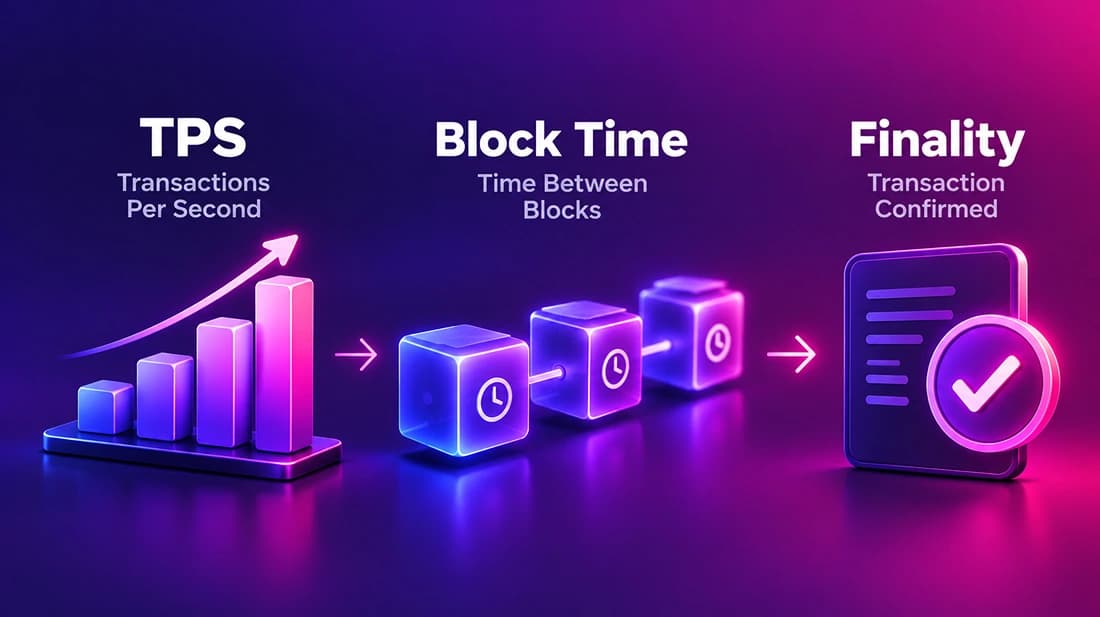
Imagine paying a shop owner with crypto. Before handing over the goods, they need to know the payment has been received and is unlikely to be reversed. How quickly a blockchain processes and settles that payment depends on three related metrics: transactions per second (TPS), block time, and finality. Each measures a different part of the process.
TPS (transactions per second) measures how many transactions a network can process each second. Higher TPS can help a blockchain handle more activity, but advertised capacity does not always reflect real-world performance.
Block time is the average interval between new blocks. Each block contains a batch of transactions. Shorter block times can help transactions get included in a block sooner, but they do not guarantee faster finality.
Finality is the point at which a transaction is considered irreversible under the network’s consensus rules. A transaction appearing in a block does not necessarily mean it has reached finality. For payments, this distinction matters because a quick confirmation and a fully finalized transaction are not always the same thing.
Think of a bank branch: TPS is how many customers it can serve per minute, block time is how often it processes a batch of transactions, and finality is when a payment is considered settled.
Which metric matters most? For everyday payments, finality and transaction fees are important. For high-volume applications, real-world TPS matters more. Block time helps explain how quickly transactions enter the chain, while blockchain scalability depends on how well the network balances throughput, settlement, fees, and security.
14 blockchains compared by speed, finality and fees
This is a blockchain speed comparison of 14 chains. Figures are what each source states, as of October 2026.
| Chain | Block time | Claimed TPS | Finality | Typical fee |
|---|---|---|---|---|
| QIE Blockchain | About 2 seconds. | 25,000+ | 1 to 2 seconds | $0.0001 |
| Monad | 300ms | 10,000 | 600ms | $0.0005 for a typical DEX swap |
| Sui | About 400ms | 120,000 | About 480ms | $0.00 for supported stablecoin transfers (gasless); other transactions pay gas |
| Aptos | About 200ms | 160,000 | About 900ms | About 0.000146 APT for a typical transfer |
| BNB Chain | 0.45s | Not published | About 1.1s | Gas price 0.05 gwei |
| Avalanche | About 2s | 4,500 | 1 to 2 seconds | Minimum base fee 5 nAVAX (October 2026) |
| Polygon | About 2s | 5,000 | 2 to 5 seconds | Fractions of a cent |
| XRP Ledger | 3 to 5s ledger close | 1,500 | 3 to 5 seconds | 0.00001 XRP default |
| Stellar | About 5s | Not published | About 5 seconds | Under one cent |
| Solana | About 400ms | 65,000 | About 0.5s confirmed, about 12.8s finalized | Median about $0.001 |
| Tron | 3s | 2,000 | About 57s (solidified) | Varies with energy |
| Base (L2) | 2s, 200ms preconfirmations | 30,000 | About 2 minutes to L1 batch, about 20 minutes to L1 finality | Under one cent |
| Ethereum | 12s | 15 to 30 | About 12.8 to 15 minutes | Varies with demand |
| Bitcoin | About 10 minutes | 7 | About 60 minutes | Varies with demand |
Top 10 fastest blockchain list by finality
Here is a top 10 fastest blockchain list. A short list like this is a starting point, so read the notes above before you pick.
- 1QIE Blockchain, 1 to 2 seconds. Combines very low fees with EVM compatibility and built-in identity. On finality alone it ties with Avalanche and sits ahead of Polygon.
- 2Sui, about 480ms. Built for fast, parallel processing. Real-world TPS (200 to 500) is far below its 120,000 claim.
- 3Monad, 600ms. An Ethereum-compatible layer 1. Its docs list speculative finality at 300ms and full finality at 600ms.
- 4Aptos, about 900ms. Highest claimed TPS in this list at 160,000, with 10 to 800 observed depending on the source.
- 5BNB Chain, about 1.1 seconds. After the Fermi upgrade in January 2026, blocks arrive every 0.45 seconds.
- 6Avalanche, 1 to 2 seconds. Quick finality and EVM support.
- 7Polygon, 2 to 5 seconds. Low fees and wide wallet support.
- 8XRP Ledger, 3 to 5 seconds. Built for payments. A validated ledger is final.
- 9Stellar, about 5 seconds. Designed for cross-border payments, with low fees.
- 10Solana, about 0.5 seconds confirmed, about 12.8 seconds finalized. Very fast to confirm and very cheap. Full finality takes longer today. The planned Alpenglow upgrade aims for 100 to 150ms finality, with testnet activation announced in September 2026.
Tron (about 57 seconds), Base (about 20 minutes to L1 finality), Ethereum (about 13 minutes) and Bitcoin (about 60 minutes) are slower to reach full finality, though some offer fast soft confirmations.
Fastest blockchain TPS: claimed vs real-world
QIE Blockchain has a claimed throughput of 25,000+ transactions per second (TPS), placing it among the higher-throughput networks in this comparison. Only Aptos (160,000 TPS), Sui (120,000 TPS), Solana (65,000 TPS) and Base (30,000 TPS) have higher stated figures. Other networks report claims ranging from Monad at 10,000 TPS to Polygon at 5,000, Avalanche at 4,500 and Tron at 2,000.
Real-world TPS figures offer another way to compare blockchain performance. Solana has reported real-world throughput of around 1,500 to 4,000 TPS in this comparison, while Aptos ranges from 10 to 800 TPS and Sui from 200 to 500 TPS. Tron, Polygon, Avalanche and XRP Ledger typically operate in the tens to low hundreds of TPS, depending on network activity and measurement method.
These differences highlight the distinction between a network’s stated capacity and the transaction volume it handles in practice. Actual throughput varies with network demand, transaction type and testing conditions.
Why advertised TPS can mislead
Advertised TPS is a ceiling, not a typical day. Three things explain the gap:
- 1Test conditions. Many claims come from lab tests with simple transfers and no congestion.
- 2What counts as a transaction. Some chains count internal validator votes. Others count only user transactions. The numbers are not like for like.
- 3Layers. A layer 2 TPS figure often adds up many rollups, which is different from one chain’s own capacity.
The gap can be huge. CoinMarketCap says Solana was designed for up to 710,000 transactions per second, yet real-world throughput typically ranges from 2,000 to 3,000 TPS.
Before you trust any TPS figure, ask who measured it and under what load.
Fastest crypto transfer: speed and fees together
A fast chain only helps if sending is cheap. Fees matter most for small, frequent payments, where a transfer can cost more than the amount sent.
| Chain | Time to confirm | Typical fee |
|---|---|---|
| QIE Blockchain | 1 to 2 seconds | About $0.0001 |
| Sui | About 480ms | $0.00 for supported stablecoin transfers (gasless) |
| Monad | 600ms | About $0.0005 for a typical DEX swap |
| Solana | About 0.5s confirmed | Median about $0.001 |
| Stellar | About 5 seconds | Under one cent |
| XRP Ledger | 3 to 5 seconds | 0.00001 XRP default |
| Base | 200ms preconfirmation | Under one cent |
| Polygon | 2 to 5 seconds | Fractions of a cent |
For more on small payments, read our guide to the best blockchains for micropayments and the blockchains with the lowest gas fees. If you are building, see how to build low gas fee dApps.
Blockchain finality in practice: what the wait feels like
Numbers like 480ms and 12.8 minutes are easier to judge as a wait. Here is what a user sees, using the finality figures above.
| Chain | Time until a payment cannot be undone | What it feels like |
|---|---|---|
| QIE Blockchain | 1 to 2 seconds | Instant at a checkout |
| Sui | About half a second | Instant at a checkout |
| Monad | 600ms | Instant at a checkout |
| BNB Chain | About 1.1 seconds | Instant at a checkout |
| XRP Ledger | 3 to 5 seconds | A short pause |
| Stellar | About 5 seconds | A short pause |
| Solana (finalized) | About 12.8 seconds | A short wait, though it feels instant at "confirmed" |
| Tron | About 57 seconds | A visible wait |
| Ethereum | About 13 minutes | A long wait for full finality |
| Bitcoin | About 60 minutes | A long wait for full finality |
Many apps do not wait for full finality on small payments. They accept a fast confirmation and take the small risk of a reversal. A $5 coffee can use a quick confirmation. A $50,000 settlement should wait for finality.
Speed, fees and security: the trade-off
Blockchain scalability is a balancing act. Most chains cannot maximize speed, low fees and decentralization at once. This is often called the scalability trilemma.
Here is how that shows up in practice:
- Faster chains often use fewer validators or stronger hardware. That can raise speed but narrow who can take part.
- Cheap fees can invite spam. Chains handle it with fee markets or limits.
- More decentralization usually means slower confirmation. Bitcoin and Ethereum favor wide participation, and they are slower to finality.
No chain in the table escapes these trade-offs. The aim is to choose the mix that suits your use case. A game needs low latency. A treasury needs strong finality. A remittance app needs both, plus low fees.
How we compared blockchain speed and finality
Figures come from each chain’s own documentation where available, and from public comparison pages where not. We list the source in the table. Numbers change often, so we show an as-of date and update this page when major upgrades land.
Chains also define speed differently, which is why the table separates block time, TPS and finality. Where two sources disagree, we show the range or note it.
For a real decision, test on a testnet with your own transaction mix.
7 questions to ask before choosing a blockchain
Use this checklist when a chain claims to be the fastest.
- 1Who measured the number? A chain’s own marketing page, an independent dashboard, or a test you ran yourself.
- 2Is it TPS, block time or finality? These are different things. Ask for the one you need.
- 3What load was used? Fast on an empty network does not mean fast at peak.
- 4What does it cost at that speed? A fast chain with high fees can still fail small payments.
- 5Is the finality full or soft? Soft confirmations can be reversed, though it is rare.
- 6What will you build with? EVM compatibility, wallet support and developer tools can matter more than raw speed.
- 7How mature is the network? A new chain may have lower real-world numbers, less liquidity and a smaller set of tools.
Conclusion
In this blockchain speed comparison, no chain wins every test. Monad, Sui and Aptos lead on stated finality, Aptos and Sui lead on claimed TPS, and Solana leads on observed throughput.
QIE Blockchain combines 1 to 2 second finality with very low fees and EVM tools, which suits payments and consumer apps.
Key Takeaways
- Speed has three parts: TPS, block time and finality. Rank chains on the one your users feel.
- Monad, Sui and Aptos lead on stated finality. QIE Blockchain offers 1 to 2 seconds finality.
- Real-world TPS is often a fraction of claimed TPS.
- Low fees decide whether speed is useful for small payments.
- Test on a testnet before you commit.
Skip the headline TPS and compare finality, fees and real-world data for your use case. To measure it yourself, open the QIE developer docs, get testnet tokens and deploy a Solidity contract.
Frequently Asked Questions
It depends on the metric. On stated finality, Monad (600ms), Sui (about 480ms) and Aptos (about 900ms) are the quickest. On claimed TPS, Aptos (160,000) and Sui (120,000) lead. On observed throughput, Solana leads at roughly 1,500 to 4,000 TPS.
TPS is how many transactions a network can handle each second. Blockchain finality is the moment one transaction can no longer be undone. A chain can be strong on one and slow on the other.
Solana confirms in about 0.5 seconds and finalizes in about 12.8 seconds, with a median fee near $0.001. Ethereum’s base layer processes roughly 12 to 15 TPS and takes about 13 minutes to finalize. Layer 2 networks add capacity on top of Ethereum.
Block time is the gap between one new block and the next. A shorter block time means transactions get into a block sooner. It does not mean they are final.
Look at finality and fees together. Stellar settles in about 5 seconds, XRP Ledger in 3 to 5 seconds, and Solana confirms in about half a second. QIE offers 1 to 2 seconds finality at about $0.0001 per transaction. Test a transfer on each testnet.
No. Advertised TPS is a ceiling. Finality, fees, uptime and real-world throughput shape what users feel day to day.