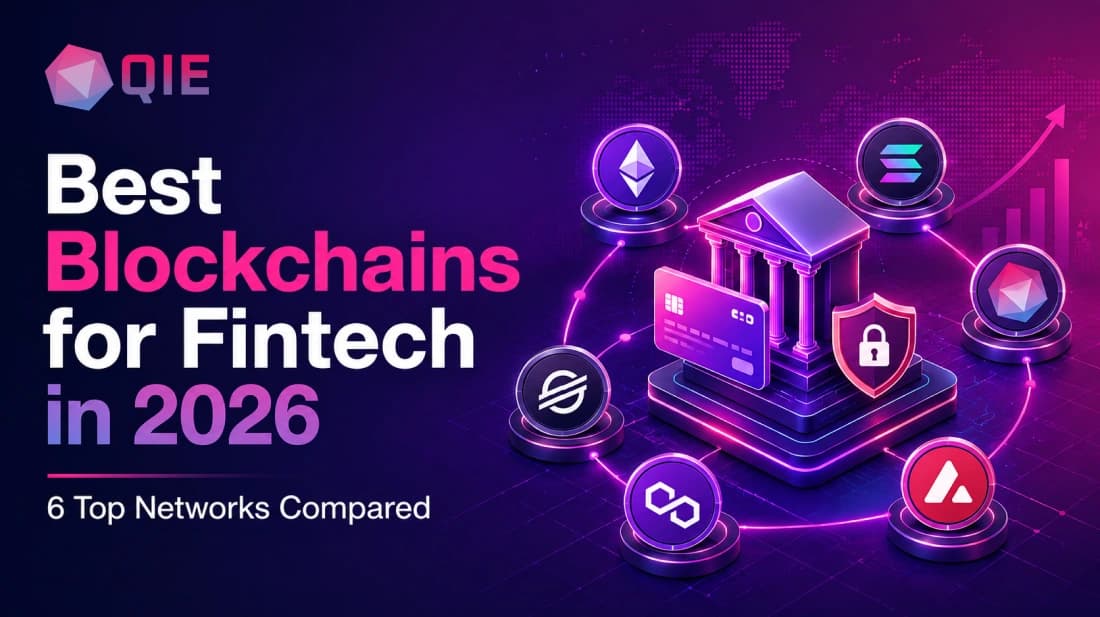
Choosing the right blockchain for fintech in 2026 means evaluating throughput, transaction costs, finality, security, compliance requirements, interoperability, and ecosystem maturity.
Different networks are optimized for different financial workloads, from cross-border payments and stablecoins to tokenization and institutional settlement.
This guide compares six blockchain networks across these factors and examines where each is best suited for fintech workloads.
Quick Answer
The Shortlist
- Ethereum: Best for institutional tokenization, stablecoins, and DeFi.
- Solana: Best for high-volume payments and consumer fintech.
- QIE: Best for identity-enabled fintech dApps requiring high throughput, low costs, and multi-ecosystem compatibility.
- Avalanche: Best for customizable institutional networks.
- Polygon: Best for low-cost EVM applications and payments.
- Stellar: Best for cross-border payments and fiat on-ramps.
What Makes a Blockchain Suitable for Fintech in 2026?
Blockchain finance, broadly defined, is the use of distributed ledger infrastructure to power payments, settlement, stablecoins, tokenization, lending, DeFi, digital identity, and broader financial infrastructure, replacing or augmenting legacy intermediaries with programmable, auditable logic.
Seven criteria determine whether a chain fits a fintech workload:
| Criterion | Why it matters for fintech |
|---|---|
| Transaction speed and finality | Determines whether settlement is real-time or batched |
| Cost per transaction | Sets the floor for viable payment sizes |
| Scalability | Sustains throughput under production load |
| Security model | Protects user funds and institutional assets |
| Smart contract support | Enables programmable money and automated agreements |
| Interoperability | Allows cross-chain liquidity without bridge risk |
| Compliance and adoption | Determines regulatory viability and partner availability |
The most common mistake teams make is benchmarking theoretical peak throughput rather than sustained output under congestion. For fintech applications, sustained throughput under realistic network conditions is more useful than theoretical peak TPS.
How Do The Top Blockchains Compare For Fintech Workloads?
The right chain depends entirely on your specific fintech application. The comparison covers Ethereum, Solana, Avalanche, Polygon, Stellar, and QIE across key fintech requirements.
1. Ethereum: Institutional Settlement and Tokenization
Best for: tokenized real-world assets, stablecoin issuance, regulated DeFi.
Ethereum’s DeFi TVL stands at $45.4 billion as of May 2026, still leading all chains despite a declining share. That depth is why JPMorgan runs JPM Coin settlements on Ethereum and BlackRock’s BUIDL fund sits there.
Ethereum remains one of the leading networks for institutional tokenization and stablecoin activity, supported by deep liquidity, mature infrastructure, and a large developer ecosystem.
Ethereum transaction costs can rise significantly during periods of congestion, making the network less predictable for high-frequency, low-value payments.
Its security and decentralization benchmarks are industry-standard, but there’s no native cross-chain identity layer at the protocol level, so every dApp re-runs KYC independently.
2. Solana: High-Frequency Payments and Stablecoins
Best for: consumer payments, stablecoin rails, high-volume DeFi.
In January 2026 alone, Solana processed 94.3 million on-chain transactions, compared to 1.9 million on Ethereum. That gap reflects Solana’s real advantage: transaction fees averaging around $0.00025 per transfer, with sub-second finality.
Stablecoin transaction volume on the Solana network surpassed $1 trillion in 2025, which tells you where the payments-focused builders have landed.
The limitation is ecosystem fit. Solana requires Rust rather than Solidity, which raises the switching cost for teams already in the Ethereum tooling stack.
The network has experienced congestion and outages in the past, though the community has invested heavily in client improvements, and the Firedancer validator client’s 2026 mainnet deployment has materially improved stability.
3. QIE Blockchain: Identity-Native Layer 1 for Fintech dApps
Best for: identity-enabled fintech dApps requiring high throughput, low transaction costs, reusable identity, and EVM and Cosmos compatibility.
QIE Blockchain is a Layer 1 designed for high-throughput applications, with reported throughput of up to 25,000 transactions per second, fast finality, low transaction costs, EVM compatibility, and Cosmos-based interoperability.
QIE also provides reusable identity infrastructure through QIE ID, allowing participating applications to verify users through a reusable identity rather than requiring them to repeat the same process across each service.
This combination makes QIE relevant to fintech dApps that need high throughput, low transaction costs, familiar EVM tooling, interoperability, and reusable identity within the same ecosystem.
4. Avalanche: Institutional Subnets and RWA Tokenization
Best for: permissioned institutional chains, tokenized securities, enterprise DeFi.
Avalanche uses a novel consensus protocol that enables sub-second finality and supports customizable Layer 1 blockchains through AvaCloud.
The C-Chain provides EVM compatibility for smart contracts and DeFi, while the multi-chain architecture lets enterprises deploy networks tailored to their compliance and performance requirements.
JPMorgan’s Onyx ran a tokenized portfolio rebalancing pilot on a permissioned Avalanche subnet in collaboration with WisdomTree and Apollo, demonstrating cross-fund collateral movement with KYC enforced at the protocol level. That’s Avalanche’s clearest edge.
The downside is fragmented liquidity: assets locked inside a dedicated subnet don’t automatically access the broader DeFi ecosystem, which matters for teams that need deep, liquid markets.
5. Polygon: EVM Scalability and Developer Reach
Best for: dApp portability, retail-scale payments, zkEVM applications.
Polygon provides EVM-compatible infrastructure designed to support scalable applications and lower-cost transactions, making it familiar territory for Solidity-based fintech teams. Teams port existing contracts with minimal friction because they’re working in familiar tooling.
Its main advantage is compatibility with Ethereum’s development ecosystem, while its architecture introduces dependencies on the underlying Ethereum network and Polygon’s specific scaling infrastructure.
6. Stellar: Cross-Border Payments and Fiat On-Ramps
Best for: remittances, stablecoin issuance, fiat-to-blockchain conversion.
Stellar processed $5.5 billion in payment volume in Q1 2026, a 72% increase year-over-year. The network was designed for cross-border payments and asset issuance rather than general-purpose computation.
It reaches consensus through the Stellar Consensus Protocol, a Federated Byzantine Agreement construction, with ledgers closing in roughly five seconds. Stellar’s limitation is smart contract maturity: Soroban launched in 2024 and is still early compared to Ethereum’s decade-old ecosystem.
Quick Comparison Table
| Chain | Reported / Typical Throughput | Avg. fee | Best fintech use case | Key limitation |
|---|---|---|---|---|
| Ethereum | ~15–30 L1 | $1–$50+ | Tokenization, institutional DeFi | High fees at congestion |
| Solana | ~2,600 sustained | ~$0.00025 | Payments, stablecoins | Non-EVM, past outages |
| QIE | Up to 25,000 | Near-zero fees | Identity-native fintech dApps | Newer ecosystem maturity |
| Avalanche | ~4,500 C-Chain | ~$0.01 | Institutional subnets, RWA | Fragmented subnet liquidity |
| Polygon | ~7,000 zkEVM | <$0.01 | EVM dApp scaling | L2 security dependency |
| Stellar | ~1,000 | <$0.001 | Cross-border, fiat on-ramps | Early smart contract ecosystem |
When Does Blockchain Outperform Traditional Financial Infrastructure?
Blockchain wins on specific, concrete problems.
Traditional international payments through SWIFT often take 3–5 days to process, creating real cash flow pressure. Some blockchain-based payment systems can settle transactions within minutes and operate around the clock, depending on the network, asset, and surrounding financial infrastructure.
For a treasury team managing cross-border supplier payments, that’s not a marginal improvement. It can reduce some pre-funding and settlement constraints and weekend settlement gaps entirely.
Public blockchain infrastructure offers a shared, programmable settlement layer that operates continuously, transparently, and without intermediaries.
That programmability is where blockchain genuinely separates from legacy rails: smart contracts can encode compliance rules, automate coupon payments on tokenized bonds, or release escrow funds on delivery confirmation, reducing the need for manual clearing and settlement processes in some workflows.
Where Traditional Infrastructure Still Wins
Regulatory clarity, custody standards, and UX maturity still favor legacy systems. Most retail users can’t manage private keys safely, and institutional custody frameworks for tokenized assets are still maturing.
Regulatory frameworks for tokenized securities remain early, and the SEC’s December 2025 no-action letter for DTCC’s pilot is promising but limited in scope and duration.
The honest framing: blockchain is a parallel infrastructure that outperforms legacy systems on cross-border speed, 24/7 availability, programmable compliance, and transparent auditability, while lagging on regulatory certainty and end-user experience. It’s not a full replacement for traditional rails today.
How Should You Choose a Blockchain for Your Fintech Product?
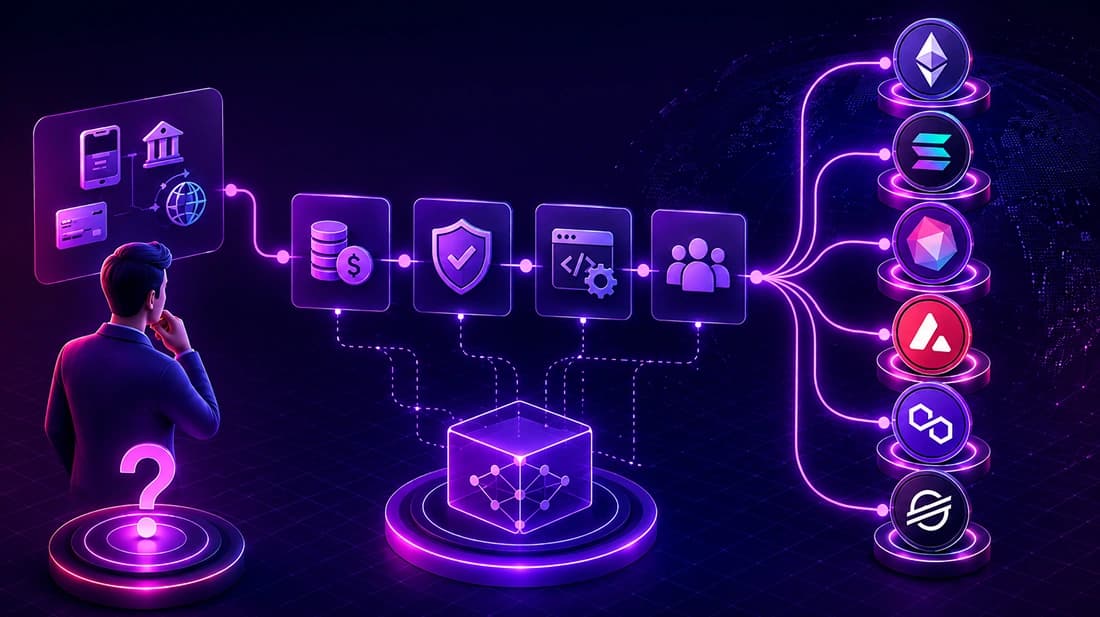
Start with your use case, then work backwards to the chain.
A stablecoin issuer targeting institutional clients may prioritize Ethereum’s liquidity, established infrastructure, and institutional adoption, even at higher fees. A cross-border remittance app serving retail users needs Stellar’s fiat on-ramps or Solana’s sub-cent fees.
A fintech building a lending platform that requires reusable KYC across multiple dApps may benefit from an identity-native architecture like QIE’s, allowing users to carry a verified QIE ID rather than re-submit documents to every protocol.
Practical Decision Framework
- Map your volume and fee tolerance. If your average transaction value is low, Ethereum mainnet fees can make the economics difficult, particularly during periods of congestion. Solana or QIE are the realistic options, and the math here is worth running before you commit to a chain.
- Assess your developer team’s tooling. Solidity developers move fastest on EVM-compatible chains, Rust expertise opens Solana, and Cosmos familiarity opens QIE’s Cosmos-compatible layer. Switching tooling stacks mid-build is expensive.
- Identify your compliance requirements. Permissioned institutional chains point to Avalanche subnets. If you need a public, auditable chain with an established ecosystem, Ethereum and Solana are among the more mature options.
- Evaluate ecosystem completeness. A chain with a live DEX, lending protocol, and wallet reduces integration work significantly. Roadmap-only ecosystems add real delivery risk, and it’s worth checking what’s actually deployed before you build on top of it.
Teams that skip congestion testing may discover performance limitations only after production traffic increases, when migrating infrastructure becomes significantly more expensive.
One trade-off most teams underestimate: paying extra for a high-security, high-liquidity chain rarely pays off when your application only needs fast, cheap settlement. Ethereum’s security premium is worth it when you’re holding billions in tokenized assets.
For a low-value remittance, those additional costs may outweigh the benefits.
Decision Matrix: Matching Your Use Case to the Right Chain
| Use Case | Recommended Chain | Why | Key Trade-off |
|---|---|---|---|
| Sub-$10 retail payments | Solana or Stellar | Low transaction fees can make small-value transfers more economically viable. | Solana requires Rust tooling; Stellar has an early smart contract ecosystem |
| Institutional tokenized assets | Ethereum | $45.4B DeFi TVL, mature custody standards, and the deepest stablecoin liquidity of any chain | Transaction costs can rise substantially during congestion. |
| Cross-border remittance | Stellar | Built specifically for fiat-to-blockchain conversion and cross-border settlement; $5.5B Q1 2026 volume confirms production scale | Smart contract capabilities lag Ethereum by several years |
| Permissioned enterprise chain | Avalanche | Customizable L1s let institutions embed KYC at the validator level, as JPMorgan’s Onyx pilot demonstrated | Liquidity stays isolated inside the subnet unless deliberately bridged out |
| Identity-gated fintech dApp | QIE Blockchain | Native on-chain identity via QIE ID eliminates per-protocol KYC re-submission; EVM and Cosmos compatibility reduces bridge dependency | Newer ecosystem means shallower third-party integrations than Ethereum or Solana |
Conclusion
The best blockchain for fintech in 2026 depends on the workload. Ethereum remains strong for institutional tokenization and DeFi, Solana and Stellar for payments, Avalanche for customizable institutional networks, and Polygon for scalable EVM applications.
For fintech dApps that need high throughput, low transaction costs, reusable identity, and EVM and Cosmos compatibility in one Layer 1 ecosystem, QIE offers a differentiated approach. Teams should ultimately compare each network based on transaction volume, compliance requirements, developer tooling, liquidity, security, and long-term scalability.
Key Takeaways
- Ethereum is best suited to institutional tokenization, stablecoins, and DeFi where liquidity and ecosystem maturity matter most.
- Solana fits high-volume payments and consumer fintech applications that prioritize speed and low transaction costs.
- QIE is particularly suited to identity-enabled fintech dApps that need high throughput, low transaction costs, reusable identity, and EVM and Cosmos compatibility in one Layer 1 ecosystem.
- Avalanche is a strong option for institutions requiring customizable networks, validator control, and compliance-focused infrastructure.
- Polygon provides familiar EVM tooling for fintech teams seeking scalable, lower-cost application infrastructure.
- Stellar remains well suited to cross-border payments, remittances, and fiat-to-blockchain applications.
- Blockchain is not a universal replacement for traditional finance infrastructure. Its strongest advantages are 24/7 settlement, programmable transactions, shared records, and reduced intermediary dependence.
- The right blockchain depends on the use case. Teams should compare sustained throughput, fees, finality, security, compliance, liquidity, and developer tooling before committing to a network.
Building a fintech dApp? Explore QIE’s developer platform to evaluate its high throughput, low transaction costs, EVM compatibility, Cosmos interoperability, and reusable identity infrastructure for your application.
Frequently Asked Questions
There is no single best blockchain for every fintech use case. Ethereum is strong for institutional tokenization and DeFi, Solana for high-volume payments, Stellar for cross-border payments, Avalanche for customizable institutional networks, Polygon for scalable EVM applications, and QIE for high-throughput fintech dApps requiring reusable identity.
Solana, Stellar, Polygon, and QIE generally offer lower transaction costs than Ethereum mainnet. The best choice depends on transaction volume, network conditions, application requirements, and ecosystem access.
Yes. Ethereum is well suited to institutional tokenization, stablecoins, and DeFi because of its deep liquidity, mature infrastructure, and large developer ecosystem. Higher and less predictable fees during congestion can make it less suitable for high-frequency, low-value payments.
Stellar is designed specifically for payments, asset issuance, and cross-border financial applications, making it a strong option for remittances and fiat-to-blockchain workflows. Solana can also suit high-volume payment applications where low fees and fast settlement are priorities.
Yes, but multi-chain architectures add bridge risk, liquidity fragmentation, and integration complexity. Teams should use multiple networks when the benefits justify the additional infrastructure and operational overhead.
QIE is particularly relevant to fintech dApps requiring high throughput, low transaction costs, EVM and Cosmos compatibility, and reusable on-chain identity. Its QIE ID infrastructure can help participating applications reduce repetitive identity verification across services.