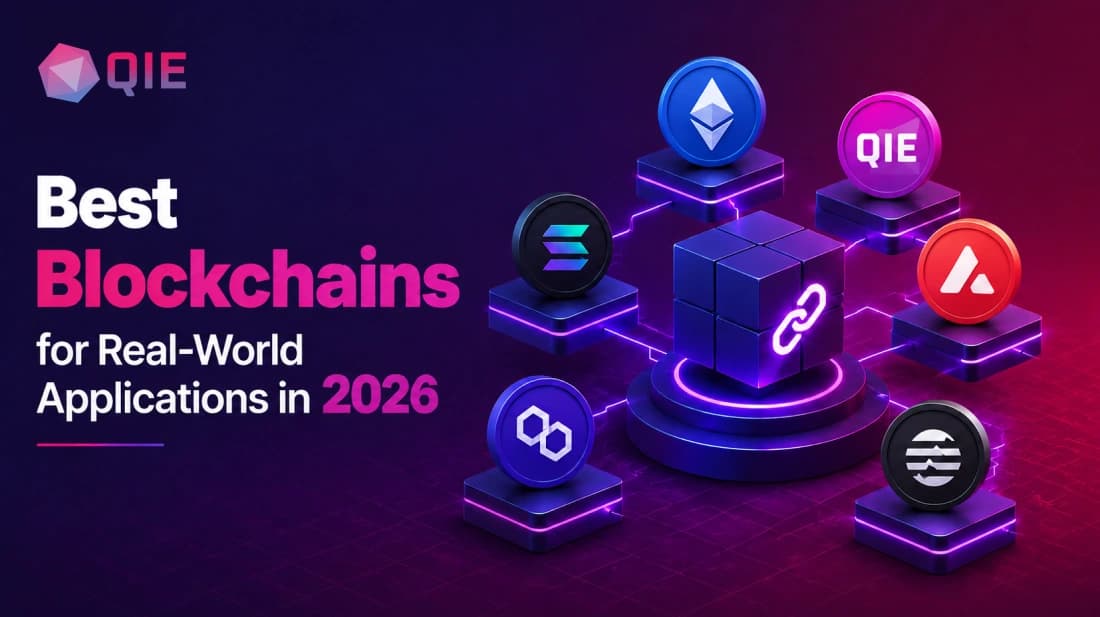
Choosing the right Layer 1 blockchain for a real-world application in 2026 depends less on brand recognition and more on the requirements of the application. Factors such as transaction fees, throughput, finality, developer support, interoperability, security, and ecosystem depth can determine whether a network is suitable for production.
Different blockchains prioritize different strengths. Ethereum offers deep liquidity and ecosystem maturity, Solana emphasizes throughput and low-cost transactions, while networks such as Avalanche, Polygon, QIE, and Aptos take different approaches to scalability, interoperability, and application development.
This guide compares seven blockchain networks to help developers and businesses identify the best fit for different real-world use cases.
Quick Answer
| Real-World Application | Best Blockchain | Why |
|---|---|---|
| DeFi & tokenized assets | Ethereum | Deep liquidity, strong security, and mature ecosystem |
| Payments & consumer apps | Solana | High throughput, fast transactions, and low fees |
| High-throughput dApps & Web3 applications | QIE | Up to 25,000 TPS, near-zero gas fees, EVM compatibility, Cosmos interoperability, and reusable identity |
| Custom enterprise networks | Avalanche | Customizable Layer 1 infrastructure and EVM compatibility |
| Low-cost EVM applications | Polygon PoS | Ethereum-compatible development with low transaction costs |
| Permissioned enterprise workflows | Hyperledger Fabric | Controlled access, privacy, and configurable architecture |
| High-throughput, low-latency applications | Aptos | Parallel execution and fast transaction processing |
Which Blockchain Networks Are Best Suited for Real-World Applications in 2026?
Ethereum leads for security and capital depth, Solana for high-throughput consumer applications, and QIE for high-throughput dApps with low-cost transactions, EVM compatibility, Cosmos interoperability, and reusable identity infrastructure. The right choice is never universal.
A blockchain application, broadly, is any software that uses a distributed, immutable ledger to execute logic without a central intermediary. Unlike a traditional database, it settles state changes with finality, makes records tamper-evident, and removes the trusted third party from data reconciliation.
Use cases have expanded well beyond cryptocurrency trading. Enterprises now rely on distributed ledgers to track goods, protect medical data, automate contracts, and move money across borders, anywhere that transparency and auditability reduce the cost of trust.
The Key Criteria to Consider When Choosing a Blockchain
Pick the wrong chain and you’ll spend months migrating everything back. Evaluate each network on: scalability (sustained TPS under realistic load, not theoretical max), transaction fees, finality speed, developer support, interoperability model (EVM, Cosmos, or proprietary), security and decentralization benchmarks, and enterprise readiness.
The blockchain market is projected to reach USD 610.96 billion by 2031 from USD 54.08 billion in 2026, according to MarketsandMarkets (2026). That growth is being pulled by production deployments in finance, identity, and supply chain, not by speculation.
How Do Ethereum, Solana, QIE, Avalanche, Polygon, Hyperledger Fabric, and Aptos Compare?
Each chain solves a different constraint. Here is the structured comparison, followed by the narrative detail that a table cannot carry.
| Chain | Real-World TPS | Finality | Best For | Key Limitation |
|---|---|---|---|---|
| Ethereum | 15–30 | ~12 sec | DeFi, RWA, TVL | High gas during congestion |
| Solana | 2,000–4,000 | ~400 ms | Payments, NFTs, gaming | Non-EVM, past outage history |
| QIE | Up to 25,000 | Near-instant | High-throughput dApps & Web3 applications | Newer ecosystem |
| Avalanche | 50–100 (C-Chain) | <1 sec | Custom enterprise L1s | Fragmented liquidity across subnets |
| Polygon | 1,000+ (PoS) | ~2 sec | EVM dApps, consumer and brand applications | zkEVM sequencer sunset |
| Hyperledger Fabric | Variable | Configurable | Permissioned enterprise workflows | Not a public Layer 1 |
| Aptos | ~13,000 (peak) | <1 sec | High-throughput financial applications | Smaller developer network |
Developer Migration And Onboarding Considerations
For teams already holding Solidity contracts or working within the Cosmos ecosystem, the practical question is how much rework a chain switch actually requires.
EVM compatibility can significantly reduce migration effort for Solidity-based applications, while Cosmos-based architecture can be familiar to teams already building within that ecosystem.
| Chain | EVM Compatible | Cosmos Ecosystem | Rust Required | Estimated Migration Effort | Reusable Identity Infrastructure |
|---|---|---|---|---|---|
| Ethereum | Yes | No | No | Low | No |
| Solana | No | No | Yes | High | No |
| QIE | Yes | Yes | No | Low | Yes |
| Avalanche | Yes (C-Chain) | No | No | Low | No |
| Polygon | Yes | No | No | Low | No |
| Hyperledger Fabric | No | No | No | High | No |
| Aptos | No | No | Yes (Move) | High | No |
Migration effort is indicative. Actual effort depends on the application’s dependencies, integrations, smart contract complexity, and chain-specific functionality.
QIE combines EVM compatibility with Cosmos SDK architecture, giving developers access to familiar Ethereum tooling while also connecting to the broader Cosmos ecosystem.
For teams migrating Solidity-based applications, EVM compatibility can significantly reduce development and migration effort compared with moving to a non-EVM environment.
Ethereum: Deep Liquidity, Security, And Ecosystem Maturity
Ethereum holds a 53.1% share of total DeFi TVL, per CoinLaw (2026). That capital concentration is the strongest argument for building on Ethereum: your protocol inherits the deepest liquidity in the space. The weakness is equally concrete.
The base layer processes 15–30 TPS, and gas fees spike unpredictably during congestion, making it a poor substrate for high-frequency or consumer-facing applications.
Ethereum also leads RWA tokenization. RWA.xyz currently ranks Ethereum as the largest blockchain by distributed tokenized real-world asset value, with roughly $16.3 billion in distributed asset value in its current dataset.
Because RWA rankings vary depending on whether stablecoins, represented assets, or distributed assets are included, comparisons should always specify the metric being used.
Solana: High Throughput And Low-Cost Consumer Applications
Solana’s non-vote transaction throughput consistently exceeds 2,500 TPS, per Crypto Briefing (2026), with fees staying well under a cent per transaction.
That combination makes Solana well suited to high-frequency consumer applications, payments, gaming, and other applications where low fees and fast transaction processing are important.
The honest caveat: Solana requires developers to learn Rust, and the network’s history of outages before the Firedancer upgrade is a real infrastructure risk to weigh against its speed advantage.
QIE: High-Throughput Layer 1 With EVM, Cosmos, And Identity Capabilities
QIE Blockchain is a production-ready Layer 1 built around a delegated proof-of-stake model. QIE reports throughput of up to 25,000 transactions per second, alongside near-instant finality and low transaction fees.
QIE combines several capabilities that are relevant to real-world applications, including high throughput, low-cost transactions, EVM compatibility, Cosmos-based infrastructure, and reusable identity through QIE ID.
QIE ID is designed to give users a reusable verified identity across participating dApps and Web3 services, reducing repetitive verification and wallet-address friction within the QIE ecosystem.
Among the networks compared here, QIE differentiates itself by combining its Layer 1 infrastructure with reusable identity through QIE ID. The network also combines EVM compatibility with Cosmos SDK architecture, allowing developers to use familiar Solidity tooling while accessing the broader Cosmos ecosystem.
This can reduce the need for additional interoperability infrastructure in application architectures that can operate within QIE’s ecosystem.
QIE’s fee model also includes burning base transaction fees, linking network activity with the token’s supply dynamics. The long-term effect on supply depends on actual network usage and the protocol’s fee and burn parameters.
Avalanche: Customizable Layer 1 Infrastructure For Enterprise Applications
Enterprises can use customizable Avalanche L1s to configure blockchain infrastructure around specific application, validator, and compliance requirements. Avalanche L1s use Avalanche’s customizable architecture while supporting EVM-compatible development through Subnet-EVM.
This flexibility can suit institutions that need greater control over their blockchain environment than a shared public network provides. The trade-off is that application-specific L1s can fragment liquidity and developer activity compared with building directly on a larger shared network.
Polygon: Low-Cost EVM Development And Ethereum Compatibility
Polygon PoS has a large EVM-compatible developer and application ecosystem, making it an established option for teams that want Ethereum-compatible tooling with lower transaction costs.
Polygon has also been used by major brands and enterprises for blockchain-based loyalty, digital collectible, and consumer programs, demonstrating its appeal for organizations that want EVM compatibility and lower-cost transactions.
Polygon zkEVM Mainnet Beta was sunset in July 2026, and the network is no longer producing blocks. Polygon’s current strategy has shifted toward its broader Polygon PoS and AggLayer ecosystem, so developers evaluating Polygon should distinguish the active PoS network from the discontinued zkEVM Mainnet Beta.
Hyperledger Fabric: Permissioned Blockchain Infrastructure For Enterprises
Hyperledger Fabric is an open-source, enterprise-grade permissioned distributed ledger platform designed for business networks. Its modular architecture allows organizations to control membership, permissions, data visibility, and consensus according to their requirements.
It is a strong fit for regulated enterprise workflows where participants need permissioned access and shared records, but it is fundamentally different from public Layer 1 networks such as Ethereum or Solana.
Aptos: Parallel Execution For High-Throughput Applications
Aptos’s Block-STM engine runs transactions optimistically and re-executes only those that conflict, letting it use every available CPU core. Its network is secured through a delegated proof-of-stake model built on the AptosBFT consensus protocol, per Everstake (2026).
Aptos has emphasized low-latency infrastructure, with its current materials citing sub-50-millisecond block times. Its Block-STM parallel execution model is designed to process independent transactions concurrently, making the network particularly relevant to high-throughput financial and consumer applications.
Which Blockchain Is Best For Different Real-World Use Cases In 2026?
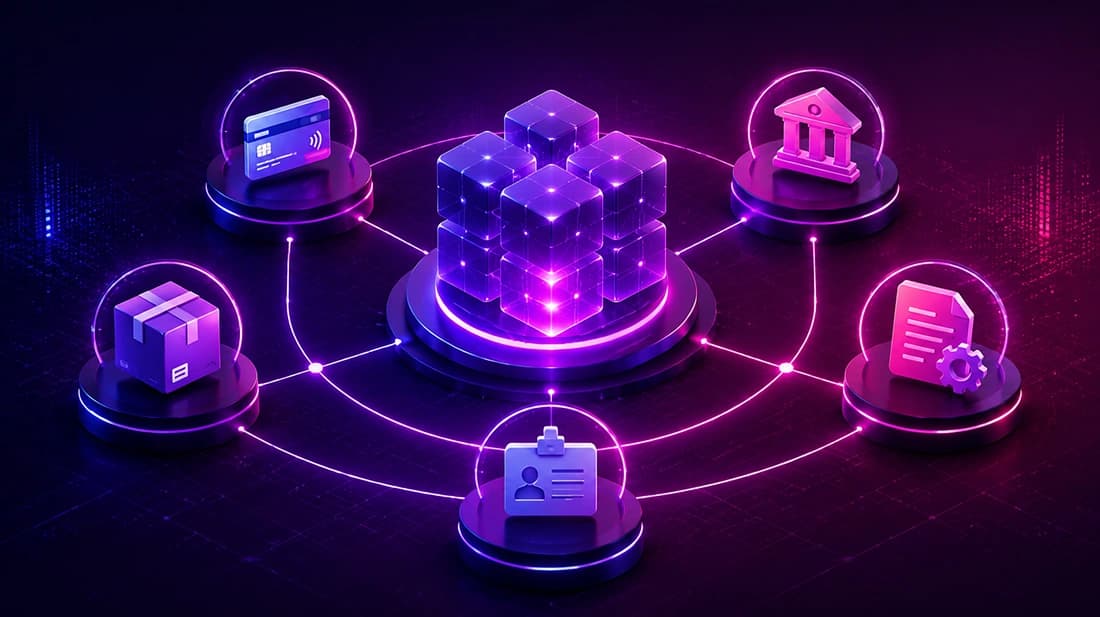
The six use cases below are where real production deployments are happening.
Payments And Remittances
Solana and Polygon are strong options for payments and consumer-facing applications where low fees and fast transaction processing are important.
In 2026, Solana processes high transaction volumes with sub-second block times and low fees, while Polygon PoS provides an established EVM environment for applications that prioritize Ethereum compatibility.
Real-World Asset Tokenization
Ethereum is currently the largest blockchain by distributed tokenized real-world asset value, according to RWA.xyz. Its position is supported by deep liquidity, institutional infrastructure, and a mature ecosystem for tokenized assets.
RWA rankings can vary depending on whether the dataset measures distributed assets, represented assets, or other categories, so comparisons should specify the metric used.
QIE adds an identity-focused approach to asset ownership, where reusable credentials can support verification across participating applications within its ecosystem.
Supply Chain Transparency
Hyperledger Fabric is widely used for permissioned supply-chain tracking, where consortium members need shared visibility without public exposure.
Public chains like Ethereum provide the auditability layer when regulators need to verify records independently.
Decentralized Identity
Governments and institutions are exploring blockchain-backed digital IDs to reduce fraud and repetitive verification, with identity management becoming one of the most influential enterprise adoption drivers, per TechTimes (2026).
QIE ID differentiates QIE by providing reusable identity infrastructure within the QIE ecosystem. Users can complete KYC once and, where supported, reuse a verifiable credential across participating applications and exchanges, reducing repeated identity checks and onboarding friction.
Gaming And NFTs
Solana’s high throughput and low fees make it well suited to consumer gaming and digital-asset applications.
Polygon is another strong option for brands and developers that want an EVM-compatible environment for digital collectibles and consumer experiences.
Enterprise Workflows
Avalanche L1s allow enterprises to customize network rules, validator requirements, and application infrastructure for specific business or compliance needs.
Hyperledger Fabric is better suited when permissioned membership and controlled data visibility are fundamental requirements.
What Makes A Blockchain Suitable For Real-World Production Applications?
The most common mistake developers make when evaluating chains is trusting the headline TPS number.
A blockchain that advertises a high theoretical TPS but delivers substantially lower throughput under realistic workloads may not be suitable for production.
Why Sustained Throughput Matters More Than Theoretical TPS
TPS is useful for comparing blockchain capacity, but the methodology matters. Some measurements include validator or consensus-related transactions, while others focus on application transactions. Benchmark conditions can also differ substantially from normal mainnet activity.
For that reason, developers should compare like-for-like measurements and consider latency, fees, hardware requirements, and application-specific workload alongside TPS.
Solana’s often-cited 65,000 TPS is a theoretical ceiling; actual non-vote throughput runs 2,000 to 4,000 TPS in normal operation.
Aptos’s Block-STM benchmarks exceed 160,000 TPS in testing, while mainnet peaks around 13,000. The difference between benchmark performance and real-world mainnet performance is therefore important when evaluating blockchain infrastructure.
Blockchain Solutions Vs. Traditional Systems
Blockchain trades some raw speed for settlement finality, transparency, and removal of intermediaries. That trade pays off for payments, identity, and RWA tokenization, where the cost of a disputed settlement or a fraudulent identity record far exceeds the cost of a slower transaction.
For high-frequency trading at microsecond latency, a centralized matching engine will always win on speed alone.
What Is Driving Blockchain Adoption In 2026?
Regulatory clarity is one of the biggest factors influencing institutional blockchain adoption. Clearer rules around stablecoins, tokenized assets, custody, and digital-asset classification can reduce uncertainty for financial institutions evaluating blockchain deployments.
Developments such as MiCA in the EU and evolving US digital-asset legislation are therefore important factors in institutional adoption.
Custody infrastructure and on-ramps have matured enough that a bank can hold tokenized assets without building its own key management system.
Why Interoperability Matters For Multi-Chain Applications
Multi-chain applications often introduce additional infrastructure between users, assets, and applications. Bridges can add smart-contract risk and operational complexity, particularly when assets or messages must move between independent networks.
QIE’s approach combines EVM compatibility with Cosmos-based infrastructure within the same Layer 1, reducing the need for developers to rely on an external bridge simply to access both ecosystems.
The practical advantage is a simpler architecture for teams that want Ethereum-compatible development alongside Cosmos interoperability.
Conclusion
There is no single best blockchain for every real-world application in 2026. Ethereum remains strongest for DeFi, liquidity, and tokenized assets, while Solana, Avalanche, Polygon, Fabric, and Aptos each serve different performance, development, and enterprise requirements.
QIE stands out as a general-purpose Layer 1 that combines high throughput, low-cost dApp transactions, EVM compatibility, Cosmos interoperability, and reusable identity infrastructure. The right choice ultimately depends on the application’s requirements for performance, security, cost, interoperability, compliance, and ecosystem depth.
Key Takeaways
- Ethereum leads in DeFi, liquidity, and tokenized assets.
- Solana is well suited to fast, low-cost consumer applications.
- QIE combines high throughput, low-cost dApp transactions, EVM compatibility, Cosmos interoperability, and reusable identity.
- Avalanche provides customizable infrastructure for enterprise use cases.
- Polygon offers an established, low-cost EVM environment.
- Hyperledger Fabric fits permissioned enterprise applications.
- Aptos targets high-throughput applications with parallel execution.
- Choose based on your application’s actual requirements, not blockchain popularity.
Explore QIE’s EVM-compatible infrastructure, Cosmos interoperability, reusable identity capabilities, and low-cost transactions. Start Building on QIE
Frequently Asked Questions
A blockchain application uses a blockchain for transactions, data, or core logic, providing transparency and decentralized control. Unlike a traditional Web2 app, it does not rely entirely on a single company or server to manage and record activity.
There is no single best blockchain. The right choice depends on requirements such as compliance, privacy, scalability, interoperability, and ecosystem access. Hyperledger Fabric suits permissioned enterprise networks, while Ethereum, Avalanche, and QIE can be considered when broader blockchain interoperability and composability are priorities.
Transaction fees depend on network architecture, capacity, and demand. Networks with higher throughput can often maintain lower fees, while congestion can cause fees to rise on networks with limited capacity. Some blockchains, such as QIE, also use fee-burning mechanisms that connect transaction activity to token supply dynamics.
Not completely. Bridges, cross-chain messaging protocols, and native integrations have made it easier to move data and assets between networks, but each approach has different security and trust assumptions. Developers should evaluate the specific interoperability solution rather than assuming all cross-chain systems offer the same level of security.
A Layer 1 is a blockchain with its own consensus and settlement infrastructure. A Layer 2 typically processes transactions using a separate execution layer while relying on a Layer 1 for settlement or security. The distinction depends on how the network is designed and where transactions are executed and settled.
Consider transaction speed, fees, scalability, users, compliance requirements, developer tools, and ecosystem compatibility. EVM-compatible networks can simplify migration for Solidity applications, while networks such as Solana may suit applications requiring high throughput. For applications that need decentralized identity, QIE also offers QIE ID as an identity infrastructure option.