The best crypto wallet in South Africa depends on whether you prioritise self-custody, multichain access, or hardware security.
For South African users, the right wallet depends on factors such as self-custody, supported networks, security, Web3 access and ZAR on/off-ramp availability. This guide compares several popular options across those criteria.
Quick Answer
If you’re looking for the best crypto wallet in South Africa, the right choice depends on how you plan to use it. Here’s the quick breakdown:
The Shortlist
- QIE Wallet: best for self-custody, multichain access, and Web3 identity.
- MetaMask: best for Ethereum, Layer 2s, DeFi, and Web3.
- Ledger: best for long-term hardware security.
- Tangem: best for simple, mobile-first cold storage.
- Trust Wallet: best for mobile multichain asset management.
- Exodus: best for beginners and desktop users.
- VALR: best for buying and selling crypto with ZAR.
For most users, the choice comes down to three things: how much security you need, which networks you use, and whether you need a ZAR on/off-ramp.
What Makes a Crypto Wallet Right for South Africa in 2026?
South Africa has an established regulatory framework for crypto asset service providers (CASPs), with the Financial Sector Conduct Authority (FSCA) overseeing licensing and supervision of regulated crypto-asset services.
That makes regulatory status an important consideration when choosing an exchange or other crypto service.
For users choosing a wallet, however, regulation is only one part of the decision. You should also consider whether the wallet is custodial or non-custodial, which assets and networks it supports, how it handles security, whether it works with Web3 applications, and how easily you can move between crypto and South African rand.
How We Compared These Wallets
We compared the wallets based on:
- Custody model
- Supported assets and networks
- Security features
- Web3 and DeFi access
- Ease of use
- Hardware security
- South African ZAR access
- Identity and payment features
- Suitability for different types of users
Crypto products, supported assets, fees and regulatory requirements can change, so check the provider’s current documentation before transacting.
Quick Comparison: Top Wallets for South African Users
| Wallet | Type | Custody | Best For | Key Strength |
|---|---|---|---|---|
| QIE Wallet | Software / Mobile | Non-custodial | Multichain + Web3 identity | 1000+ coins, QIE ID identity, 400+ dApps |
| MetaMask | Software / Browser + Mobile | Non-custodial | EVM DeFi + NFT projects | MetaMask Snaps extensibility |
| Ledger (Nano X / Flex) | Hardware | Non-custodial | Long-term cold storage | Secure Element chip, offline key isolation |
| Trust Wallet | Software / Mobile | Non-custodial | Mobile DeFi + altcoins | Built-in dApp browser, broad network standard support |
| VALR | Exchange wallet | Custodial | ZAR on/off-ramp | FSCA-licensed, local ZAR pairs |
| Exodus | Software / Desktop + Mobile | Non-custodial | Beginners, desktop users | Clean UI, built-in swap |
| Tangem | Hardware (NFC card) | Non-custodial | Mobile-first cold storage | No seed phrase required by default |
Best Crypto Wallets in South Africa: Detailed Comparison by Type and Use Case
Each wallet below is reviewed using the same criteria: best for, custody, key features, and verdict.
1. QIE Wallet: Best for Multichain + Reusable Web3 Identity
Best for: Users who interact with multiple chains and dApps and want a wallet with integrated identity features.
QIE Wallet is a non-custodial, multichain wallet that currently advertises support for more than 1,000 coins and connections to more than 400 dApps. It also combines wallet functionality with QIE ID, an identity layer designed to reduce repeated KYC and onboarding across participating partner platforms.
QIE Wallet also provides users with a free QIE ID, which can act as a human-readable wallet identifier instead of requiring users to rely solely on long blockchain addresses. The wallet supports swapping, staking and multichain activity from within the app.
Genuine limitation: QIE Wallet is newer than established products such as MetaMask and Ledger, so users looking for a longer-established track record may prefer those platforms.
Verdict: A strong option for users who want multichain access combined with reusable identity and human-readable payment features.
2. MetaMask: Best for EVM DeFi and NFT Projects
Best for: Active Ethereum and Layer 2 DeFi users and people who regularly connect to Web3 applications.
MetaMask is one of the most widely recognised wallets in the EVM ecosystem and is available as a browser extension and mobile application. Its ecosystem is particularly strong for Ethereum, Layer 2 networks, DeFi protocols and NFT applications.
MetaMask Snaps also allow developers to extend wallet functionality beyond the standard EVM environment by adding support and functionality for other networks and use cases.
Genuine limitation: MetaMask does not provide a universal reusable KYC layer across every exchange or application. Its interface can also feel more technical to beginners.
Verdict: A strong choice for users who regularly interact with Ethereum, Layer 2 networks, DeFi or NFT applications.
3. Ledger: Best for Hardware Security and Long-Term Holding
Best for: Long-term holders who want private keys protected by a dedicated hardware device.
Ledger hardware wallets keep private keys inside the device and perform transaction signing on the device rather than exposing the private keys to the connected computer or phone. This can significantly reduce the risk of malware on a connected device directly accessing the keys.
Ledger offers several hardware models, including the Nano S Plus, Nano X and Flex, with differences in storage, connectivity and device features.
Genuine limitation: A hardware wallet adds upfront cost and extra steps to everyday transactions. It can also be less convenient for users who frequently interact with DeFi applications.
Verdict: A strong choice for users holding significant crypto for the long term. It is less convenient as a daily driver for highly active Web3 users.
4. Trust Wallet: Best for Mobile DeFi and Multichain Assets
Best for: Mobile-first users managing assets across multiple blockchain networks.
Trust Wallet provides a mobile-focused experience with support for a broad range of assets and blockchain networks. It can be useful for users who want to manage multiple assets and interact with Web3 applications from a phone.
Genuine limitation: Its identity functionality is more limited than wallets specifically built around reusable identity features.
Verdict: A practical mobile multichain wallet for users who prioritise asset and network coverage.
5. VALR: Best for ZAR On/Off-Ramp
Best for: South African users who primarily need to buy or sell crypto using South African rand.
VALR is a custodial crypto exchange rather than a self-custody wallet. It provides ZAR trading and local banking functionality, making it useful as an entry and exit point between traditional currency and crypto.
VALR operates within South Africa’s CASP regulatory framework. Users should check the current FSCA register and VALR’s own regulatory disclosures for the latest licensing information.
Genuine limitation: Custodial, so it is different from a self-custody wallet and may not be suitable for users who want direct control of their private keys.
Verdict: A practical option for South African users who need a ZAR on/off-ramp. Many users may choose to use an exchange for buying and selling and a self-custody wallet for assets they want to control directly.
6. Exodus: Best for Beginners and Desktop Users
Best for: Users who want a clean interface across desktop and mobile without giving up self-custody.
Exodus is a non-custodial wallet available across Windows, macOS, Linux, iOS and Android. Its interface is designed to make portfolio management and common wallet functions accessible to newer users.
Built-in swapping and a clear portfolio view can make it easier for users moving from an exchange to self-custody.
Genuine limitation: The core wallet code is closed-source, which limits independent security auditing compared to fully open-source alternatives. No native identity or KYC portability layer.
Verdict: A good starting point for users moving into self-custody who want a simpler interface.
7. Tangem: Best for Mobile-First Cold Storage
Best for: Users who want hardware-based key protection without carrying a traditional USB-style hardware wallet.
Tangem is a card-sized NFC hardware wallet. Users can tap the card against a compatible phone to interact with the wallet and sign transactions.
Tangem can be configured without a traditional seed phrase, depending on the setup chosen. Users can also use backup cards for redundancy.
Genuine limitation: Limited direct dApp access compared to software wallets; the no-seed-phrase default means recovery depends entirely on your backup cards, so losing all cards without a backup is unrecoverable. Ecosystem integrations are narrower than Ledger.
Verdict: A practical cold-storage option for mobile-first users who want hardware-based key protection in a simple physical format.
Software Wallet or Hardware Wallet: Which Trade-Off Makes Sense?
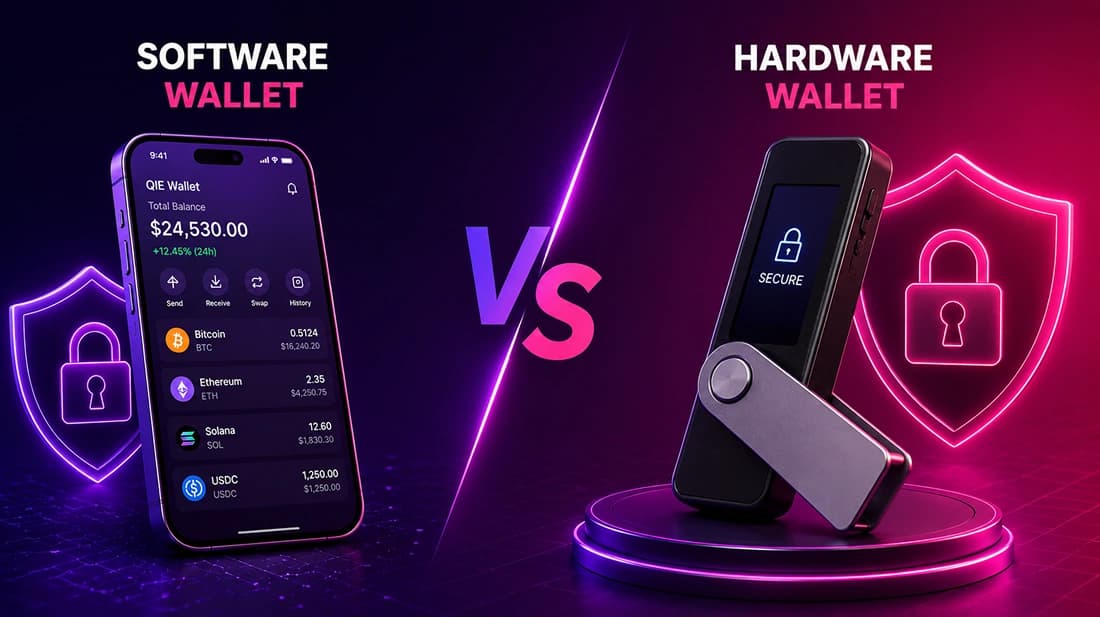
Software wallets such as MetaMask, Trust Wallet and QIE Wallet keep the keys on or are accessed through an internet-connected device, giving users convenient access to DeFi, swaps and Web3 applications. The trade-off is that a compromised device can increase the risk of wallet compromise.
Hardware wallets keep private keys within a dedicated device and perform transaction signing there. This provides an additional security layer for larger or long-term holdings.
Hardware does not automatically make every setup better. A beginner holding a relatively small amount may prefer the convenience of a software wallet, while someone holding a larger amount for years may value hardware security more.
For many users, a practical setup is to use a software wallet for everyday activity and hardware storage for larger long-term holdings.
How to Choose and Secure Your Wallet: A Practical Checklist for South African Users
Custody preference: Do you want full control (non-custodial) or convenience (custodial)? If you’re unsure, start non-custodial and use a local FSCA-licensed exchange only for ZAR conversions.
Asset and network support: List the coins and chains you actually hold before choosing. A wallet that doesn’t support your niche altcoin is useless regardless of its other features.
Fee tolerance: Swap fees, network gas, and staking commissions vary widely. The guide to swapping crypto on QIE Wallet breaks down what in-wallet swapping actually costs versus going through an exchange. Run that check on your own setup before taking anyone’s word for it.
Security setup: Write your recovery phrase down rather than storing it digitally, keep it offline in a secure location, and enable biometric or PIN protection on your device.
South African Crypto Regulation and Tax: What Wallet Users Need to Know
South Africa regulates certain crypto-asset services through the CASP framework under the Financial Advisory and Intermediary Services (FAIS) Act. The FSCA states that CASPs must obtain a licence to conduct business, with licensing requirements applying according to the activities and services provided.
Businesses providing regulated crypto-asset services in South Africa may need to obtain CASP authorisation from the FSCA, depending on the services and activities they perform. Check the FSCA register before transacting.
For users, the practical takeaway is simple: when dealing with an exchange or service provider, check its regulatory status rather than assuming that every crypto product is regulated in the same way.
Best Wallet by Use Case
| Use Case | Recommended Wallet |
|---|---|
| Beginners | QIE Wallet or Exodus |
| Self-custody, general | QIE Wallet or MetaMask |
| Multichain access | QIE Wallet |
| Bitcoin long-term storage | Ledger |
| XRP and altcoins | Trust Wallet or QIE Wallet |
| USDT payments | QIE Wallet |
| Web3 / DeFi | MetaMask or QIE Wallet |
| Hardware cold storage | Ledger or Tangem |
| ZAR on/off-ramp | VALR |
Conclusion
There’s no single best crypto wallet for every South African user. QIE Wallet stands out for multichain access and reusable Web3 identity, while MetaMask is a strong choice for EVM-based DeFi, Ledger and Tangem focus on hardware security, Trust Wallet offers broad mobile support, and VALR remains useful for ZAR on/off-ramps.
The right choice ultimately depends on how you use and store your crypto.
Key Takeaways
- Choose based on how you use crypto: active Web3 users, long-term holders, beginners and ZAR traders have different wallet needs.
- Self-custody gives you control: you hold the private keys, but you’re also responsible for securing your recovery credentials.
- Multichain support matters: choose a wallet that supports the networks and assets you actually use.
- Hardware wallets add an extra layer of security: Ledger and Tangem are suited to users prioritising long-term protection.
- ZAR access matters for South African users: an exchange such as VALR can complement a self-custody wallet when buying or selling crypto.
- QIE Wallet combines multichain and identity features: QIE ID makes it particularly relevant for users looking for a more connected Web3 experience.
- Always verify before transacting: check current fees, supported networks, regulatory information where applicable and the recipient address before sending funds.
Looking for a non-custodial wallet that combines multichain access, Web3 identity and human-readable wallet addresses? Explore QIE Wallet and see if it fits your crypto needs.
Download QIE Wallet and get started today.
Frequently Asked Questions
For long-term storage, a properly configured hardware wallet such as Ledger or Tangem can provide an additional layer of protection because private-key signing takes place on a dedicated device. For daily use, a non-custodial software wallet with a securely stored recovery phrase (QIE Wallet, MetaMask, or Trust Wallet) covers most users well, provided the device itself is protected.
Yes. QIE Wallet is available to South African users as a non-custodial, multichain wallet. Its QIE ID identity layer is designed to let users reuse verified identity credentials across participating partner exchanges and dApps, reducing the need to repeat the same verification process.
A wallet stores your private keys so you control your assets directly. An exchange is a trading platform, and a custodial exchange holds your keys on your behalf. VALR and Luno are exchanges; QIE Wallet, MetaMask, and Ledger are wallets. Many users combine an exchange for buying and selling with a self-custody wallet for assets they want to control directly.
No single answer fits everyone. If you’re buying crypto with ZAR and trading frequently, a custodial FSCA-licensed exchange like VALR is a practical starting point. For medium or long-term holding, self-custody means no third party can freeze or lose your funds. Most experienced South African users do both.
Network fees (gas) apply on every chain and vary with congestion, and in-wallet swaps carry a service margin on top. Staking QIE tokens unlocks discounts on partner app subscriptions, which can offset those costs over time. Check the current schedule on the QIE Wallet swap guide before transacting.