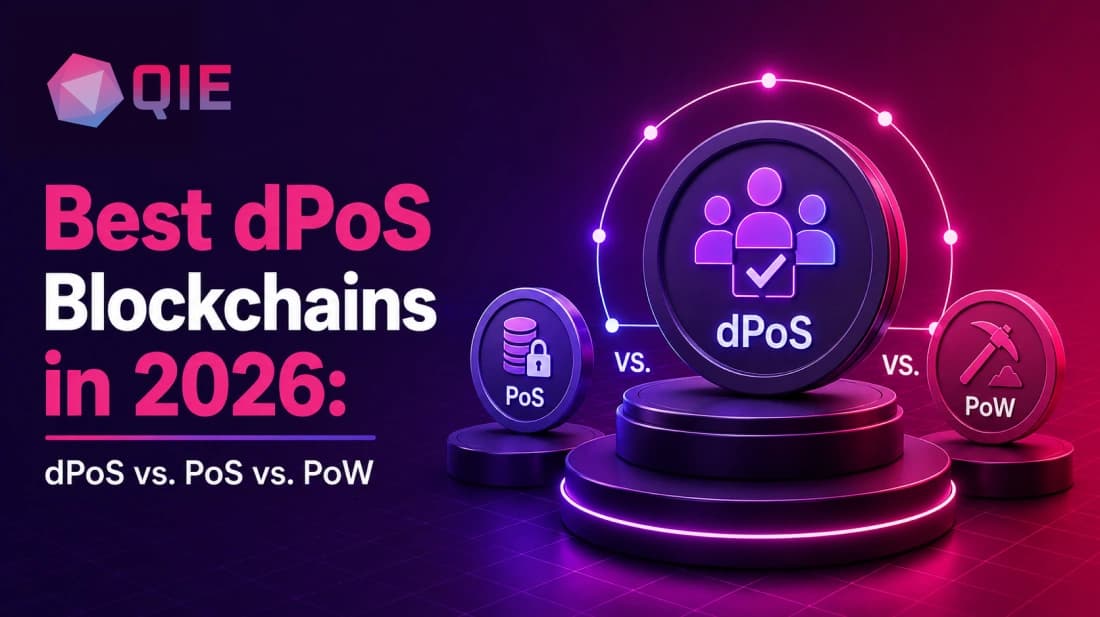
The best dPoS blockchains in 2026 are QIE, TRON, EOS, Cosmos Hub, and Polkadot, each compared here by TPS, fees, validator count, and use case.
At QIE Blockchain, dPoS is the architectural foundation for a web3 identity layer capable of up to 25,000 TPS. This guide compares the leading chains so you can choose the right one for your needs.
Quick Answer: What Are the Best dPoS Blockchains in 2026?
dPoS is a variation of Proof of Stake where token holders participate in selecting a smaller group of block producers or validators. This can enable fast block production and low transaction costs, but the smaller active validator set can create trade-offs around decentralisation and governance.
Here’s the quick comparison:
The Shortlist
- QIE: best for high-throughput applications, EVM-compatible development, and Web3 identity.
- TRON: best suited to high-volume stablecoin transfers and payment activity.
- EOS: a strong option for high-throughput applications such as gaming and enterprise workloads.
- Cosmos Hub: best for interoperability and IBC-based applications.
- Polkadot: a useful NPoS alternative, particularly for shared security and interoperable blockchain architecture.
There is no universally best consensus model. The right choice depends on your requirements for throughput, decentralisation, security, interoperability, governance, and cost.
What Is dPoS and How Does It Actually Work?
Delegated Proof of Stake (dPoS) is a consensus mechanism where token holders participate in selecting a set of block producers or validators, typically through voting or delegation.
Instead of having every eligible participant involved directly in block production, dPoS systems generally use a smaller active group. This can improve coordination and support fast transaction processing.
Think of it like a shareholder vote for a board of directors. Shareholders elect representatives who run the company, and they can replace those representatives if performance falls short.
That accountability loop is what separates dPoS from standard PoS, where selection is pseudo-random and there’s no direct recall mechanism.
How dPoS Works
The exact implementation varies by blockchain, but a typical dPoS process looks like this:
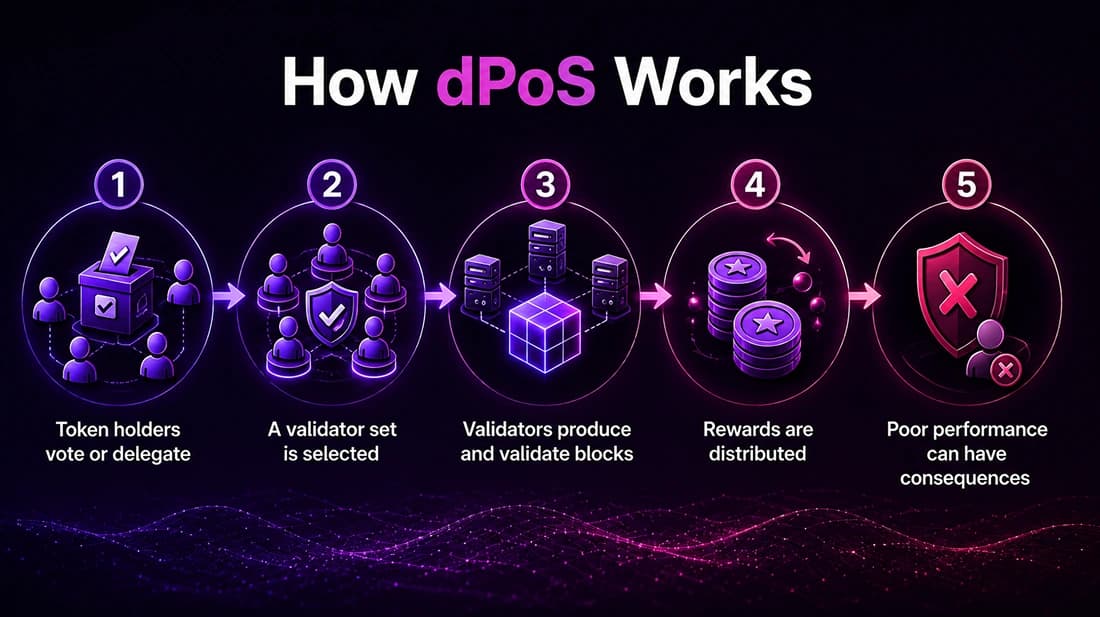
- Token holders vote or delegate: Users participate in selecting validators or block producers.
- A validator set is selected: The protocol chooses a defined group to participate in block production.
- Validators produce and validate blocks: The selected participants process transactions and maintain the network.
- Rewards are distributed: Validators and, depending on the protocol, their delegators can receive rewards.
- Poor performance can have consequences: Depending on the network, validators may be voted out, jailed, or penalised for certain behaviour.
For example, where a protocol applies delegated slashing, a validator that violates consensus rules may be penalised and, depending on the network’s rules, its delegators may also be affected.
Best dPoS Blockchains in 2026: Performance, Fees, and Real-World Use
| Blockchain | Best For | Consensus | TPS (vendor-reported) | Avg. Fee | Key Limitation |
|---|---|---|---|---|---|
| QIE Blockchain | Identity, DeFi, dApp dev | dPoS + Tendermint Core | Up to 25,000 | ~$0.0001 | Newer ecosystem, smaller developer community |
| TRON | Stablecoins, high retail adoption | dPoS (27 Super Reps) | ~2,000 | ~$0.0003 | Centralization concerns (27 validators) |
| EOS | Enterprise, gaming | dPoS (21 BPs) | 4,000+ | Near-zero | Governance disputes, smaller mindshare |
| Cosmos Hub | Interoperability, IBC apps | dPoS + Tendermint BFT | ~10,000 (ecosystem) | Low | Per-chain fragmentation |
| Polkadot | Subnet customizability, institutional use | NPoS (600 validators) | 1,000+ per parachain | Low | Parachain slot complexity |
Note: Polkadot is included as an NPoS comparison, not as a dPoS blockchain.
1. QIE: Best for High-Throughput Web3 Applications
Best for: Developers and users looking for high throughput, low transaction costs, EVM compatibility, and integrated Web3 identity.
QIE is a Layer 1 blockchain designed for high-throughput applications. QIE reports throughput of up to 25,000 transactions per second, sub-two-second block times, and near zero transaction fees.
Its consensus model combines delegated validator participation with BFT-style consensus. QIE also uses slashing and jailing mechanisms as part of its validator security model.
One of QIE’s key differentiators is its focus on Web3 identity. QIE’s identity infrastructure is designed to let users establish reusable identity credentials while maintaining control of their wallet and assets.
QIE is also EVM-compatible, allowing developers familiar with Ethereum tooling to build and deploy compatible applications.
Why QIE stands out
- Reported throughput of up to 25,000 TPS
- Sub-two-second block times
- EVM compatibility
- Cosmos interoperability
- Web3 identity infrastructure
- dPoS-based validator model
Trade-offs
- Smaller ecosystem than established networks such as Ethereum
- Reported TPS should be evaluated alongside the methodology and conditions used to achieve it
- Validator concentration and governance should be considered when evaluating any dPoS network
Verdict: QIE is particularly differentiated by its reported throughput, low fee structure, EVM compatibility, and focus on Web3 identity.
2. TRON: Best for Stablecoin Transfers and Payments
Best for: High-volume stablecoin transfers, payments, and applications built around the TRON ecosystem.
TRON uses a delegated Proof of Stake model in which 27 Super Representatives participate in block production. Super Representatives are elected by TRON users and produce blocks on a rotating basis.
TRON’s design has helped it become widely used for stablecoin transfers, particularly USDT.
The network produces blocks at roughly three-second intervals and is commonly reported at up to around 2,000 TPS, although real-world throughput varies according to transaction type and network conditions.
Why TRON stands out
- Large stablecoin ecosystem
- 27 elected Super Representatives
- Fast block production
- Low transaction costs for many transfers
- Established ecosystem
Trade-offs
- Smaller active validator set than many traditional PoS networks
- Greater validator concentration creates governance considerations
- Primarily associated with the TRON ecosystem rather than broad cross-chain infrastructure
Verdict: TRON is particularly well suited to high-volume stablecoin transfers and payment-oriented applications.
3. EOS: Best for High-Throughput Applications
Best for: Gaming, enterprise applications, and developers looking for fast execution and low transaction costs.
EOS uses a delegated Proof of Stake model in which token holders participate in selecting block producers.
Its architecture was designed around high transaction throughput and low-cost transactions, making it suitable for applications that need frequent on-chain activity.
EOS also demonstrates an important dPoS trade-off: governance becomes particularly important when a relatively small group of elected block producers is responsible for maintaining the network.
Why EOS stands out
- High-throughput design
- Low transaction costs
- Fast block production
- Suitable for gaming and application workloads
- Delegated governance model
Trade-offs
- Smaller ecosystem than some larger smart-contract platforms
- Concentrated block production creates governance considerations
- Historical governance disputes illustrate the importance of validator accountability
Verdict: EOS remains worth considering for application workloads where fast execution and low fees are important.
4. Cosmos Hub: Best for Interoperability
Best for: Developers and ecosystems that prioritise interoperability between independent blockchains.
Cosmos Hub takes a different approach from networks such as TRON. It is part of the broader Cosmos ecosystem, which consists of independent application-specific blockchains that can communicate using the Inter-Blockchain Communication (IBC) protocol.
The Cosmos Hub uses a delegated Proof of Stake model alongside BFT-style consensus. Validators participate in securing the Hub while token holders can delegate their stake to validators.
The broader Cosmos architecture is particularly notable because applications can operate on their own chains while communicating with other compatible networks.
Why Cosmos stands out
- IBC interoperability
- Delegated validator participation
- BFT-style consensus
- Strong focus on independent application-specific chains
- Large ecosystem of interconnected networks
Trade-offs
- More complex architecture than a single-chain model
- Performance varies across individual Cosmos chains
- The Cosmos ecosystem should not be treated as a single blockchain with one universal TPS figure
Verdict: Cosmos Hub is a strong option for teams prioritising interoperability and IBC-based applications.
5. Polkadot: Best NPoS Alternative for Shared Security
Best for: Projects interested in shared security and interoperability across specialised blockchain environments.
Polkadot is included here as a comparison point because it uses Nominated Proof of Stake (NPoS) rather than dPoS.
In Polkadot’s model, nominators support validators by backing them with their stake. The network uses this system to select validators while providing shared security across its broader architecture.
This makes Polkadot useful when comparing different approaches to validator selection, staking, interoperability, and blockchain scalability.
Why Polkadot stands out
- NPoS validator selection
- Shared security architecture
- Interoperability
- Specialised blockchain environments
- Strong focus on cross-chain communication
Trade-offs
- More complex architecture
- Different model from traditional dPoS networks
- Not directly comparable with dPoS chains on every performance metric
Verdict: Polkadot is a useful NPoS alternative for projects where shared security and interoperable blockchain architecture are priorities.
How Do dPoS, PoS, and PoW Differ in Practice?
dPoS is a PoS-family variant, not a separate category. The distinction matters because people sometimes treat the three as equally different from each other, when PoW is the real outlier.
Proof of Work
Bitcoin is the most prominent example of Proof of Work. Miners compete to solve computational problems to add blocks to the chain.
The model provides strong resistance to certain forms of manipulation, but requires significant computational resources and energy.
Proof of Stake
Proof of Stake replaces mining competition with validators who commit capital to participate in securing the network.
PoS can significantly reduce energy consumption compared with PoW. Different PoS networks use different validator-selection and finality mechanisms, so their performance and security characteristics vary.
Delegated Proof of Stake
dPoS adds a voting or delegation layer to the validator-selection process.
Instead of relying on a very large active validator set, the protocol generally selects a smaller group of representatives to produce blocks.
This can provide performance benefits while creating a key trade-off: validator concentration becomes more important to the network’s governance and decentralisation model.
Which Is Better: dPoS, PoS, or PoW?
No consensus mechanism is universally superior. Each involves trade-offs, and the right choice depends on what you’re building.
- Choose PoW if you need Bitcoin-grade censorship resistance and can accept slow throughput and high per-transaction energy cost. It’s battle-tested over 15 years.
- Choose PoS if you want broad validator decentralization across thousands of participants and can tolerate slightly slower finality. Ethereum’s ecosystem depth is unmatched.
- Choose dPoS if throughput, low fees, and fast finality are non-negotiable, and you accept a smaller validator set in exchange. It’s the right model for payments, gaming, identity, and high-frequency DeFi.
For most application developers in 2026, dPoS chains offer a better execution environment. The decentralization trade-off is real but manageable if you pick a chain with transparent slashing, on-chain governance, and a growing validator set.
How to Evaluate a dPoS Blockchain: A Decision Framework
Most teams pick a dPoS chain based on TPS marketing numbers and miss the factors that actually determine whether the network holds up under load. Run this check on your own shortlist before taking anyone’s word for it.
What Actually Matters
- Validator distribution: How many active validators, and how concentrated is stake? A Nakamoto coefficient below 5 is a red flag.
- Slashing history: Has slashing ever been triggered? A chain that has never slashed a validator either has perfect validators or no real enforcement.
- Finality guarantees: Is finality probabilistic or BFT? BFT finality (Tendermint-style) means a confirmed block cannot be reversed.
- Fee structure: Are fees burned, distributed, or both? A burn mechanism aligns validator incentives with network growth.
- Smart contract maturity: EVM compatibility is the fastest path to a live dApp; non-EVM chains require custom tooling.
- Cross-chain capability: Native IBC or EVM bridges? Native is safer and cheaper.
- Governance transparency: Are governance votes on-chain and auditable?
Common Mistakes to Avoid
Teams consistently overweight TPS and underweight validator concentration. A chain with 100,000 theoretical TPS and 7 validators is more fragile than one with 10,000 TPS and 200 validators. Low fees don’t always mean better value either.
A chain with near-zero fees but no slashing enforcement has no economic security backing those cheap transactions.
Conclusion
There is no universally best consensus model or dPoS blockchain. QIE is particularly differentiated by its reported high throughput, low fees, EVM compatibility, Cosmos interoperability, and Web3 identity focus.
TRON stands out for stablecoin activity, EOS for high-throughput application workloads, and Cosmos Hub for interoperability through IBC. Polkadot provides a useful NPoS alternative for projects interested in shared security and interoperable blockchain architecture.
The right choice ultimately depends on the balance you need between performance, decentralisation, security, governance, interoperability, and cost.
Key Takeaways
- dPoS prioritises fast coordination: a smaller elected validator set can support fast block production and low fees, but introduces validator-concentration and governance trade-offs.
- QIE: a strong option for high-throughput applications, EVM-compatible development, interoperability, and Web3 identity.
- TRON: particularly suited to high-volume stablecoin transfers and payment activity.
- EOS: worth considering for gaming and enterprise applications that prioritise fast execution and low fees.
- Cosmos Hub: strong for interoperability and IBC-based applications.
- Polkadot: uses NPoS rather than dPoS and provides an alternative approach focused on shared security and interoperability.
- TPS needs context: maximum reported TPS figures are not directly comparable across networks without considering transaction types, testing conditions, and methodology.
- Consensus is a trade-off: evaluate validator distribution, finality, governance, security, fees, and ecosystem maturity, not just speed.
Looking for a high-throughput blockchain for your next dApp? QIE combines EVM compatibility, low transaction costs, fast finality, Cosmos interoperability, and Web3 identity infrastructure for developers building the next generation of DeFi and Web3 applications.
Frequently Asked Questions
Delegated Proof of Stake is a consensus model where token holders participate in selecting a smaller group of validators or block producers. The approach can support fast block production while introducing trade-offs around validator concentration and governance.
Not universally. dPoS can provide performance and coordination benefits by using a smaller active validator set, while other PoS designs may prioritise broader validator participation and decentralisation. The best choice depends on the application’s requirements.
Generally, yes. dPoS does not rely on the energy-intensive mining process used by Proof of Work, making its energy requirements substantially lower.
Yes. QIE uses a dPoS-based validator model combined with BFT-style consensus. Its design focuses on high throughput, low transaction costs, and interoperability.
QIE uses dPoS to combine delegated validator participation with a smaller active validator set designed to support fast block production and low-cost transactions. Like other dPoS systems, this involves trade-offs around validator concentration and governance.