Choosing the right blockchain for business in 2026 means matching throughput, compliance, cost, and integration requirements to a network that can support them in production.
The strongest candidates differ in how they approach scalability, transaction costs, smart contract development, interoperability, privacy, and regulatory requirements.
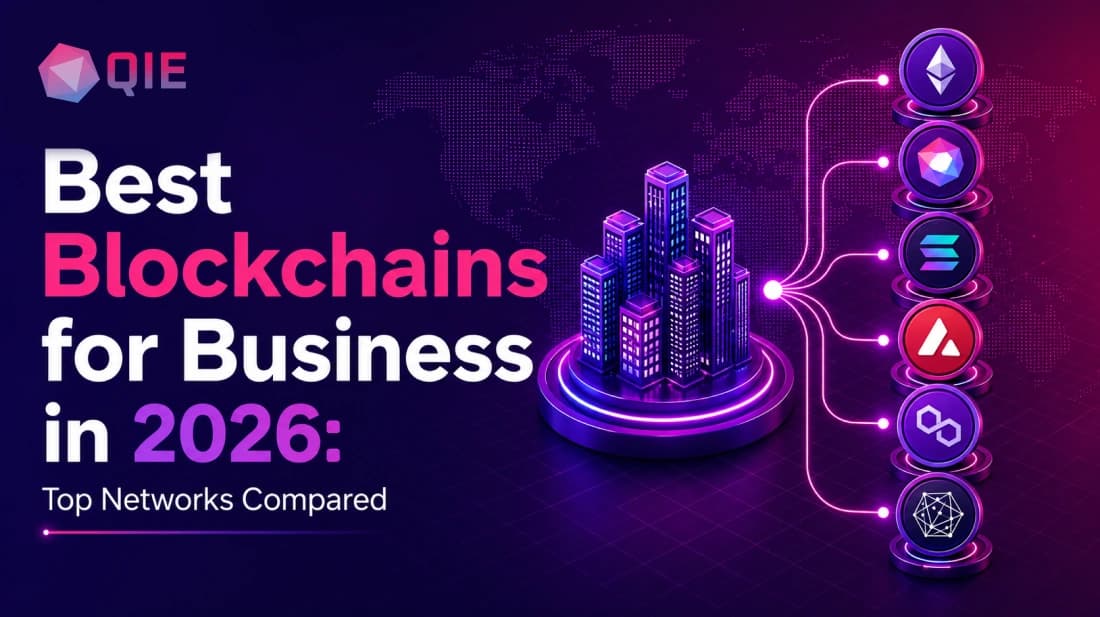
This guide compares six blockchain networks across these factors and examines where each is best suited for business workloads.
Quick Answer
The Shortlist
- Ethereum: Best for DeFi and tokenized assets.
- QIE: Best for high-throughput dApps needing near-zero gas fees, EVM + Cosmos compatibility, and reusable identity.
- Solana: Best for high-throughput, low-fee applications.
- Avalanche: Best for customizable business networks.
- Polygon: Best for low-cost EVM applications and payments.
- Hyperledger Fabric: Best for permissioned enterprise workflows.
What Makes A Blockchain Suitable For Business Use In 2026?
Enterprise-grade blockchains earn that label by performing under realistic load. Real-world TPS should be evaluated under realistic network conditions rather than relying solely on theoretical or controlled benchmark results.
This distinction is particularly important for businesses planning production workloads.
Core Evaluation Criteria For Business Blockchain Selection
| Criterion | What to measure | Why it matters |
|---|---|---|
| Scalability (TPS) | Sustained throughput under load | Determines production capacity |
| Transaction fees | Cost per operation + burn mechanism | Affects unit economics at scale |
| Security model | Validator count, audit history | Decentralization benchmarks |
| Smart contracts | Language support, tooling maturity | dApp development platform depth |
| Interoperability | Native EVM/Cosmos vs. bridge dependency | Cross-chain friction and risk |
| Privacy controls | Private channels, ZK proofs | Regulatory compliance readiness |
| Developer ecosystem | Active devs, tooling, grants | Long-term build velocity |
| Consensus mechanism | Finality time, validator coordination | Determines latency guarantees |
Delegated Proof of Stake, or DPoS, is a consensus model in which token holders participate in validator selection. It can support fast transaction processing, although the security, decentralization, and performance characteristics depend on how each network implements its consensus system.
Finality time is another important consideration that can be overlooked. A chain that confirms in 400ms behaves differently in a payment flow than one that takes 12 seconds, even when both advertise similar TPS numbers.
How Do Ethereum, Solana, Avalanche, Polygon, QIE, And Hyperledger Fabric Compare?
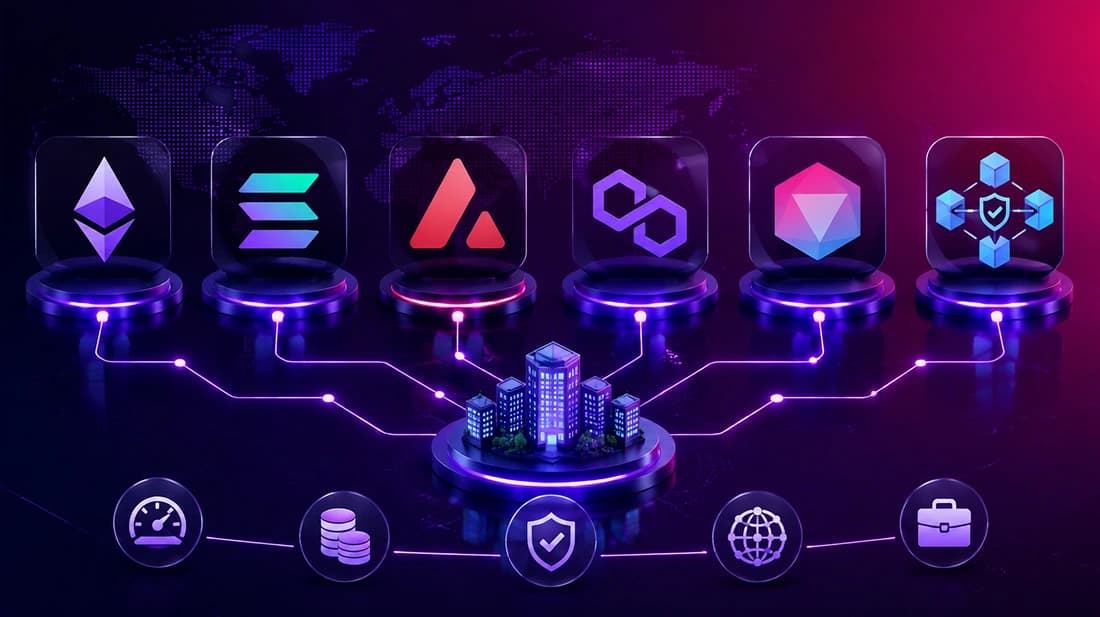
No single network wins every category. The right answer depends on whether your priority is ecosystem depth, raw speed, compliance isolation, or identity.
1. Ethereum: Deep Developer Ecosystem And High-Value Settlement
Best for: high-value settlements, tokenized assets, DeFi composability.
Ethereum carries the deepest developer network effects and TVL of any public chain. Ethereum transaction fees have declined significantly from previous cycle highs, improving its economics for larger-value transactions. However, fees can still increase during periods of network congestion, making cost predictability more challenging for high-frequency applications.
Identity and KYC functionality on Ethereum is typically handled through application-layer protocols and external identity providers, giving developers more flexibility but also placing more responsibility on individual applications.
2. Solana: Low-Cost Transactions And High-Throughput Applications
Best for: consumer-facing apps, liquid NFT markets, high-frequency DeFi.
Solana’s sub-cent fees and strong retail adoption make it a leading network for NFT, consumer, and high-frequency applications.
Solana’s reliability has improved significantly from its earlier history of network interruptions, although infrastructure stability remains an important consideration for businesses evaluating production deployments.
Solana’s development ecosystem is primarily Rust-based for on-chain programs, rather than Solidity-based like Ethereum and other EVM networks.
Solana’s validator requirements can also create a higher infrastructure burden than some other networks. High-performance CPU, memory, storage, and networking requirements can increase the cost of operating a validator, which businesses should consider when evaluating decentralization and infrastructure participation.
3. Avalanche: Customizable Blockchain Infrastructure For Institutions
Best for: regulated financial applications, tokenized securities, app-specific chains.
Avalanche’s consensus architecture uses repeated validator sampling to reach agreement with low latency. Avalanche L1s can provide customizable network environments with EVM-compatible development, application-specific configuration, and control over validators and network parameters.
This flexibility can be valuable for regulated applications that require greater control over their infrastructure. However, dedicated networks also introduce additional operational, governance, and liquidity considerations compared with deploying on a shared public chain.
4. Polygon: EVM-Compatible Infrastructure For Payments And Applications
Best for: stablecoin payments, enterprise payment rails, Ethereum-adjacent dApps.
In 2026, Polygon has a strong position in payments, stablecoin applications, and Ethereum-compatible development, while its broader strategy also emphasizes interoperability through the AggLayer ecosystem.
For businesses, the more relevant consideration is whether Polygon’s current infrastructure, ecosystem, transaction costs, and tooling match the application’s requirements.
5. QIE: High-Throughput Layer 1 With EVM, Cosmos, And Identity Capabilities
Best for: high-throughput dApps requiring reusable identity, cross-ecosystem interoperability, and low transaction costs.
QIE Blockchain is a Layer 1 designed for high-throughput applications, with reported throughput of up to 25,000 transactions per second, fast finality, and low transaction costs.
Its architecture combines EVM compatibility with Cosmos-based infrastructure, allowing developers to work with tooling and capabilities from both ecosystems within the same network.
QIE also includes reusable identity infrastructure through QIE ID. The system is designed to let users maintain a verified identity across participating applications and services, reducing repetitive verification and onboarding friction where supported.
For businesses, the combination of high throughput, low-cost transactions, EVM compatibility, Cosmos interoperability, and reusable identity makes QIE particularly relevant to dApps and Web3 applications that need multiple capabilities within one Layer 1 environment.
6. Hyperledger Fabric: Permissioned Infrastructure For Enterprise Networks
Best for: consortium networks, regulated data sharing, supply chain with known participants.
Hyperledger Fabric is a modular, extensible open-source blockchain platform whose architecture supports pluggable consensus mechanisms, flexible endorsement policies, and private data collections. You get compliance and privacy, but you give up public network effects, DeFi composability, and the ability to issue liquid assets.
Quick Comparison Of Business-Focused Blockchain Networks
| Network | Consensus | Typical Throughput | EVM Support | Finality / Confirmation | Business Strength |
|---|---|---|---|---|---|
| Ethereum | PoS | ~30 mainnet | Native | ~12 sec block time; longer economic finality | DeFi, RWA, high-value settlement |
| Solana | PoH + PoS | 2,000–4,000 | No (Rust) | ~400 ms confirmation | Consumer apps, payments |
| Avalanche | Snowman | ~4,500 | Yes (C-Chain) | Sub-second to seconds | Custom enterprise networks |
| Polygon PoS | DPoS | 7,000+ | Yes | Seconds | Payments, EVM applications |
| QIE | DPoS | Up to 25,000 | Yes + Cosmos | Fast / near-instant | High-throughput dApps |
| Hyperledger Fabric | PBFT variants | Variable | No | Configurable | Permissioned enterprise networks |
Hyperledger Fabric differs from the other networks in this comparison because it is a permissioned enterprise blockchain framework rather than a public Layer 1. It is included because businesses evaluating blockchain infrastructure often need to compare public networks with permissioned alternatives.
Seven Blockchain Use Cases Delivering Business Value
Blockchain has moved from pilots to production in several verticals. It outperforms traditional databases when multiple untrusting parties need shared, tamper-evident records.
Where a single operator controls the data and primarily needs fast reads and writes, a conventional database will often be more efficient and cost-effective than a blockchain.
Supply Chain Traceability
Blockchain can provide shared, tamper-evident records across manufacturers, logistics providers, distributors, and retailers.
The strongest use cases involve provenance, product verification, and multi-party reconciliation, although off-chain data still needs reliable sources such as IoT systems and enterprise databases.
Cross-Border Payments
Traditional international payments can involve multiple intermediaries, settlement delays, and foreign-exchange or transaction fees.
Blockchain-based payment systems can reduce settlement times and automate reconciliation when the underlying infrastructure and regulatory requirements support them.
Real-World Asset Tokenization
RWA tokenization has expanded significantly across 2025–2026, with institutional asset managers increasingly using blockchain infrastructure for tokenized funds, securities, and other financial assets.
Identity And Access Management
Reusable digital identity can reduce repetitive verification and shorten onboarding workflows when credentials are accepted across multiple participating services.
Process Automation
Smart contracts can reduce manual reconciliation and administrative overhead by automating predefined settlement and invoicing workflows.
Multi-Party Data Sharing
Immutable audit trails can simplify multi-party reconciliation by giving consortium members a shared record of transactions and events, although regulatory data residency rules may affect how and where information is stored.
Fraud Prevention
Cryptographic proof and tamper-evident records make duplicate invoicing structurally harder. Teams building on a dApp development platform with low gas fees can deploy fraud-prevention logic without fee costs eroding the economic case.
What Framework Should Guide Your Blockchain Selection And Implementation?
Start with your threat model. Most teams pick the wrong chain because they optimize for speed before confirming who the untrusting parties actually are.
One practical challenge businesses should plan for is integrating blockchain-based identity with existing authentication and user-management systems. Treating identity integration as a separate service can help reduce disruption to the core application architecture.
The framework below reflects that experience alongside external reference points. The Enterprise Ethereum Alliance’s interoperability specifications, for instance, provide a useful baseline for evaluating whether a chain’s cross-ecosystem claims hold up under scrutiny.
Industry research increasingly emphasizes identity, interoperability, compliance, and integration requirements alongside raw network performance when evaluating enterprise blockchain infrastructure.
A Practical Decision Map For Business Blockchain Selection
- Single operator, internal data? A traditional database beats any blockchain on cost and latency. Don’t build a distributed ledger for a problem that doesn’t require distributed trust.
- Known consortium, regulatory compliance required? Hyperledger Fabric or an Avalanche private subnet fits here, with the liquidity trade-off understood upfront.
- Public network effects matter, EVM tooling required? Ethereum mainnet for high-value settlements, Polygon for high-frequency payments.
- Need identity portability alongside EVM and Cosmos interoperability? QIE’s architecture combines these capabilities within a single Layer 1, potentially reducing the need for third-party bridge infrastructure.
- Consumer-facing, liquid NFT or meme market? Solana is a strong fit given its retail adoption and low transaction costs, provided your team can work with its development stack.
Seven Implementation Factors To Evaluate Before Choosing A Blockchain
- Performance: what TPS do you need sustained, not peak?
- Cost structure: per-transaction fees at your expected volume, plus validator staking or infrastructure costs
- Security and compliance: data residency, audit requirements, regulatory jurisdiction
- Ecosystem maturity: wallet support, third-party integrations, grant programs
- Team expertise: Solidity vs. Rust vs. Go is a hiring decision, not just a technical one
- Migration flexibility: consider whether the chain supports standards and tooling that make future migration easier, including EVM compatibility where relevant.
- Network effects: a chain with no liquidity is a chain with no composability
Custom subnet infrastructure adds operational and governance complexity, so it is most appropriate when an application genuinely requires dedicated block space, validator control, or regulatory isolation.
Conclusion
The best blockchain for business in 2026 depends on the workload, not a single performance metric. Ethereum remains strong for liquidity and high-value applications, Solana for high-throughput consumer use cases, Avalanche for customizable networks, Polygon for low-cost EVM applications, and Hyperledger Fabric for permissioned workflows.
QIE is particularly relevant for businesses that need high throughput, near-zero gas fees, EVM compatibility, Cosmos interoperability, and reusable identity within one Layer 1 ecosystem. The right choice ultimately comes down to your performance, compliance, development, and integration requirements.
Key Takeaways
- Ethereum remains strong for DeFi, tokenized assets, and high-value settlement.
- Solana is suited to high-throughput applications that prioritize low transaction costs.
- Avalanche provides customizable infrastructure for businesses needing greater network control.
- Polygon offers established EVM compatibility for payments and other high-volume applications.
- Hyperledger Fabric fits permissioned networks requiring controlled participation and data access.
- QIE combines high throughput, near-zero gas fees, EVM compatibility, Cosmos interoperability, and reusable identity within one Layer 1.
- Blockchain is most valuable when multiple parties need shared, verifiable records or programmable settlement. Traditional databases remain better suited to many single-operator workloads.
Ready to build on QIE? Explore the QIE developer environment and deploy your first smart contract on the public testnet.
With near-zero gas fees, near-instant finality, up to 25,000 TPS, EVM compatibility, and Cosmos interoperability, QIE gives developers the infrastructure to build high-performance dApps without abandoning familiar Solidity tooling.
Frequently Asked Questions
Not necessarily. Blockchain reduces the risk of a single party altering shared records, making it useful when multiple organizations need a common source of truth. However, smart contract vulnerabilities, private-key loss, poor access controls, and compromised data inputs can still create security risks.
Public blockchains provide open participation, broader network effects, and access to public applications and liquidity. Private or permissioned networks restrict participation and provide greater control over data and access. Businesses should choose based on their requirements for transparency, privacy, compliance, and interoperability.
Businesses typically integrate blockchain through APIs, middleware, or dedicated blockchain services rather than replacing existing systems. A practical approach is to start with one workflow, such as payment settlement, invoicing, or asset tracking, measure the results, and expand after proving the business case.
Blockchain is most useful when multiple parties need to share and verify records without relying entirely on one central authority. Common applications include cross-border payments, asset tokenization, supply-chain tracking, digital identity, automated settlement, and multi-party data sharing.
Usually not. Existing networks can provide faster deployment and access to established infrastructure, developer tools, and ecosystems. A dedicated blockchain may make sense when a business needs custom governance, regulatory isolation, dedicated capacity, or specialized network controls.
QIE combines EVM compatibility with Cosmos-based infrastructure within a single Layer 1 ecosystem. This allows developers to use familiar Ethereum tooling while accessing Cosmos-based capabilities without relying on a separate bridge simply to connect the two environments.
Costs vary based on the blockchain, contract complexity, network activity, and deployment requirements. Ethereum generally has higher and more variable deployment costs, while networks such as Polygon, Solana, and QIE are designed for lower-cost transactions. QIE also uses a fee-burning mechanism that supports its deflationary token model.