Gas fees vary by orders of magnitude across networks, and picking the wrong chain can make a $2 DeFi swap cost $20.
While low gas fees reduce costs, they shouldn't be the only factor when choosing a blockchain. Security, scalability, developer tools, ecosystem maturity, and interoperability also play a critical role.
In this guide, we compare the blockchains with the lowest gas fees in 2026 and explain which platforms offer the best balance of affordability and performance.
Quick Answer
The blockchains with the lowest gas fees in 2026 include Solana, QIE Blockchain, Polygon, and Ethereum Layer-2 networks like Arbitrum, Optimism, and Base. While Ethereum mainnet remains the most expensive, low-cost alternatives significantly reduce transaction fees without sacrificing performance.
What to Compare
- Transaction costs: average fees for transfers, swaps, and smart contract execution.
- Scalability: how well the network handles high transaction volumes.
- Developer compatibility: support for tools like Solidity, MetaMask, Hardhat, and Remix.
- Ecosystem maturity: availability of wallets, DeFi protocols, explorers, and infrastructure.
- Interoperability: native cross-chain communication and asset transfers.
The right blockchain depends on your use case. Developers often prioritize tooling and compatibility, while users may care more about transaction costs, speed, and available applications.
Why Gas Fees Matter, and Why They Vary So Wildly Across Blockchains
Every time I pull a cross-chain fee report, the same thing jumps out: the number on your confirmation screen looks like a single price, but it's actually the output of several interacting architectural decisions made years before you submitted that transaction.
Four architectural factors have the biggest impact on gas fees:
- Throughput: how many transactions the network can process per second
- Consensus design: how validators are selected and how fast they agree
- Rollup/batching architecture: whether costs are shared across many transactions
- Fee-burn mechanics: whether fees are burned, redistributed, or inflated away
A gas fee is the computational cost a user pays to have a transaction processed and recorded by a blockchain's validators. Network throughput is one of the biggest factors influencing gas fees. A network that processes 30 transactions per second, like Ethereum mainnet, creates a permanent auction for scarce block space.
When demand spikes, users outbid each other and fees climb fast. Spread that same fixed infrastructure cost across thousands of concurrent transactions and each one drops to a fraction of a cent.
Consensus design amplifies this further. Proof-of-Work chains pay miners through fees and inflation; delegated proof-of-stake chains elect a smaller validator set, reach agreement faster, and carry less overhead per block.
Rollup architecture adds another dimension: Ethereum L2s like Arbitrum and Base batch hundreds of transactions and post compressed data to mainnet, splitting the L1 data cost across every transaction in the batch. The March 2024 Dencun upgrade introduced dedicated "blob" space for this data, cutting L2 posting costs by 50–90% in many cases, per Spark.money’s May 2026 cross-chain fee tracker.
How Network Congestion Affects Gas Fees
The part developers consistently underestimate is how fast fees spike during demand events. A simple token swap that costs $0.03 on Arbitrum on a quiet Tuesday can hit $2+ during a popular NFT drop or a liquidation cascade.
Ethereum mainnet is the most extreme case: DEXTools (2026) puts a simple transfer anywhere from $0.50 to $50 depending purely on timing. That unpredictability is itself a cost for dApp developers, because it shapes user abandonment rates directly.
Fee-burn models add a deflationary dimension worth understanding separately. Ethereum burns a portion of every base fee under EIP-1559. QIE Blockchain burns 80% of gas fees per transaction, tying network growth to token scarcity rather than just validator revenue.
Which Blockchains Actually Have the Lowest Fees Right Now?
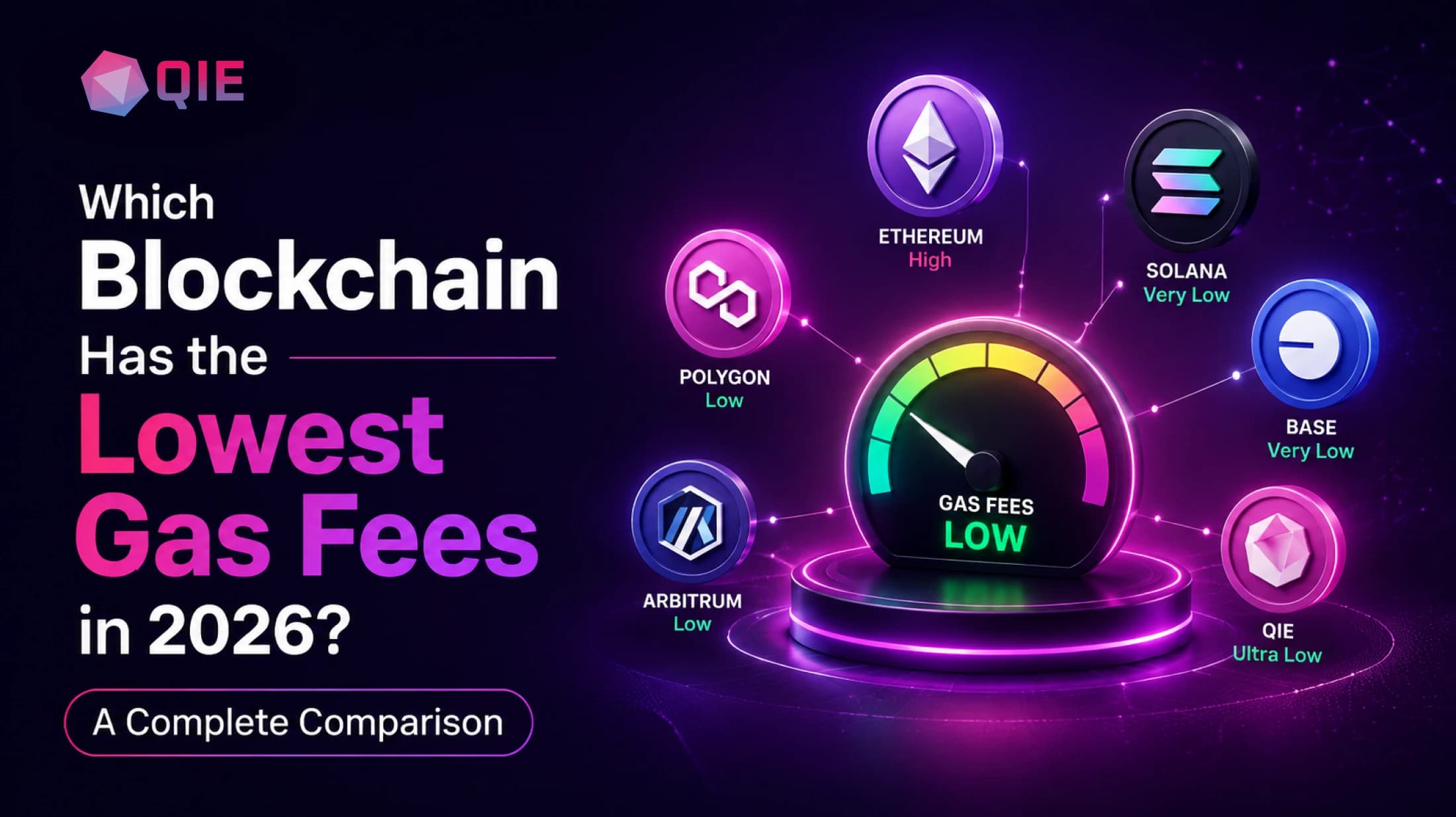
Solana and QIE Blockchain lead the field on extremely low transaction fees in 2026, both targeting sub-cent and near-zero costs.
Ethereum L2s like Arbitrum, Base, and Optimism occupy the middle ground at roughly $0.01–$0.30. Ethereum L1 remains the most expensive, ranging from $0.50 to $20+ under congestion.
All figures below are approximate as of 2026 and fluctuate with network load.
| Chain | Typical Fee Range (2026) | Architecture | Finality | Dev Language |
|---|---|---|---|---|
| Ethereum L1 | $0.50–$20+ | PoS L1 | ~15 min (2 epochs) | Solidity/Vyper |
| QIE Blockchain | ~$0.0001 | DPoS L1 | ~3 sec | Solidity/Vyper |
| Arbitrum | ~$0.05–$0.30 | Optimistic rollup | 1–2 sec (L2) | Solidity/Vyper |
| Base | ~$0.01–$0.10 | Optimistic rollup | 1–2 sec (L2) | Solidity/Vyper |
| Optimism | ~$0.05–$0.50 | Optimistic rollup | 1–2 sec (L2) | Solidity/Vyper |
| Solana | ~$0.0001–$0.01 | PoH + PoS L1 | ~12 sec full | Rust/Anchor |
| Nano / IOTA | $0 | DAG | Seconds | None/limited |
Real Transaction Examples
The gap becomes concrete when you price specific operations. A DeFi swap costs roughly $0.001 on Solana versus $0.03 on Arbitrum versus $2–$10 on Ethereum L1, according to CoinLaw’s L2 statistics (2026).
An NFT mint runs $0.005 on Solana, $0.05 on Arbitrum, and $15–$50 on Ethereum L1 during high demand, also per CoinLaw's 2026 dataset. For a dApp developer running thousands of user interactions daily, that difference compounds into a material infrastructure cost that doesn't show up in any single transaction.
Feeless chains like Nano and IOTA use Directed Acyclic Graph architecture with no validators to pay, so fees are genuinely zero. The trade-off is ecosystem depth: neither has the DeFi infrastructure, liquid NFT markets, or developer tooling that Solana or EVM chains offer.
The Counterintuitive Truth About Lowest Fees
The chain with the lowest headline fee isn't always cheapest in practice. Solana's base fee is fixed at 0.000005 SOL per signature, per Solana Labs’ documented fee schedule, but priority fees can push costs up during congestion events.
Backpack Exchange data cited by the Bitcoin Foundation (2026) puts Solana's average at $0.00025, though that average masks spikes. For a dApp with high retail adoption and active NFT or meme-coin markets, those spikes happen regularly enough to matter.
What Actually Drives Low Fees: Throughput, Consensus, and Fee-Burn Mechanics
Low fees are an output of architecture. Three mechanisms do most of the work.
Parallelization and Throughput
Solana's Proof of History consensus timestamps transactions cryptographically before they reach validators, allowing the Sealevel runtime to process non-conflicting transactions simultaneously across multiple CPU cores.
Spreading fixed infrastructure costs across thousands of concurrent transactions rather than a sequential queue pushes the cost per transaction to fractions of a cent.
QIE Blockchain reaches similar throughput through Tendermint BFT consensus under a delegated proof-of-stake model, targeting up to 25,000 TPS with approximately 3-second finality. That finality is deterministic: a transaction confirmed at 3 seconds is actually settled, not optimistically accepted pending a challenge window.
Rollup Batching
Arbitrum and Base reduce fees by batching hundreds of L2 transactions into a single Ethereum L1 submission, splitting that L1 data cost across every transaction in the batch. The result is low costs for Ethereum-aligned developers who want Ethereum security without paying L1 prices.
The catch is Arbitrum's 7-day challenge window for full L1 withdrawal finality, which matters for large cross-chain movements. QIE's native L1 design removes that dependency entirely by avoiding reliance on cross-chain bridges for core operations.
Fee-Burn Deflationary Tokenomics
QIE burns 80% of every gas fee collected, with validator emissions halving every two years. More transactions mean more supply reduction, aligning developer activity with long-term token value.
Ethereum burns a portion of fees under EIP-1559, but the percentage is variable. QIE's 80% burn rate is a hard protocol parameter, making its deflationary pressure more aggressive and predictable than Ethereum's approach.
How to Deploy on Low-Fee Chains Without Sacrificing Developer Tooling
Cheap fees mean nothing if your team spends a month rewriting contracts in an unfamiliar language. That's where the real cost comparison lives.
Solana: Fast but Foreign
- Requires Rust and the Anchor framework, a steep learning curve for Solidity teams
- Smaller tooling ecosystem than the EVM world, with fewer audited libraries
- Local testing environments can behave differently from mainnet in ways that catch developers off guard
- Documented history of network stability issues, including multiple outages in 2022–2023 driven by bot-induced transaction floods
High retail adoption and active NFT and meme markets make Solana compelling for consumer apps, but any Ethereum-native team is looking at a genuine rewrite.
Arbitrum and Base: Familiar but Layered
- Accept Solidity contracts and support the full EVM-compatible toolchain: Hardhat, Foundry, Remix, MetaMask — deployment is nearly identical to Ethereum L1
- Base offers direct access to Coinbase’s verified user ecosystem, a meaningful distribution advantage for consumer dApps
- Trade-offs: centralized sequencer risk and the bridging friction that comes with any L2 (both Arbitrum and Base currently run a single sequencer operated by the core team, per BingX’s 2026 transaction-cost analysis)
- Neither chain provides a native protocol-level identity solution, so developers building anything that requires user verification still need to integrate third-party KYC
Arbitrum's documentation and SDK support are mature, but the sequencer and identity gaps above are real for teams evaluating long-term architecture, not just fees.
QIE Blockchain: EVM Tooling at L1 Speed
When we look at what Solidity teams actually need to redeploy on QIE, the answer is almost nothing. Per the QIE developer documentation, QIE accepts Solidity contracts and supports MetaMask, Hardhat, Truffle, Remix, and standard Web3 APIs out of the box.
A team deploying on Arbitrum today can redeploy on QIE without touching their contract code. The Cosmos SDK integration adds IBC interoperability for cross-chain communication without external bridges.
For developers building a dApp that needs a verified user ecosystem, QIE ID provides reusable on-chain identity: users verify once and carry that credential across exchanges and dApps, removing the repeated KYC friction that drives abandonment.
Testnets, fee mechanics, and developer grants are documented, and the broader QIE ecosystem includes a live DEX, lending protocol, wallet, and trading bots already deployed on mainnet. For a closer look at how QIE compares for builders specifically, see best blockchain for developers.
Conclusion
Solana leads among established L1s on raw fee minimums, with Polygon PoS and the Ethereum L2s offering a practical middle ground for teams that need EVM compatibility. Ethereum L1 remains the most expensive option for everyday transactions and should be reserved for settlement and security-critical operations.
QIE Blockchain sits alongside Solana at the near-zero end of the fee spectrum, adding EVM compatibility, 3-second deterministic finality, and a built-in verified user ecosystem that none of the alternatives match natively.
If you're building a Solidity-based dApp and want Solana-level transaction costs without rewriting your contracts or relying on bridges, explore the QIE testnet, deploy your first smart contract, and experience near-zero gas fees firsthand.
Frequently Asked Questions
Among chains with active DeFi ecosystems, Solana and QIE Blockchain offer the lowest fees. Backpack Exchange data puts Solana's average at $0.00025 per transaction, and QIE targets near-zero. Feeless chains like Nano and IOTA charge nothing at all, but lack the smart contract infrastructure needed for DeFi or dApp development.
Yes, but near-zero by design, and 80% of what you pay is burned by the protocol rather than distributed to validators, so most of the fee reduces circulating supply rather than functioning as validator income.
Ethereum processes roughly 15–30 transactions per second on its base layer, and when demand exceeds that capacity, users bid up a priority tip to get included faster. A busy NFT drop or DeFi liquidation event can push a simple transfer from $0.50 to $20+ within minutes.
QIE Blockchain. It's the only chain covered here with a native, protocol-level identity layer: QIE ID lets users verify once and reuse those credentials across dApps and exchanges, without routing through a centralized gatekeeper.