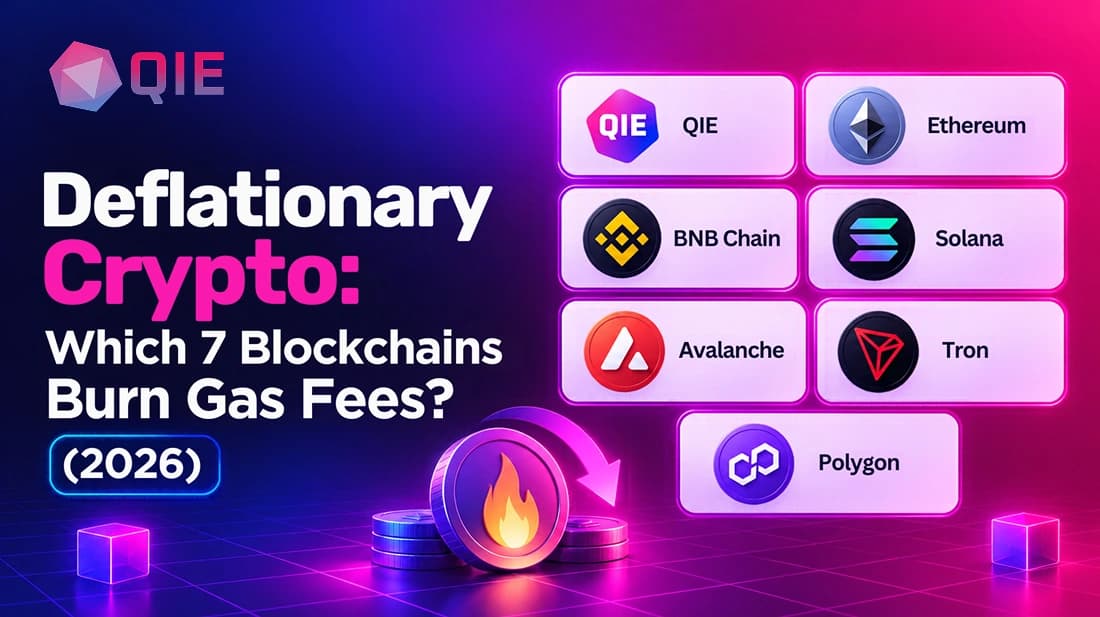
Deflationary crypto burns more tokens than it issues, and only some fee-burning chains qualify. Many people hear that a chain burns gas fees and assume its supply must shrink, but that is not always true.
This guide compares seven blockchains, QIE, Ethereum, BNB Chain, Solana, Avalanche, Tron and Polygon, on what they burn and whether net supply can really fall.
Quick answer
Almost every chain in this guide burns something, but burning alone does not make a coin deflationary. What matters is net supply: new issuance minus everything burned. Here is the short version:
The Shortlist
- QIE: burns 80% of gas fees, with a hard cap of 150,000,565 QIE and a fixed reward pool of 66 million QIE.
- Ethereum: burns the base fee, and net supply can fall on high-demand days when the burn beats new issuance.
- BNB Chain: combines scheduled burns with a real-time gas fee burn, and its docs describe supply as decreasing by design.
- Solana: burns 50% of the base fee, but it also follows a scheduled inflation rate.
- Avalanche: burns both the base fee and the priority fee on the C-Chain.
- Tron: burns TRX when an account runs out of free or staked resources, while also minting block rewards.
- Polygon: burns the base fee under EIP-1559 while emitting about 2% new POL a year.
The test for any chain is burn minus issuance, checked over a period you can see on a block explorer.
What does it mean when crypto burns gas fees, and why does it matter?
Burning means sending tokens to a place where nobody can spend them again, so they leave supply for good. People say coin burn and token burn for the same idea.
A chain burns gas fees when part of what users pay per transaction is destroyed instead of going to validators. Three ideas get blurred together, and it pays to keep them apart:
- Gas fee burn: a share of each transaction fee is destroyed automatically by protocol rules.
- Scheduled or buyback burn: tokens are destroyed on a calendar or from treasury funds, whatever the transaction activity.
- Net supply: new issuance minus everything burned. Only this number tells you whether supply shrinks.
How do gas fee burn and token burn work differently?
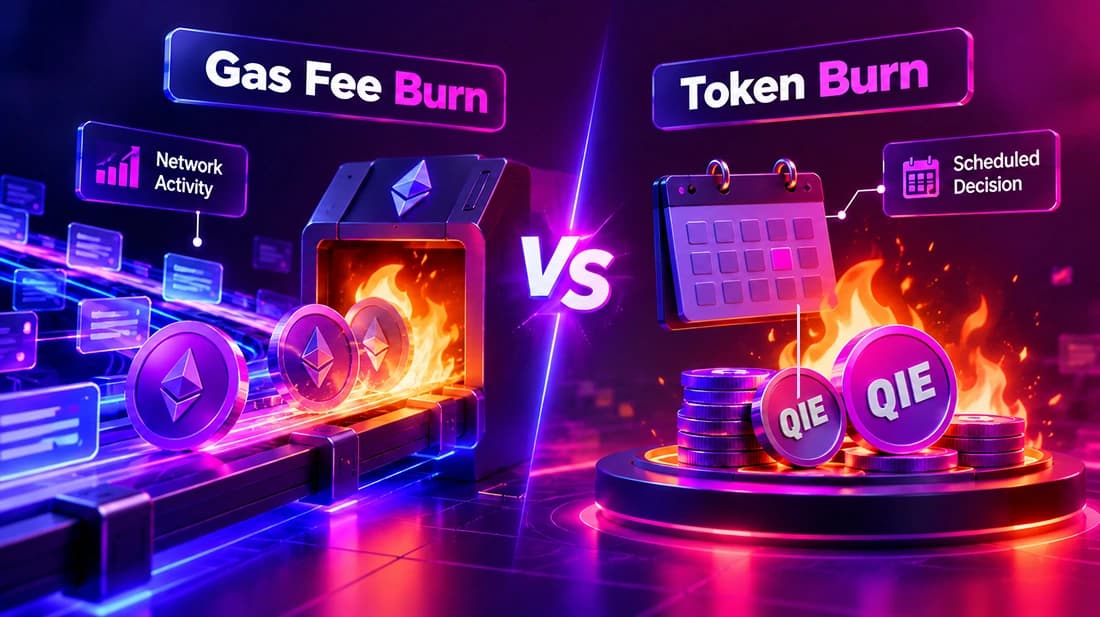
A gas fee burn follows usage, while a scheduled token burn follows a decision. The first scales with how busy the network is. The second happens whether anyone transacts or not.
Gas fee burn: tied to activity
Ethereum’s EIP-1559 specifies that the base fee per gas rises when blocks run above the gas target and falls when below it, and that this base fee is burned.
Solana splits its base fee. Solana’s fee documentation says the per-signature base fee goes 50% to burn and 50% to the validator, and the optional prioritization fee goes 100% to the validator. Only part of what you pay is destroyed.
Why a burning chain can still be inflationary
Burn is only half the equation. A chain that pays validators with freshly minted tokens adds supply every block. If that issuance beats what users burn, supply grows even though the coin burn is real. Most burn headlines skip this.
7-Blockchain Comparison: What Gets Burned and How It Affects Token Supply
| Chain | What is burned | Burn rule | Issuance or supply cap | Net effect |
|---|---|---|---|---|
| QIE | Gas fees | 80% of gas fees burned; the base fee is burned on every transaction (QIE docs) | Hard cap of 150,000,565 QIE; a fixed reward pool of 66 million QIE | Supply is capped, issuance is finite and the burn is permanent |
| Ethereum | Base fee | Burned and adjusts with block fullness (EIP-1559) | Issuance comes only from validator rewards since the Merge (ethereum.org) | Net supply can fall on high-demand days |
| BNB Chain | Gas fee share plus scheduled burns | A fixed ratio of each block’s gas fee, adjustable by governance (BNB Chain) | No new BNB mined; 100m BNB target supply | Described as decreasing by design |
| Solana | Half of the base fee | 50% of the base fee; the prioritization fee is not burned | Scheduled inflation: 8% at the start, falling 15% a year to 1.5% | Burn offsets part of the inflation |
| Avalanche | Transaction fees | Base fee and priority fee are both burned | Validator rewards are minted; the supply cap is commonly cited as 720 million AVAX, so confirm it in the Avalanche docs | Compare burn and rewards on an explorer |
| Tron | TRX used to pay for resources | TRX is burned when staked resources and the free quota run out | 16 TRX per block to the block producer, plus 160 TRX per block shared by votes | New TRX is minted every block while TRX is also burned |
| Polygon | Base fee | EIP-1559 base fee burn since January 2022 | About 2% a year in new POL, split between validators and the community treasury | Emission continues while the base fee is burned |
QIE
QIE is a layer 1 blockchain that pairs a gas fee burn with a hard supply cap. Every transaction burns 80% of gas fees, which reduces circulating supply as usage grows, and the burned amount follows a simple rule: burned fee equals base fee times gas used.
Supply can never pass the cap of 150,000,565 QIE, and rewards for validators and delegators come from a fixed pool of 66 million QIE spread over about 100 years, with block rewards halving every two years. The QIE low gas guide lists a block reward of 0.5 QIE.
For developers, QIE is an EVM compatible blockchain built on the Cosmos SDK, so Solidity contracts deploy with Hardhat, Foundry and MetaMask. It uses delegated proof of stake, and its published figures are 25,000+ TPS and an average fee of $0.0001.
Ethereum
The base fee per gas is destroyed and floats with congestion, and users add a priority fee that goes to the validator. That makes the burn volatile by design: it rises in a busy period and falls in a quiet one.
Since the Merge, ethereum.org says execution-layer issuance is zero and only validator rewards create new ETH.
The same page says that when gas prices are high enough, the burn offsets that day’s issuance and brings net ETH inflation to zero or below. So Ethereum can be net deflationary on busy days and slightly inflationary on quiet ones.
BNB Chain
BNB Chain combines a scheduled burn with a real-time gas burn. BEP-95 burns a fixed ratio of each block’s gas fee, adjustable through governance, so the rate is a policy lever and not a constant.
Mind the governance dependency: a burn rule that can be changed is one you should re-check from time to time.
Solana
Solana burns half of the per-signature base fee, and the base fee itself is 5,000 lamports per signature. The prioritization fee, which is what you pay to jump the queue, is not burned at all.
Solana’s inflation schedule starts at 8% a year and falls 15% each year toward a long-term rate of 1.5%, so the burn offsets only part of the new supply.
Avalanche
Avalanche burns transaction fees. Its docs say that on the C-Chain both the base fee and the priority fee are burned. The base fee rises when network use is above the target and falls when it is below, and validators now vote on the minimum base fee.
Validators are rewarded with newly minted AVAX, and the supply cap is commonly cited as 720 million AVAX, so check the Avalanche docs before you call it deflationary.
Tron
Tron works differently. Transactions use bandwidth and energy, which you get by staking TRX or from a small free quota. When those run out, TRX is burned from the sender’s balance to pay for them. So Tron’s burn depends on how many users pay with TRX instead of staked resources.
At the same time, Tron’s docs say block producers earn 16 TRX per block and 160 TRX per block is shared by votes, so new TRX is minted every block.
Polygon
Polygon PoS adopted EIP-1559, so the base fee is burned and the priority fee goes to block producers. DappRadar reports the burn went live in January 2022.
Polygon’s docs say new POL is emitted at about 2% a year, split between validators and the community treasury, so the base fee burn works against ongoing emission.
Which chains are actually deflationary, and which are not?
Going by the sources used, no single answer fits every chain, and that is the point. Only BNB Chain’s own documentation describes the token as deflationary by design.
Ethereum can be net deflationary on high-demand days. QIE has a hard cap and a finite reward pool, so its supply is bounded. The rest need a net-supply check.
| Chain | Burn documented | Issuance documented | Can net supply fall? |
|---|---|---|---|
| QIE | Yes | Yes (fixed pool and hard cap) | Supply is bounded by the cap; check the explorer for the live trend |
| Ethereum | Yes | Yes | Yes, on high-demand days |
| BNB Chain | Yes | Yes (no mining) | Yes, by design |
| Solana | Yes | Yes (scheduled inflation) | Not shown in the docs |
| Avalanche | Yes | Partly | Depends on the live balance; check an explorer |
| Tron | Yes | Yes (block rewards) | Depends on the live balance; check an explorer |
| Polygon | Yes | Yes (about 2% a year) | Depends on the live balance; check an explorer |
This is the inflationary vs deflationary crypto distinction in practice: a chain can run a real fee burn and still add more than it destroys. The test is always burn minus issuance.
How are meme-coin burns different from protocol burns?
Many people first meet the idea of a coin burn through meme coins such as Shiba Inu, where holders or the team send tokens to a dead address on a schedule or after an event. That is a manual or announced burn, and it depends on people choosing to do it.
A protocol burn is different. It is built into the chain’s rules and happens automatically on every transaction, as with Ethereum’s base fee. Both reduce supply, but a protocol burn follows real network usage, while a manual burn follows a decision.
In both cases, check the explorer for the real numbers and ask what the issuance is.
Why do developers and investors care about gas fee burn?
For developers, burn ties network use to token scarcity. A low gas fee dApp strategy works best when the chain’s economics reward usage and do not penalise it.
For investors, burn is an economic fact and not a forecast. Destroying tokens reduces supply, but supply is only one input, and demand, security and adoption all matter.
Nothing here predicts a price outcome or constitutes financial advice. Digital-asset investing carries risk of loss.
What should you look for when evaluating a chain’s burn mechanism?
Run any chain through five checks before you trust a “deflationary” label:
- 1What exactly is burned? Gas fees, a scheduled amount, or both. Name the mechanism.
- 2Is the rule automatic or governance-controlled? BNB’s ratio is adjustable through governance, which limits how far you can rely on it.
- 3What is the issuance? Find the block reward or minting schedule in official docs. QIE lists a block reward of 0.5 QIE and a fixed pool of 66 million QIE.
- 4Is there a hard cap? QIE’s cap is 150,000,565 QIE, and a cap bounds the long-run outcome.
- 5What does net supply do over a period? Pull circulating supply at two dates from a block explorer and compare. Burn minus issuance settles the argument.
If a chain’s docs do not state a rule, treat it as not published and do not fill the gap from a headline. For a wider selection lens, see the best blockchain for developers and the QIE products suite.
Conclusion
Burning is a real feature, but it is only half of the supply story. The chains in this guide burn in different ways, and the honest question is always whether the burn beats new issuance.
QIE pairs an 80% gas fee burn with a hard cap and a finite reward pool, which gives its supply a clear upper bound.
Key Takeaways
- Burn is the drain, issuance is the tap, and a chain is deflationary only when the drain wins.
- BNB Chain’s docs call its supply decreasing by design, and Ethereum can be net deflationary on busy days.
- QIE pairs an 80% gas fee burn with a hard cap of 150,000,565 QIE.
- Separate gas fee burn, scheduled burn and net supply before you believe a “deflationary” label.
Deploy one Solidity contract on the QIE testnet with the tools you already use, then read the burn on the explorer yourself before you decide.
Frequently Asked Questions
Yes. If new issuance, such as validator rewards, exceeds the tokens burned, total supply still grows even though a burn is running. Solana is an example: it burns half of the base fee but also follows a scheduled inflation rate.
No. Burn decides where part of the fee goes after you pay it. It says nothing about how much you pay.
Start with the chain’s official documentation for the burn rule. Then open a block explorer, note circulating supply on two different dates, and see which way it moved.
No. A shrinking supply says nothing on its own about security, usage or demand, so judge a chain on what you need it to do.
Your balance stays the same. The token’s total supply is lower, so your share of what remains is slightly larger. That is a supply fact and not a price promise.
BNB Chain. Binance’s scheduled burns reduce supply toward a 100m BNB target, and BEP-95 adds a real-time gas fee burn that continues afterward.
QIE publishes a hard cap of 150,000,565 QIE, a fixed reward pool of 66 million QIE for validators and delegators, an 80% gas fee burn rule and a block reward of 0.5 QIE. Check circulating supply on the QIE explorer for the live number.