Most USDT holders are exposed in two ways at once: they keep their balance on an exchange instead of a wallet they control, and they don’t realize USDT actually exists as four separate tokens, one each on Ethereum (ERC20), Tron (TRC20), BNB Chain (BEP20), and Solana (SPL). Get either one wrong and the money doesn’t come back.
This guide ranks the five best self-custody wallets for USDT in 2026 on what actually matters: multi-chain support, fees, staking, and how you recover access if you lose your device.
Quick Answer
Choosing a self-custody wallet for USDT comes down to three things: how many of the four USDT networks you actually use, whether you want staking built in, and how you’d recover access if you lost your device.
There’s no single right answer, but the five wallets in this guide cover almost every use case.
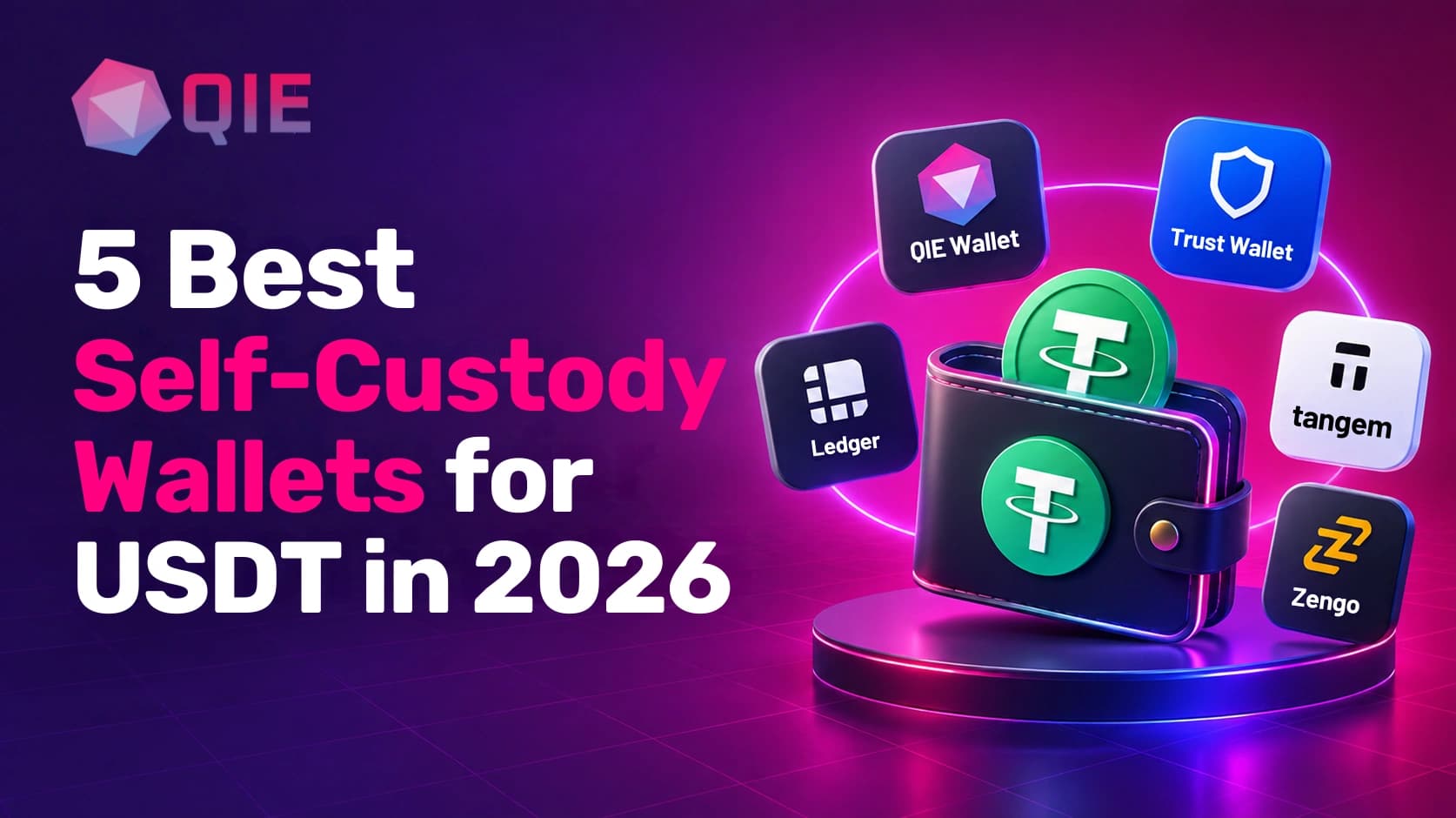
The Shortlist
- QIE Wallet: best overall for most USDT holders. Covers all four major USDT networks under one recovery phrase and replaces long addresses with a readable QIE ID.
- Trust Wallet: best for broad non-EVM coverage if you’re holding assets beyond the major chains.
- Ledger: best for hardware-grade key isolation on larger, long-term balances.
- Tangem: best if you want to skip seed phrases entirely and use a physical card instead.
- Zengo: best mobile-first pick for the same seed-phrase-free approach, backed by MPC instead of a card.
Whichever you pick, judge it on the same five things: chain coverage, fee visibility, staking access, recovery model, and track record. The full comparison below breaks down how each wallet handles all five.
Why USDT self-custody matters and where most holders go wrong
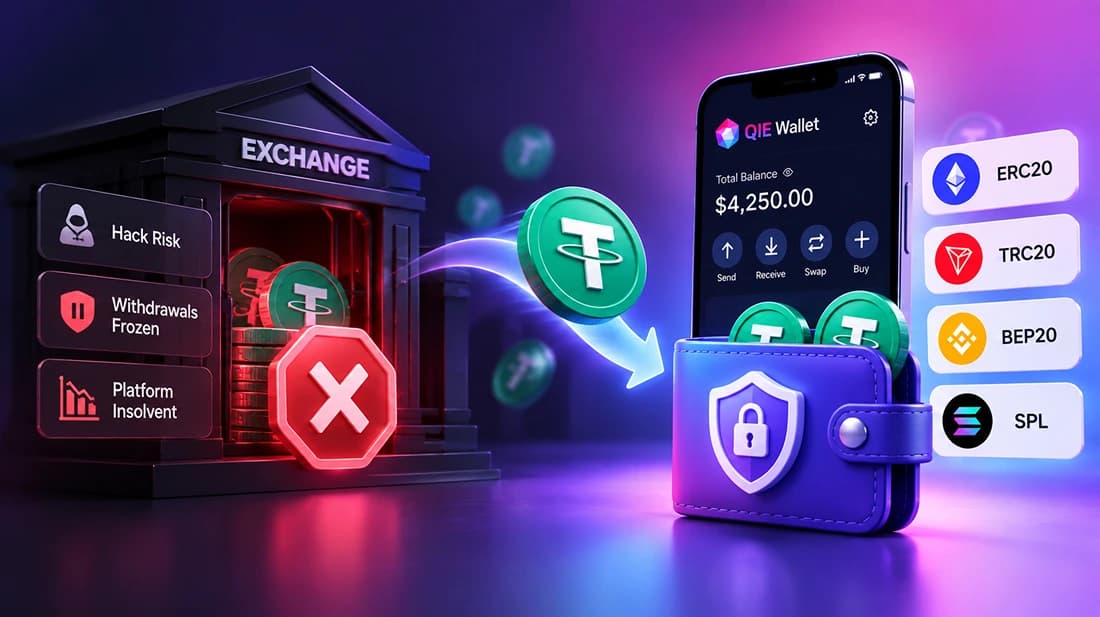
The best move for most USDT holders in 2026 is a self custody wallet that covers all four major USDT networks under one recovery phrase, and QIE Wallet leads this list for that reason.
USDT is issued separately on Ethereum (ERC20), Tron (TRC20), BNB Chain (BEP20), and Solana (SPL), and each version carries its own address format and fee structure.
Most holders never touch self-custody at all. They buy USDT on an exchange, leave it there, and treat the exchange balance as their wallet.
That works fine until the exchange freezes withdrawals, gets hacked, or simply goes insolvent. A self custody wallet removes that dependency because your private key, not a company’s server, controls the funds.
Self-custody: holding your own private keys so no exchange, bank, or third party can freeze, seize, or lose your funds on your behalf. This is different from a custodial account, where the platform technically owns the crypto and you own a claim against it.
The five best self-custody wallets for USDT in 2026
Here’s how the five wallets stack up on the criteria that actually matter for USDT holders:
| Wallet | Chains for USDT | Fees | Staking | Multichain ID | Security model |
|---|---|---|---|---|---|
| QIE Wallet | Bitcoin, Ethereum, BNB Chain, Solana, Tron, Avalanche, Polygon, Arbitrum | Low, fast transactions | QIE token staking via Loyalty Lock | Free QIE domain (yourname.qie), reusable QIE ID identity | Non-custodial, on-device key generation |
| Trust Wallet | Wide multichain, non-EVM support | Network gas only | Native staking on select chains | Basic ENS-style naming | Non-custodial, seed phrase |
| Ledger | 100+ chains via Ledger Wallet app | Varies by provider | Stablecoin Yield | None dedicated to identity | Hardware Secure Element chip |
| Tangem | Multichain via companion app | Network gas only | Not a core feature | None dedicated to identity | EAL6+ certified card, no seed phrase entry |
| Zengo | Multichain via MPC wallet | Network gas, discounts on Pro | Not a core feature | None dedicated to identity | MPC, no seed phrase |
1. QIE Wallet
QIE Wallet supports USDT across Bitcoin, Ethereum, BNB Chain, Solana, Tron, Avalanche, Polygon, and Arbitrum, making it one of the few wallets built specifically to handle multiple USDT standards without forcing users to juggle separate apps.
The standout feature is QIE ID that replaces long wallet addresses with a readable name like yourname.qie, resolving automatically to the correct address on the correct chain.
The wallet is fully non-custodial: your private key generates on-device and QIE has no access to it, no admin override, and no recovery pathway through customer support.
It also connects to 400+ dApps through QIE ID, a reusable identity layer that lets you verify once instead of repeating KYC on every partner platform, and supports in-app staking and crypto swap without leaving the app.
To be clear on scope: QIE Wallet is a multichain wallet and identity layer supporting over 1,000 coins and 400 dApps, with the reusable QIE ID as its core differentiator. It is not a hardware device, and it does not compete with MetaMask Snaps on niche EVM extensibility.
2. Trust Wallet
Trust Wallet covers a wide range of chains including many non-EVM networks, and its mobile app with a built-in dApp browser is genuinely one of the smoother mobile DeFi experiences available.
The limitation is identity: naming is limited to basic ENS-style addressing, with no reusable KYC layer, so you still verify separately on every exchange you connect to.
3. Ledger
Ledger’s strength is hardware security, backed by a Secure Element chip and the Ledger Wallet app, which lets you compare providers, swap, and track a portfolio across 100+ chains from one interface, according to Ledger’s own page.
That’s real domain authority in the hardware security niche. The trade-off is friction: a physical device is a barrier for anyone who wants to manage USDT purely from a phone, and identity features aren’t built for cross-platform reuse.
4. Tangem
Tangem replaces the seed phrase with a physical card set, starting at $54.90 for a two-card pack, with the company describing its EAL6+ certification as comparable to a biometric passport chip.
That’s a genuine niche: no seed phrase to type or lose. The limitation is that staking isn’t a core in-app feature, so USDT holders looking for yield need a separate protocol.
5. Zengo
Zengo uses multi-party computation (MPC) instead of a seed phrase, and its Pro tier adds theft guard and legacy transfer features starting at $19.99 per month.
It’s a strong pick for users who specifically want to avoid ever writing down a recovery phrase. The honest limitation is cost: the premium security layer sits behind a recurring subscription rather than being free by default.
What to look for when choosing a USDT self-custody wallet?
The five things that matter most are chain coverage, fee visibility, staking access, recovery model, and track record, and each one is a trade-off rather than a simple checkbox.
Get any one of these wrong and you either lose funds, overpay, or end up locked out with no way back in.
Multi-chain support and fee visibility
USDT on TRC20 typically moves for effectively $0 if you’ve staked TRX energy, or roughly $4 for a typical one-off transfer without it, while ERC20 transfers can cost several dollars depending on network congestion. Gas trackers like Etherscan’s gas tracker illustrate how much ERC20 costs swing with congestion, so treat any flat figure as a snapshot rather than a fixed rate.
A wallet that supports all four USDT networks lets you choose the cheapest rail for each transfer instead of being stuck on whichever chain your exchange defaulted to. If you’re also holding Solana, our Solana self-custody wallet guide covers chain-specific setup in more depth.
Staking, recovery, and track record
Staking turns idle USDT-adjacent holdings into yield, but only if the wallet has a native mechanism rather than routing you to a third-party contract you have to research yourself.
On crypto staking, rewards are earned directly inside the wallet rather than through an external protocol you have to trust separately.
Recovery model is the criterion most people underweight until it’s too late. A seed phrase gives you full portability across BIP-39 compatible wallets. Card-based or biometric recovery trades some of that portability for a lower chance of user error, since there’s no phrase to mistype or misplace.
Track record matters too: age, audit history, and whether the company has weathered a real security incident all tell you something a marketing page won’t.
Readers holding Bitcoin or XRP alongside USDT can check our Bitcoin self-custody wallet guide and our XRP self-custody wallet guide for chain-specific recovery notes.
Why sending USDT to the wrong chain costs you money?
Sending ERC20 USDT to a TRC20 address (or the reverse) usually results in permanent loss because the two networks don’t recognize each other’s transaction format. An Ethereum USDT address starts with “0x” and follows EVM standards.
A Tron address starts with “T” and follows a completely different structure, yet both display the same token in your balance. For a deeper look at how Tron’s addressing and fee model works, see our TRON self-custody wallet guide.
The same rule applies across every USDT network: a BEP20 (BNB Chain) address and an SPL (Solana) address follow their own distinct formats too, so always confirm the network on both ends before sending, not just the address string.
Here’s the part that catches people out: some wallets and exchanges will let you paste an Ethereum address into a Tron withdrawal field without blocking it, because the string is technically valid on the sending side.
The funds leave your custody, the transaction appears to succeed, and there is no receiving wallet on the other end to catch them since blockchain transactions cannot be reversed. This is exactly the kind of copy-paste risk that a readable blockchain username is designed to prevent, since a name resolves to the correct address on the correct chain instead of relying on you to eyeball a long alphanumeric string.
How to move USDT into self-custody safely?
Start by setting up your wallet and writing down the recovery phrase offline before you send a single dollar, because that phrase is the only thing standing between you and total loss if your device fails.
- 1Set up the wallet and secure the recovery phrase. Write it on paper, not a screenshot, and store it somewhere your phone camera roll will never touch.
- 2Verify the receiving address on-chain. Check the first and last four characters match exactly, and confirm the network (ERC20, TRC20, BEP20, or SPL) matches what you’re sending.
- 3Send a small test amount first. A few dollars of USDT is cheap insurance against a typo or wrong-network mistake that would otherwise cost you everything.
- 4Confirm arrival before moving more. Look for the correct balance showing up in the receiving wallet itself, since a confirmed send on your end doesn’t guarantee the funds landed where you meant them to.
- 5Move the full amount once the test succeeds.
Move to self-custody if you’re holding long-term, planning to stake, or worried about exchange risk. If you trade frequently in small amounts, the extra steps may not be worth the friction, and keeping working capital on a reputable exchange can make more sense.
Conclusion
The best self-custody wallet for USDT isn’t the one with the most features, it’s the one that matches how you actually use the token.
If you’re moving USDT across Ethereum, Tron, BNB Chain, and Solana without thinking twice, QIE Wallet’s multi-chain coverage and QIE ID solve the exact mistake that costs people money: sending to the wrong network. If you’re sitting on a larger balance you rarely touch, Ledger or Tangem’s hardware-grade isolation is worth the extra step.
Whichever you pick, the real fix for USDT’s biggest risk isn’t a specific wallet, it’s not putting off self-custody any longer. Move it off the exchange, test with a small amount first, and confirm the network every time.
Key Takeaways
- USDT exists as four separate tokens, on Ethereum (ERC20), Tron (TRC20), BNB Chain (BEP20), and Solana (SPL), so chain awareness matters as much as wallet choice.
- QIE Wallet covers all four networks under one recovery phrase and replaces long addresses with a readable QIE ID, the single biggest guard against wrong-network transfers.
- Hardware options like Ledger and Tangem trade mobile convenience for physical key isolation, while Zengo swaps the seed phrase for MPC-based recovery.
- Always test-send a small amount before moving your full USDT balance, regardless of which wallet you choose.
- Long-term holders and anyone planning to stake should prioritize self-custody now; frequent small traders can reasonably wait.
Ready to move your USDT off the exchange? Download QIE Wallet, set up support for all four USDT networks in one place, and claim your QIE ID in under five minutes.
Frequently Asked Questions
Yes, if the wallet supports the specific USDT standards you need (ERC20, TRC20, BEP20, SPL), you can hold and manage each version separately, though moving USDT itself between chains usually requires a bridge or swap rather than a simple transfer.
A standard BIP-39 recovery phrase is the only backup most wallets offer, so losing it without a copy stored elsewhere means the funds are gone for good, since no company can reset or recover it for you. This is why writing it down offline immediately during setup matters more than almost any other step.
For very small, frequently-traded balances, the friction of managing seed phrases and gas fees may outweigh the benefit. For anything you plan to hold for months or stake, self-custody is generally worth the setup time.
Not necessarily. A hardware wallet like Ledger or a card-based option like Tangem adds a physical security layer, but a non-custodial software wallet with a properly stored seed phrase can be secure enough for most holders who follow good practices.
TRC20 (Tron) is generally the cheapest network for moving USDT, effectively free if you’ve staked TRX energy, or roughly $4 without it, while ERC20 transfers on Ethereum can run several dollars during busy periods according to on-chain gas trackers such as Etherscan’s.
No. Features like QIE ID is built on top of a non-custodial architecture where the private key is generated and stored on your device, so the convenience layer doesn’t require handing control to a third party.
QIE Wallet is a comprehensive multichain solution supporting over 1,000 coins and 400 dApps, built around a reusable decentralized identity called QIE ID. MetaMask instead focuses on EVM extensibility through Snaps, and Ledger focuses on hardware-based security. The right choice depends on whether you value identity portability, software extensibility, or physical key isolation most.